January 8, 2024

Shay Nir, Marketing Manager, Orca AI
Share


Executive summary:
Modern ship collision avoidance depends on a combination of radar, AIS, visual lookouts, and increasingly AI-powered navigation tools. As global traffic intensifies and human-factor risks rise, the limitations of traditional systems become more apparent. AI-driven solutions such as Orca AI enhance bridge situational awareness, improve COLREGs decision support, and reduce the likelihood of radar-assisted collisions and other human-error-driven incidents. This article outlines the strengths and weaknesses of conventional technologies and highlights how AI augments vessel safety technology for safer, more efficient maritime operations.
Ship collisions continue to be a pressing issue in the maritime industry, posing serious threats to ships, the environment, and people’s safety. The rapid growth of global maritime trade and the increasing congestion in major waterways have heightened the likelihood of these incidents. To address these risks, Artificial Intelligence (AI) and computer vision-based Vessel Collision Avoidance Systems (VCAS) have become crucial tools for obstacle avoidance. These systems employ 24/7 computer-vision technology and sensor fusion to assess risks in real-time, contributing significantly to maritime safety. This blog post aims to delve into the significance of advanced ship collision avoidance systems and how they play a vital role in preventing accidents at sea.
What Is a Ship Collision Avoidance System?
A ship collision avoidance system is a set of technologies designed to detect obstacles, evaluate collision risk, and support navigators in taking timely action under COLREGs. These systems traditionally fuse radar, AIS, ECDIS, visual inputs, and alarms to provide bridge teams with actionable situational awareness.
The Looming Threat: Collisions at Sea and Their Implications
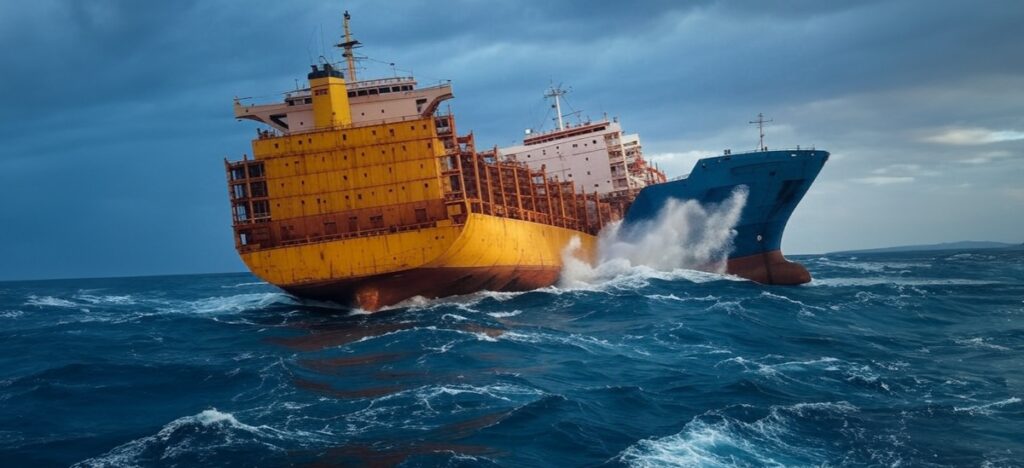
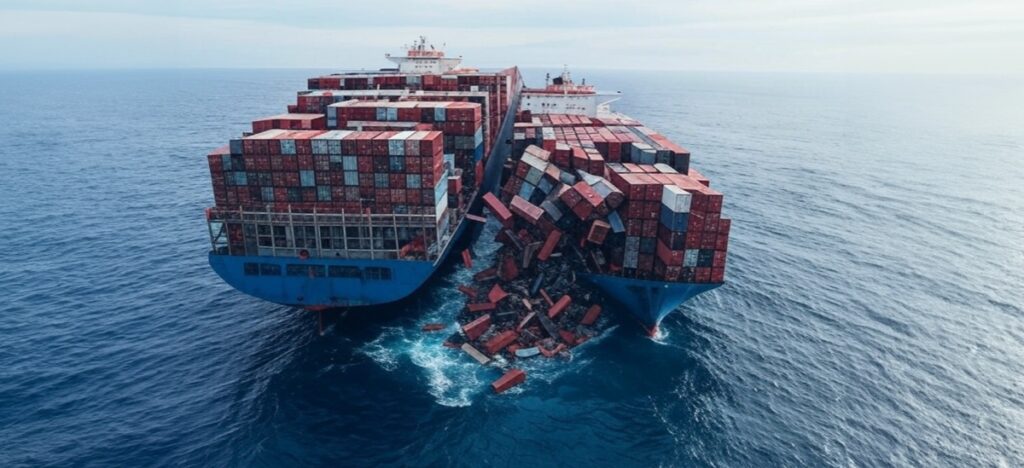
Ship collisions at sea remain a significant challenge in the maritime industry, with far-reaching consequences. According to the Annual Overview of Marine Casualties and Incidents in 2023 by the European Maritime Safety Agency, there are approximately 4,000 safety-related incidents annually. This figure, while indicative of a decline in incidents compared to previous years, underscores the persistent nature of the problem. These collisions between vessels result in an estimated financial loss of $20 billion to the maritime industry each year in damages, prolonged downtime for repairs, environmental degradation, supply chain disruptions, health and safety incidents for crews, and erosion of trust among corporate stakeholders heavily invested in seafarers.
Ship collisions stem from diverse factors, including human error, machinery failures, and adverse weather conditions. A substantial body of evidence underscores human error as a primary catalyst for maritime incidents. Safety investigations conducted between 2014 and 2022 revealed that 59.1% of accident events were attributed to human action, and 50.1% of contributing factors were linked to human behavior. When examining both human action events and human behavior contributing factors collectively, the human element accounted for a staggering 80.7% of investigated marine casualties and incidents during this period. Overconfidence, recklessness in responding to commercial pressures, fatigue, and lack of adequate experience and communication are found as the leading causes of proper obstacle avoidance.
These concerning statistics shed light on a critical deficiency within the maritime industry, especially considering the anticipated shortage of senior and experienced seafarer officers, which, according to a study conducted by the ICS and Bimco in 2015, is projected to face a shortfall of 96,000 seafarers by the year 2026. This shortage further exacerbates the challenges posed by the human element in maritime incidents and underscores the urgent need for comprehensive strategies to address and mitigate human-related risks in order to enhance overall safety at sea.
Common Causes of Maritime Collisions and How AI Helps Prevent Them
Most collisions stem from a combination of human fatigue, poor visibility, misinterpretation of radar, and high-density traffic where multiple vessels converge. AI-powered navigation tools assist by continuously analyzing sensor inputs, highlighting small or low-visibility targets, and providing predictive risk assessments before CPA/TCPA thresholds become critical. This allows crews to act earlier and with greater confidence.
The Role of Ship Collision Avoidance Systems in Maritime Operations
Ship Collision Avoidance Systems in maritime operations rely on established navigational aids and protocols to prevent collisions at sea and form the baseline for maritime safety. Systems such as Radar, ECDIS, ARPA, VTS, and navigational lights and shapes have been in use for many years. They have demonstrated reliability over years of practical application in diverse maritime environments. Some of the most prominent features of these vessel collision avoidance systems include:
Range and bearing information: Provides real-time information about the range and bearing of surrounding objects (vessels, land masses, and obstacles in the vicinity), helping the navigator assess the vessel’s position in relation to its environment. For instance, radar systems can detect approaching vessels up to several nautical miles away, enabling timely decision-making and course adjustments.
Alarm and warning systems: Conventional collision avoidance systems often include alarms that warn the navigator of potential collisions at sea based on the closest point of approach (CPA) time to the closest point of approach (TCPA) and potential hazards. These alarms can trigger visual and auditory alerts, prompting immediate action from the crew to avoid maritime collisions.
Interconnected functionality: Many of these systems work in tandem, providing a layered approach to collision avoidance. The integration of radar, AIS, visual observations, and regulatory guidelines creates a comprehensive safety net and enhances situational awareness. For example, using AIS data alongside radar can improve target identification and tracking, significantly reducing the likelihood of maritime collisions.
Human-in-the-loop: Human judgment and decision-making play a crucial role in the operation and effectiveness of these systems. Crew members are actively involved in interpreting data, making decisions, and responding to potential collision threats. This interaction helps in refining the decision-making process, particularly in complex maritime environments where automated systems might misinterpret data.
Responsive maneuvering: Effective collision avoidance systems are designed to detect potential hazards well in advance, enabling ship operators to make informed adjustments to course and speed in real-time. This proactive approach allows for safe maneuvers rather than last-minute adjustments, minimizing the need for excessive accelerations that can lead to increased fuel consumption and emissions.
Adaptability to visibility conditions: These systems are designed to operate in varying visibility conditions. They have filters to minimize interference from rain and sea clutter, improving the accuracy of target detection and providing crucial communication cues when visual observations may be challenging.
Types of Collision Avoidance Technologies
- Radar and ARPA for long-range detection
- AIS for vessel identification and traffic interpretation
- ECDIS for route planning and navigation layers
- Visual lookout systems and bridge watch routines
- AI bridge watch systems such as Orca AI’s SeaPod for 24/7 computer-vision-based obstacle detection
Charting the Unseen: Limitations of Ship Collision Avoidance Systems
Vessel Collision Avoidance Systems (VCAS), tirelessly work to prevent catastrophic incidents at sea. However, despite their remarkable capabilities, these systems are not without their challenges and limitations. Understanding these limitations is crucial to ensuring maritime navigation’s continued safety and efficiency.
Data accuracy and interference: Conventional collision avoidance systems heavily rely on the accuracy and reliability of data inputs. Therefore, inaccurate data, whether due to sensor malfunction, environmental interference, interference from other electronic devices or human error, can lead to false alarms or missed warnings, potentially increasing the risk of collisions.
Detection resolution: VCAS might struggle to accurately determine the size, shape, or composition of detected objects. This can lead to difficulties in distinguishing between different types of objects, such as a small object close to a larger one.
Limited range: VCAS might struggle to detect objects beyond a certain distance, especially if there are obstructions in the signal path or there are adverse weather conditions such as dense fog, heavy rain, or strong winds.
Over-reliance on external factors: Traditional collision alert systems rely on navigation aids like AIS data, and if these are not available or are unreliable, it can hinder the ability of ship collision alert systems to detect and prevent potential vessel collisions accurately.
Limited elevation sensing: Traditional collision avoidance systems excel at detecting objects at a similar elevation but may struggle with those significantly higher or lower than the radar emitter. This limitation becomes particularly evident in the current threat landscape, marked by the proliferation of hostile airborne drones operating at varying altitudes, posing unprecedented challenges to existing collision avoidance mechanisms.
Leveraging Artificial Intelligence for Ship Collision Avoidance Systems
Nowadays businesses need to gradually adopt new technologies such as robotics, artificial intelligence, and machine learning to increase their performance, reduce costs, and therefore be competitive in the market environment. Digitalization trends and competitive pressure have changed the way businesses from all sectors are operated and managed and organizations across the world are paying more attention to the development and introduction of innovative technologies to adequately adapt their strategies.
In the last decade, the development of new information technologies and rapid computing allowed for the creation of suitable opportunities for marine navigation automation and the modernization of decision-support systems, fostering advancements in maritime safety and maritime collision avoidance systems. By utilizing AI and computer vision, modern navigational assistant systems are transforming navigation at sea. These systems, driven by advanced complex algorithms, analyze extensive real-time data, prioritize potential threats, including collisions between vessels, based on risk levels, and issue timely alerts to the vessel’s crew for preventive actions.
A key strength of AI-powered maritime autonomous navigational assistants lies in their precise pattern detection and identification of collision risks. These systems adeptly analyze various factors—vessel trajectories, speed, proximity to other vessels, and environmental conditions—to predict potential collisions at sea with high accuracy. This heightened situational awareness empowers crew members to make informed decisions and proactively avert potential dangers, significantly reducing the risk of incidents at sea. Essentially, the synergy between human intelligence, adept at interpreting navigational regulations, and machine intelligence, with its computational prowess, forms a complementary and effective approach, which will eventually, enable maritime autonomous navigation.
Leveraging AI and Computer Vision for Enhanced Maritime Situational Awareness
Orca AI’s digital wathckeeper, SeaPod brings a change to conventional navigation safety by using artificial intelligence and computer vision to automate and enhance the navigation process. The system detects, tracks, and classifies targets that may pose a risk to the vessel or violate the company’s SMS, and provides real-time information and alerts to the crew. By acting as a fully automated navigational assistant that mimics human watchkeeping 24/7, the SeaPod reduces the crew’s cognitive load, especially in complex marine traffic situations, allowing them to focus on critical decisions.
How Orca AI Enhances Maritime Collision Avoidance
Orca AI’s system strengthens bridge situational awareness by combining real-time video analytics, radar inputs, vessel trajectories, environmental conditions, and machine learning models into one unified view. Rather than replacing watchkeepers, it acts as an AI bridge watch system that reduces workload, flags anomalies, and provides earlier warnings, especially during poor visibility, congested waterways, and night navigation
Understanding COLREGs and the Role of AI in Compliance
COLREGs require constant vigilance (Rule 5), accurate assessment of collision risk (Rule 7), and early, decisive action (Rule 8). Human operators often struggle to maintain continuous awareness in demanding conditions. AI supports compliance by:
- Continuously monitoring all objects, including non-AIS vessels
- Highlighting when crossing/overtaking situations trigger COLREGs obligations
- Tracking dynamic CPA/TCPA changes in real time
- Providing interpretable prompts that reinforce navigator judgment, not replace it
This strengthens the human-in-the-loop model while reducing the likelihood of misinterpretation.
Radar-Assisted Collisions: When Technology Becomes a Risk
Radar is indispensable, yet over-reliance on it can lead to radar-assisted collisions: events where navigators trust screen data over direct visual confirmation. The UK MAIB has emphasized in recent reports that several incidents occurred because crews misjudged ARPA vectors, failed to account for poor target resolution, or neglected visual lookouts entirely. AI systems like Orca AI counter this risk by fusing computer vision and radar, providing visual confirmation of targets and contextual alerts that reduce misinterpretation.
A Maritime Renaissance?
As maritime traffic experiences a substantial increase and technological advancements unfold across diverse sectors, the imperative for the maritime industry to embrace digitalization and integrate cutting-edge technologies has become increasingly evident. The maritime sector finds itself at the cusp of a transformative era, wherein technological innovations will redefine operational efficiency, safety protocols, and environmental stewardship. AI-powered collision alert systems, like the SeaPod, are instrumental in minimizing collisions at sea by providing real-time detection, tracking, and classification of potential risks. Embracing such technological advancements can mark the beginning of a new phase in maritime operations characterized by safety, efficiency, and sustainability.
Summary
Global shipping demands smarter maritime collision avoidance systems that go beyond radar and AIS. AI-powered navigation, such as the capabilities offered by Orca AI, strengthens bridge situational awareness, reduces the likelihood of radar-assisted collisions, and supports confident COLREGs-compliant actions. By enhancing human judgment with predictive analytics and real-time computer vision, AI is becoming a strategic enabler of safer, more efficient, and lower-risk vessel operations worldwide.
Frequently Asked Questions (FAQs)
1. How does an AI-powered maritime collision avoidance system reduce human-error risks on the bridge?
AI systems such as Orca AI operate as continuous bridge-watch assistants, analyzing visual, radar, and AIS data simultaneously. They reduce cognitive load by highlighting only relevant hazards, classifying targets, and providing predictive alerts before CPA/TCPA thresholds become critical. This supports safer decision-making without replacing the navigator’s authority.
2. Can AI solutions improve COLREGs compliance during complex crossing or overtaking situations?
Yes. AI-driven situational awareness systems help officers interpret developing encounters more clearly by tracking vessel behavior, identifying when COLREGs obligations are triggered, and providing contextual prompts. This is particularly valuable at night, in congested waterways, and when vessels without AIS transmitters are present.
3. What operational ROI can fleet operators expect from adopting AI-enhanced navigation tools?
Major ROI drivers include fewer near-misses and incidents, reduced downtime from repairs, lower insurance exposure, and improved fuel efficiency thanks to earlier and smoother maneuvers. Shore-side teams also gain better oversight of fleet behavior, enabling more consistent safety standards across vessels with varying crew experience.
4. How does AI help detect fishing vessels, small craft, and non-AIS targets that traditional radar may miss?
AI-powered navigation systems rely on real-time computer vision and sensor fusion, allowing them to detect low-profile or unlit objects, wooden hulls, fishing gear, and small boats that radar struggles to pick up. This provides a more reliable obstacle avoidance layer in high-risk regions such as East Asian fishing grounds.
5. Does integrating AI into navigation workflows require major changes to bridge operations?
No. Modern AI systems are designed to complement existing bridge routines and work alongside radar, AIS, and ECDIS. Integration typically focuses on enhancing visibility, reducing false alarms, and providing actionable insights—not redesigning bridge procedures. Crews retain full authority, with AI serving as an additional safety layer that strengthens bridge performance.