December 22, 2025

Noemie Ifrah, Marketing & Communications Manager, Orca AI
Share


The commercial maritime sector is defined by cycles of boom, bust, and relentless regulatory change. Through it all, one fundamental truth persists, though often obscured by quarterly reports and competitive pressures: operational integrity is the single greatest determinant of long-term profitability.
For the leaders at the helm of shipping companies – tasked with maximizing revenue, enforcing rigorous expense control, ensuring regulatory compliance, and strategically integrating new technologies into their fleets – the concept of “safety” can often be relegated to the realm of compliance. This is a profound, and financially dangerous, miscalculation.
In today’s environment, where every basis point of efficiency is scrutinized, and where single events can trigger multi-billion-dollar losses, we must fundamentally shift our perspective. Enhanced safety is not a cost center; it is a foundational, non-negotiable layer of commercial advantage and risk mitigation. Executives must move beyond reactive, checklist-based safety towards zero-incident shipping – a predictive, data-driven framework that locks in operational performance and shields the balance sheet from systemic shock.
The catastrophic collapse of the Francis Scott Key Bridge, reportedly stemming from a single loose wire that initiated a full ship blackout aboard the containership Dali, serves as a brutal reminder. A seemingly minor, high-frequency operational failure in system integrity instantly escalated into what could be one of the largest marine insurance payouts in history, potentially surpassing USD 2 billion. This single incident demonstrates that in a global supply chain running on finely tuned schedules, small, systemic failures in navigation, machinery, or system redundancy are, in fact, the largest single point of financial vulnerability in your enterprise.

The True Financial Cost: Beyond the Policy Limit
To accurately assess the business case for radical safety investment, we must look beyond the immediate P&I (Protection and Indemnity) and H&M (Hull and Machinery) claim costs. The true cost of a significant navigational incident – a collision, contact, or grounding – cascades across an organization, eroding enterprise value in four quantifiable, critical dimensions.
1. The Deep Cost of Downtime and Lost Opportunity
When an incident occurs, the immediate consequence is the vessel being removed from service. Our internal industry data shows that incident-related repairs can force a vessel into offhire status for an average of 40 days. For a C suite executive, this downtime represents a devastating hemorrhage of potential revenue.
Consider the specific vessel class you operate. For a Capesize bulk carrier or a modern VLCC, the daily charter rate could range from $30,000 to over $100,000, depending on the market cycle. A 40-day loss means a minimum of USD $1.2 million in unrecoverable revenue for a single asset, not including the continued overheads (crew wages, financing costs) of an idle ship.
Furthermore, just a single incident can jeopardize freight agreements, forcing your commercial team to purchase expensive spot-market tonnage to cover contractual obligations, or worse, incurring penalties for delivery failure. The total Loss of Hire (LoH) exposure often eclipses the direct repair costs, making asset availability, driven by operational integrity, the primary commercial metric.
2. The Hidden Premium Spike and Reputational Damage
Following a major claim, the C suite faces immediate, painful consequences in the insurance market. Your Loss Ratio deteriorates, and your P&I and H&M premiums spike significantly: a rise that can persist for multiple underwriting years. This isn’t a one-time charge; it’s an increase in your annual OPEX, effectively taxing your profitability for years to come.
Crucially, in the age of ESG scrutiny, transparency, and instant communication, incidents carry significant reputational damage. A high-profile grounding, for example, can severely impact your standing with cargo owners, financiers, and the general public. This can complicate financing, raise the cost of capital, and potentially deter blue-chip charterers who prioritize environmental and operational excellence, thereby shrinking your addressable, high-value market.
3. Operational Inefficiency: The Pervasive Cost of Near-Misses
The majority of navigational risks never result in a policy claim, but they constantly erode profitability. These are the high-frequency, low -everity events: the necessity of an unplanned course alteration, an aggressive avoidance maneuver, or a near-miss requiring the master to apply emergency propulsion.
Every time a vessel deviates from its optimal route to avoid a risk, it burns excessive fuel: typically wasting 20 to 40 minutes of non-optimal sailing time and fuel. Annually, these unplanned maneuvers accumulate into significant, unnecessary OPEX. Furthermore, they stress machinery and components, increasing the likelihood of high-frequency machinery claims, which are currently trending upward in severity and cost across the industry. This is a systemic drag on the bottom line.
4. The Regulatory Tax: CII, Emissions, and Market Access
The IMO’s Carbon Intensity Indicator (CII) and Energy Efficiency Existing Ship Index (EEXI) have fundamentally linked operational efficiency with regulatory compliance. Unplanned maneuvers directly undermine your compliance strategy.
Maintaining a high CII rating (‘A’ or ‘B’) is essential for future marketability. When a vessel is forced to deviate or increase speed outside its optimal profile for safety reasons, it immediately degrades its operational efficiency and worsens its CII score trajectory. A persistently poor score (‘D’ or ‘E’) forces management to undertake costly remediation (e.g., speed reduction, potentially impacting contracted schedules, or CAPEXintensive engine modifications) and signals to charterers that the asset is becoming a liability. Navigational safety is therefore the primary validation point for your entire decarbonization strategy. Without it, all investments in optimizing hull coatings, engine performance, and route planning are placed at continuous risk.
The Strategic Response: Integrating Predictive Digital Safety
The limitations of traditional navigational tools (AIS, Radar, human watchkeeping) are well documented, particularly in high-density waters, during periods of fog or low visibility, and under the inevitable pressure of crew fatigue. The operational complexity of modern shipping has simply outpaced the efficacy of these analog systems.
The C suite mandate is clear: invest in digital technologies that replace subjective judgment with objective, predictive, and continuous data.
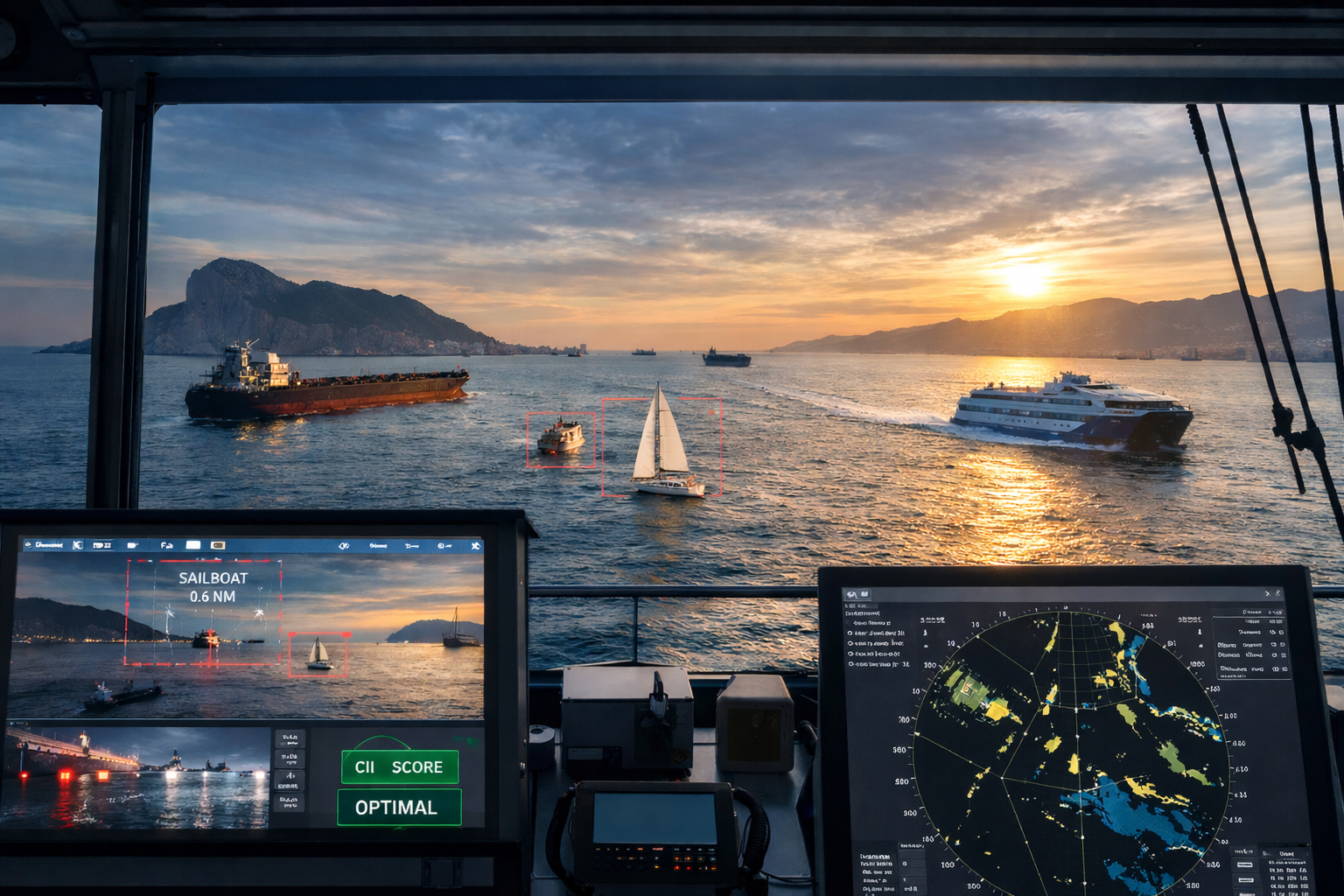
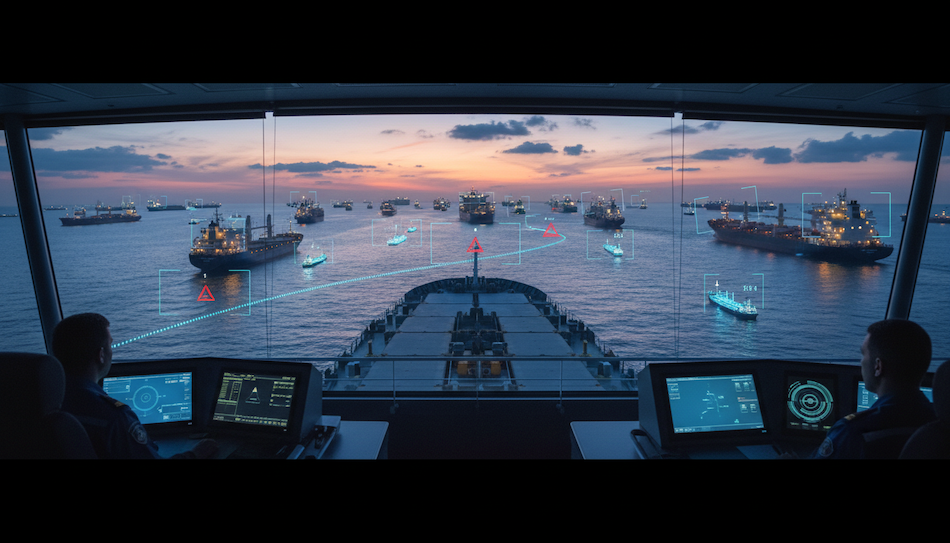
A core feature of a zero-incident strategy is the implementation of a Digital Safety Layer: a continuous, AI-driven situational awareness system that provides decision support to the master and bridge team.
This is where the new wave of advanced technologies proves its value, shifting the operational paradigm from reaction to prevention. Specifically, modern platforms utilizing advanced computer vision and sensor fusion are essential. A leading solution like the ORCA AI operational platform drastically reduces the risk of collisions and near-misses by providing enhanced situational awareness around the clock. These systems process data from multiple sources (cameras, Radar, weather) in real time, providing highly accurate object detection and classification far earlier and more reliably than the human eye or standard Radar in cluttered environments. By offering predictive alerting and decision support for collision avoidance, this technology mitigates the stress on fatigued crews and ensures course integrity.
This investment in predictive safety is not simply OPEX; it is CAPEX deployed to protect billions in assets and revenue streams.
The Technology Integration Mandate: Redundancy and Resilience
When introducing new technologies, the C suite must demand three non-negotiable attributes:
- System Redundancy: The Dali incident proves the failure of single points of failure. New navigational systems must be designed with redundant power, processing, and sensor inputs to guarantee operation even during partial ship blackouts or system failures.
- Cyber Resilience: As we connect more systems, the risk of cyber intrusion grows. All new technology must meet stringent cyber-security standards, protecting the integrity of the navigational data and preventing malicious external interference.
- Seamless Integration: The technology must function as a layer augmenting the crew, not replacing them. This ensures rapid adoption and prevents “alarm fatigue.” The system must filter noise and present actionable, simple-to-understand alerts that integrate directly into the master’s decision-making process.
Re-engineering the Culture: From Check Box to KPI
The greatest systemic risk remains the human element, often exacerbated by fatigue, workload, and pressure to meet schedules. To support a high-tech safety strategy, the C suite must enact a cultural transformation.
Safety metrics must become operational KPIs, not merely compliance audits.
- Fatigue Risk Management Systems (FRMS): Implementing certified FRMS is essential, but they must be supported by technology that genuinely reduces cognitive load. An advanced situational awareness system allows officers to focus on strategic navigation rather than constantly scanning for targets, mitigating stress and error.
- No Blame Reporting: Encourage a true “no blame” culture where near-misses and small operational failures are reported immediately. This raw data, the moments where the system almost failed, is the most valuable input for continuous improvement and predictive modeling.
- Invest in Training: Technology is only as effective as the hands operating it. Investment in high-fidelity simulation and recurrent training, specifically focusing on the new digital safety tools, is essential CAPEX to maximize ROI.
Conclusion: Safety as the Ultimate Commercial Accelerator
Zero-incident shipping is the definitive commercial model for the modern maritime enterprise. It is the framework that allows you to:
- Protect the Balance Sheet: By minimizing the exposure to policy claims, soaring insurance premiums, and catastrophic, unrecoverable downtime.
- Ensure Regulatory Compliance: By enforcing optimal operational profiles, protecting your vessels’ CII scores, and maintaining crucial market access.
- Validate Digital Investment: By providing the foundation of stability that allows performance optimization platforms to deliver their promised ROI.
The choice for the C suite is clear: continue to manage safety as a reactionary cost, accepting the systemic financial drag and catastrophic event risk, or strategically invest in a predictive Digital Safety Layer. By adopting advanced technologies like predictive visual intelligence for collision avoidance, we transform safety from a necessary evil into the ultimate commercial accelerator, driving superior asset utilization and securing sustainable, long-term profitability.
To understand how this integrated approach can quantify your fleet’s specific navigational risk and safeguard your profitability targets, contact our risk-management specialists today.
Frequently Asked Questions
1. How does investing in predictive safety technology directly impact our Loss Ratio and P&I premiums?
Answer: Navigational incidents (collisions, contacts, groundings) are among the largest drivers of high-value P&I and H&M claims. By implementing predictive visual intelligence systems, you significantly reduce the frequency of both major incidents and minor near-misses (which often lead to costly machinery claims or operational delays). A sustained, demonstrable reduction in incident frequency and severity directly improves your fleet’s Loss Ratio over time, positioning you for more favorable negotiation of P&I and H&M premiums during renewal cycles, translating directly into reduced annual OpEx.
2. Given the push for decarbonization (CII/EEXI), how does Zero-Incident Shipping contribute to our environmental compliance goals?
Answer: Navigational safety is intrinsically linked to energy efficiency and environmental compliance. Unplanned maneuvers for collision avoidance consume excess fuel and force the vessel off its optimal route and speed profile. Every deviation degrades the vessel’s operational efficiency, negatively impacting its required operational profile and resulting in a worse Carbon Intensity Indicator (CII) rating. By using advanced predictive systems to ensure optimal course-keeping and minimize unnecessary maneuvers, you safeguard your CII score, secure compliance, and protect the asset’s future marketability against regulatory penalties.
3. What is the typical Return on Investment (ROI) for advanced systems like AI-driven situational awareness?
Answer: The ROI is realized through immediate risk mitigation and long-term operational efficiency. The cost of a single major incident (including direct repair, Loss of Hire (LoH) for 40+ days, and consequential contract penalties) can easily exceed the cost of outfitting an entire fleet with predictive technology. The primary ROI drivers are:
-
Avoided Costs: Eliminating just one serious incident per decade provides a substantial return.
-
Operational Savings: Reducing minor, high-frequency deviations saves significant fuel (OpEx) annually and improves adherence to slow-steaming programs.
-
Enhanced Asset Value: Demonstrating superior safety and compliance attracts higher-value charterers and stabilizes the vessel’s valuation.
4. How do we ensure these new digital systems actually support our existing crew and mitigate fatigue, rather than just adding complexity to the bridge?
Answer: Effective digital safety layers, such as those employing Advanced Computer Vision and Sensor Fusion, are designed specifically for decision support, not replacement. They integrate seamlessly with existing ECDIS and radar displays. The systems process and filter vast amounts of complex real-time data to provide only highly prioritized, actionable alerts far earlier than traditional methods allow. This reduces the cognitive load on the watch team, allowing them to focus on strategic navigation rather than constant target scanning, which is a key factor in mitigating human error caused by fatigue and sensory overload.