January 19, 2026

Dor Raviv, Co-Founder & CTO, Orca AI
Share


As of December 2025, Norway has transitioned from a global testbed for autonomous maritime technology to the world’s first operationally integrated autonomous ecosystem. This shift is not merely a technical achievement but a result of a “Triple Helix” alignment between pragmatic regulators, domestic industrial giants, and a world class technology cluster.
The October 2025 milestone Reach Remote 1 received a permit for uncrewed operation in the North Sea – “special exemptions” towards defined repeatable regulatory pathways. Given the January 1, 2026 zero emission mandate for the World Heritage Fjords, autonomous navigation has emerged as a critical enabler for battery electric efficiency under tightly constrained operational conditions. This article details the infrastructure, regulatory framework, and commercial cases that have made Norway the sovereign sandbox for the future of global shipping.
1. The 2026 tipping point: from pilot to production
For years, the maritime world viewed autonomous shipping as a series of isolated experiments. The Yara Birkeland was often cited as a lonely pioneer. However, as we close out 2025, the narrative has shifted fundamentally. Norway is no longer testing autonomy. It is deploying it at scale within defined operational envelopes to meet rigid environmental and economic requirements.
The most significant driver is the January 1, 2026 deadline. From this date, all passenger ships, ferries, and tourist boats under 10,000 gross tonnes operating in Norway’s World Heritage fjords must be zero emission. In this high stakes environment, autonomy is the efficiency engine. By eliminating or downsizing bridge structures, crew accommodations, and inefficiencies associated with a continuous human helm, autonomous electric vessels have achieved the range and reliability necessary to make these green routes commercially viable.
2. The triple helix: the secret sauce of norwegian leadership
Norway’s success is built on a foundation of trust and physical proximity between three distinct sectors. This Triple Helix has created a tightly coupled innovation cycle that is difficult for other nations to replicate without similar regulatory trust and industrial proximity.
The pragmatic regulator (NMA)
The Norwegian Maritime Authority has moved beyond the RSV 12/2020 guidelines to provide clear, standardized pathways for uncrewed surface vessels. Their willingness to work with industry, rather than waiting for the IMO to set global rules, has provided Norwegian companies with regulatory certainty, a rare and valuable commodity. This approach has not eliminated risk, but it has clarified responsibility, which is a prerequisite for insurability and commercial deployment.
The commercial customer
Leadership is defined by those who pay for it. Domestic giants like ASKO in logistics and Yara in chemicals have provided steady demand. ASKO’s Sea Drones, MS Marit and MS Therese, are now integrated components of a cross fjord logistics chain, replacing thousands of truck journeys.
The technical backbone
The physical proximity of Kongsberg Maritime, Vard, and DNV in the Norwegian maritime cluster ensures that hardware, software, and classification are developed in parallel.
3. The infrastructure of autonomy: the brain onshore
The most visible change in the Norwegian market is not just the ships, but the infrastructure on land. Norway has recognized that an autonomous ship is only as good as the onshore network that supports it.
The remote operations center (ROC)
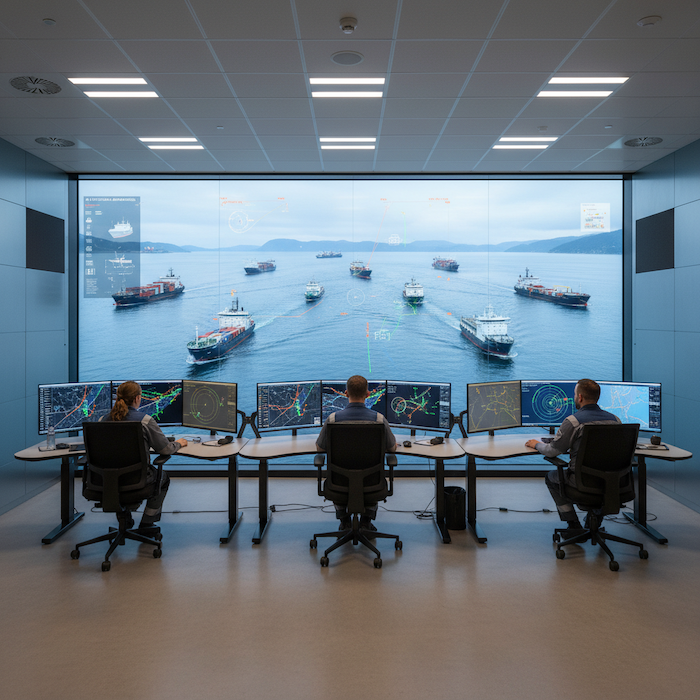
The Massterly ROC in Horten, which became fully operational in 2024, is now a mature nerve center. It monitors a diverse fleet ranging from subsea robotics to container feeders. This facility has demonstrated that a certified master can oversee multiple assets from shore, provided the situational awareness data, escalation protocols, and connectivity meet defined thresholds.
The Norwegian maritime AI centre (MAI)
Launching in January 2026 in Trondheim, the MAI represents the next phase of Norway’s strategy. Led by NTNU and funded by the Research Council of Norway, this center will focus on the software-defined vessel.
Goal
To enable a transition from remote control towards high-level autonomy where the AI can handle complex COLREGs collision regulations maneuvers independently, with humans only intervening by exception.
Partners
Includes the entire value chain, from Equinor to the Norwegian Seamen’s Association.
4. Case study: reach remote and the October milestone
In October 2025, the Norwegian maritime industry reached a point of no return. Reach Subsea, in collaboration with Kongsberg and Massterly, announced that Reach Remote 1 had been granted a trading permit by the NMA to operate entirely via remote control, without a support vessel.
Previously, autonomous vessels required a shadow ship to intervene if things went wrong. Reach Remote 1’s successful mission to Shell’s Ormen Lange field in the North Sea demonstrated that:
AI situational awareness using LiDAR, radar, and optical sensors can meet or exceed human lookout requirements for defined offshore operational contexts. .
Redundant connectivity using LEO satellites and 5G has reached reliability thresholds approaching “five nines” – a benchmark long associated with offshore operations.
Insurance markets have found a way to price the risk of uncrewed operations, using Norwegian operational data as the benchmark.
5. The human element: redefining the seafarer
A common misconception is that autonomy eliminates jobs. In Norway, the narrative is about transition, not elimination.
Starting January 1, 2026, the NMA will officially take over the issuance of ROC Remote Operations Center and GOC General Operator Certificate licenses for shore based maritime personnel. This represents one of the most significant structural shifts in maritime labor history since the introduction of ECDIS and integrated bridge systems. These roles consolidate navigational authority, system integrity monitoring, and escalation decision-making into a single, shore-based function.
The new maritime professional
Training institutions in Norway are already pivoting. The future captain is now being trained in data science, cybersecurity, and remote sensor interpretation.
Quality of life
By moving the bridge to land, the Norwegian industry is attracting a new generation of talent who want a maritime career without the six month stints away from home.
6. The sovereign sandbox and the global export
Norway is not just building ships. It is exporting a repeatable process for turning uncertainty into concrete regulation.
As the IMO International Maritime Organization works toward its MASS Code Maritime Autonomous Surface Ships, it is looking at Norway’s experience building phase from 2025 to 2028 as the gold standard.
Compliance by design
Norwegian tech providers are building systems that are FuelEU Maritime ready and MASS Code compliant out of the box.
The blueprint
When a port in Singapore or Rotterdam looks to automate, they are increasingly hiring Norwegian consultants such as DNV, Kongsberg, and Massterly to replicate not just technology, but the regulatory and operational sequencing behind it..
7. Economic reality: the “Autonomous dividend”
For Norwegian shipowners operating high-frequency short-sea routes, autonomy is finally showing up on the bottom line. While early-stage capital costs remain higher, life-cycle economics increasingly favor autonomous electric vessels in tightly regulated, repetitive operating patterns.
| Metric | Traditional Crewed (Electric) | Autonomous Electric (Norwegian Model) |
| Payload Capacity | Standard | +15% (No crew quarters/bridge) |
| Operational Costs | High (Onboard labor + rotation) | Lower (Shared ROC personnel) |
| Energy Efficiency | Variable (Human steering) | Optimized (AI-driven pathfinding) |
| Insurance Premium | Baseline | Initially higher, now equal (post-2025) |
“Autonomy is the means, not the target. The target is a sustainable, competitive, and safe maritime industry that can survive in a high-cost labor market like Norway.” — Tom Eystø, Massterly
Recap: The state of the nation
As we enter 2026, four structural realities are now shaping Norway’s maritime sector:
- Mandates as Catalysts: The 2026 zero-emission fjord requirement has made autonomous efficiency a “must-have” rather than a “nice-to-have.”
- Infrastructure Maturity: With the Horten ROC and the upcoming Trondheim AI Centre, the “brain power” of shipping has moved onshore.
- Regulatory Standardisation: The October 2025 Reach Remote permit proves that uncrewed operation is now a standard commercial activity.
- Labor Evolution: The NMA is now certifying the world’s first generation of shore-based “Vessel Managers,” securing Norway’s lead in maritime human capital.
The path forward
Norway has successfully moved maritime autonomy out of the innovation lab and into early industrial deployment. For global maritime stakeholders, the lesson is clear: leadership is not about having the fastest AI; it is about having the most coherent ecosystem.