




February 9, 2026

Noemie Ifrah, Marketing & Communications Manager, Orca AI
Share


For the Greek shipping community, custodians of 20% of the world’s merchant fleet by ownership, EU climate regulation has introduced new financial and operational constraints across global fleets. In congested European waters, particularly the Mediterranean, these requirements collide with some of the world’s most complex navigational conditions.. With the EU Emissions Trading System (ETS) now active and FuelEU Maritime in force since January 2025, carbon emissions have shifted from environmental metrics to critical balance sheet items.
For C-level executives, the challenge is clear: maintain Greece’s traditional commercial agility while satisfying increasingly strict EU reporting requirements. That tension is being addressed through a combination of operational discipline, data transparency and technology, with AI-driven situational awareness emerging as a critical link between bridge safety and boardroom economics.
The Mediterranean risk profile: congestion, complexity, and risk
The Mediterranean accounts for 20% of global seaborne trade despite its compact size. It’s a high-pressure environment where vessel density and geography collide, creating a persistent near-miss environment.
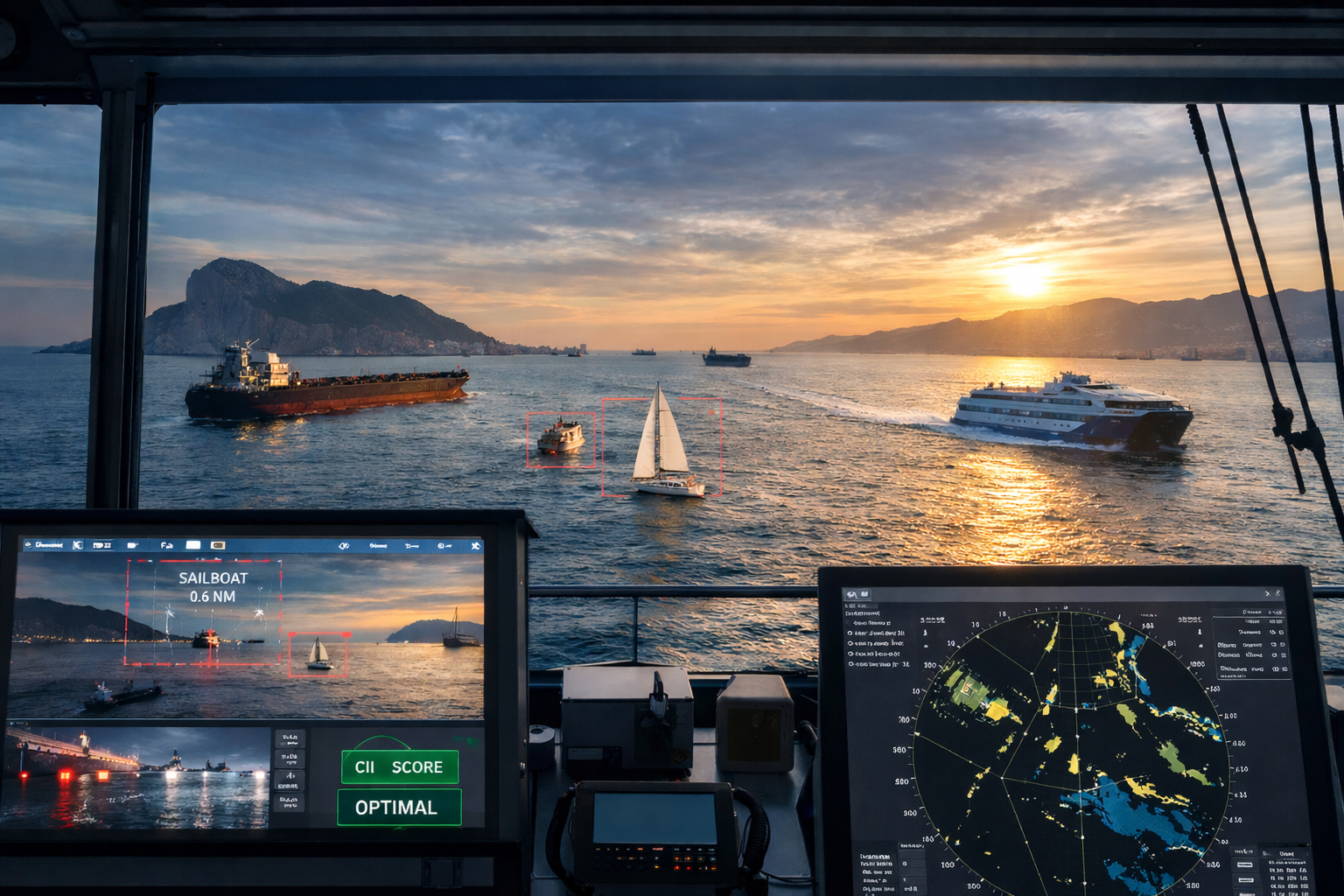
The Strait of Gibraltar, just 14km wide, requires navigating tidal streams reaching 6 knots while traffic passes every few minutes. Massive tankers share these constrained waterways with high-speed ferries and a dense population of pleasure craft, sailboats, and yachts. During peak summer months, these often non-AIS equipped vessels create unpredictable swarming patterns that stretch traditional Radar and human watchkeepers beyond their design limits.
Every evasive maneuver or emergency speed drop to avoid a small craft leads to fuel burn volatility and increased emissions – regardless of where a vessel operates. Under EU climate regulations, the cumulative effect of these operational adjustments over time is now reflected directly in a fleet’s emissions reporting and compliance costs. Which is why many Greek shipowners are turning to technology to manage risk more predictably.

Safety as a commercial Lever: AI-enhanced situational awareness
In modern maritime operations, strong safety performance increasingly underpins both operational resilience and commercial outcomes. As part of their strategies to master navigational complexity in the Mediterranean and elsewhere, Greek shipowners are adopting AI-driven collision avoidance systems like Orca AI to automate and enhance the navigation process.
Multi-sensor fusion and ground truth
By fusing high-resolution thermal and visual cameras with Radar and AIS, AI provides ground truth that Radar alone cannot offer. It identifies “non-cooperative” targets like sailboats, yachts, and fishing vessels that lack AIS transponders and are often invisible to traditional sensors in high-sea clutter or low visibility.
The always-on digital lookout
While human attention fluctuates due to fatigue, AI remains vigilant 24/7. Performance data across the ORCA AI fleet has demonstrated a 33% reduction in close encounters in open waters and a 40% decline in crossing events.
Early decision support
AI highlights risks before Closest Point of Approach (CPA) thresholds become critical. Across monitored fleets, ships saw a 26% increase in the average minimum distance sailed. Crews are taking action much earlier and with greater confidence.
The impact is already measurable in Greek operations.
Managing emissions performance: Real results from greek fleets
Greek fleets are now using AI to navigate the overlapping carbon regimes of the EU ETS and FuelEU Maritime. Both require a much higher level of transparency around fuel consumption, emissions and associated costs..
The regulatory timeline
Under the EU ETS, operators must surrender allowances for 70% of emissions in 2025, rising to 100% by 2026. FuelEU Maritime adds a further layer by linking the GHG intensity of energy used on board to economic incentives and penalties. The reduction target starts at 2% in 2025 and scales to 80% by 2050.
Case study: Sea Traders SA (Greece)
Since equipping their bulkers with ORCA AI, this Athens-based operator recorded a 64% reduction in close encounter events in open waters. For the vessel Galio operating in congested waters, the reduction reached 83%.
Decarbonization through smooth operations
By enabling earlier detection of hazards, AI ensures smoother speed profiles. In 2024, ORCA AI’s platform contributed to a total estimated reduction of 195,000 tons in CO2 emissions across monitored fleets. The key was reducing avoidable sharp maneuvers and speed drops while maintaining safe navigation.
On average, avoiding these deviations saves a vessel approximately $100,000 in fuel costs per year. This directly lowers the financial exposure to ETS carbon pricing.

The Greek roadmap: From planning to fleet-wide adoption
The Greek maritime industry is transitioning toward what industry leaders call “Augmented Intelligence.” Technology is increasingly viewed as a strategic asset to sustain competitiveness and global leadership.
National and industry frameworks
Greece’s national climate law sets a target for full carbon neutrality by 2050, supported by intermediate GHG reduction goals. The Hellenic Decarbonization Committee (HDC) works on practical solutions for the local fleet, including carbon capture studies and the implementation of EEXI and CII ratings.
Greek companies in general demonstrate remarkable resilience. 84% are already implementing carbon reduction initiatives. While 56% have adopted digital technologies, the use of generative AI is growing, reaching 27% among large firms.
How Greek shipping operators are implementing AI
Typical adoption follows a clear pattern:
- Planning and buy-in: Greek operators define clear objectives like reducing high-severity near misses. They frame AI as a tool to reduce bridge fatigue rather than a surveillance system.
- Integration with safety management systems: Leading firms roll out AI platforms fleet-wide, integrating them directly into their SMS to replace subjective reporting with real-world data.
- Growth through automation: By minimizing manual processes and optimizing resource allocation, Greek owners lower operational costs while improving decision-making accuracy. Many now use AI safety scores to incentivize captains toward safer, fuel-efficient transits.
Successful adoption in Greek fleets like Sea Traders SA involves a “culture before code” approach. By framing AI as another pair of eyes that detect what the human eye cannot, owners encourage masters and officers to engage with the technology as a supportive tool.
The bottom Line: compliance as competitive advantage
The convergence of rising traffic complexity in the Mediterranean – and increasingly across global trade routes – ambitious EU climate legislation is sharpening the operational value of AI-driven situational awareness as a strategic tool. This convergence is one of the factors driving the rapid expansion of the maritime AI market as the industry seeks to bypass avoidable risks and improve voyage efficiency.
For the Greek shipping community, in addition to its value for collision avoidance, automation is becoming part of a broader effort to manage operational risk more consistently, improving decision-making on the bridge while supporting commercial and fleet emissions performance ashore..
Frequently Asked Questions (FAQs)
How does AI situational awareness help Greek shipowners comply with FuelEU Maritime 2025?
FuelEU Maritime mandates a 2% reduction in GHG fuel intensity starting in 2025. AI platforms help meet this by reducing sharp maneuvers by 26.9% and extreme speed drops by 18%, which are fuel intensive. By maintaining a steady speed and avoiding emergency course corrections, vessels preserve their Carbon Intensity Indicator (CII) scores and reduce their carbon footprint.
Can AI truly detect small pleasure craft and sailboats that lack AIS transponders?
Yes. Modern AI systems use high-resolution thermal and visual cameras to provide a 225-degree field of view, detecting objects that are non-cooperative or invisible to traditional radar due to sea clutter or night conditions. This is critical in the Mediterranean, where sailboats and yachts significantly increase collision risks during summer.
What is the average Return on Investment (ROI) for installing AI navigation assistants?
Beyond safety improvements, AI alerts that lead to smoother voyages have shown a 54% reduction in close encounter events. This operational efficiency translates to an average of $100,000 in fuel savings per vessel annually, in addition to significant reductions in potential CO2 emissions and liability risks.
How do Greek crews react to the introduction of AI monitoring on the bridge?
Successful adoption in Greek fleets like Sea Traders SA involves a culture before code approach. By framing AI as a co-pilot that detects what the human eye cannot, and even introducing healthy competition through safety scores, owners encourage masters and officers to engage with the technology as a supportive tool rather than a surveillance system.


