



October 29, 2025

Noemie Ifrah, Marketing & Communications Manager, Orca AI
Share


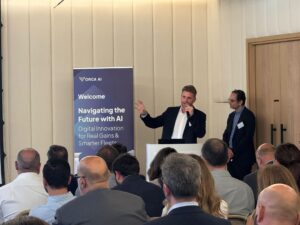
Against the backdrop of the Athens Riviera, members of the Greek maritime community gathered at the One&Only Aesthesis for an event hosted by Orca AI titled “Navigating the Future with AI – Digital Innovation for Real Gains and Smarter Fleets”. The event set out to move beyond speculation and pilot projects, focusing instead on the measurable ways AI is already reshaping ship operations and safety culture at sea.
Moderator Edwin Lampert of Riviera Maritime Media framed the discussions around evidence rather than promise. “This isn’t about distant futures,” he said. “It’s about the tangible results being realised today – safer navigation, sharper decision-making and measurable fleet performance.”

The programme kicked off with perspectives from class society Bureau Veritas and Athens-based bulk-carrier owner Sea Traders SA before turning to Orca AI CEO Yarden Gross, whose presentation connected those real-world experiences to the broader trajectory of AI adoption and autonomous operations.
Data proving safety impact
Gross opened with a blunt message. “Everyone here probably uses ChatGPT,” he said, “so we all see how fast AI is entering daily life. The same shift is happening in shipping.”
He presented validated findings from a landmark study with the P&I club NorthStandard, covering data equivalent to eight million nautical miles from over 100 container vessels. Within the first year of platform adoption, the number of high-severity near-misses per vessel dropped by 58% across a NorthStandard-insured fleet. “These results were verified by insurers whose business is risk,” he said. “AI isn’t theoretical – it’s creating safety impact right now.”
He described how Orca’s vision is to act as the crew’s indispensable co-pilot, enhancing human capability rather than replacing it. In poor visibility, for example, the AI detects what human eyes cannot. The system fuses camera, Radar and environmental data to provide real-time situational awareness and decision support, while recording navigational performance over time.
Gross also offered a glimpse into what’s next: Orca’s collaboration with NYK in Japan, where two new car carriers will enter service next year with full autonomous capabilities under human supervision. “Autonomy isn’t about taking humans out,” he said, “it’s about giving them tools to operate with more confidence and fewer errors.”
Bureau Veritas: defining “smart shipping”
The event’s first speaker, Vassilios Dimoulas, Technology and Innovation Director for East Europe at BV, placed the digital shift in a broader regulatory and technical context. He described smart shipping as a continuum – from computer-enhanced ships to connected ships, to augmented and ultimately autonomous ships.
Digital technologies, he said, are allowing shipping to move “from reactive to proactive safety management”. But progress requires rigorous data quality, cyber-resilience and clear standards. “One of the biggest challenges is defining where human responsibility ends and machine responsibility begins,” he noted, referencing the ongoing development of the IMO’s MASS (Maritime Autonomous Surface Ship) Code, expected by 2028.
Dimoulas explained how BV is already helping shipowners demonstrate “equivalent safety” – proving through detailed risk assessments that AI systems can match or exceed the protection offered by traditional human operations. “Regulations come after technology,” he said, “so class must lead by providing frameworks industry can work with now.”
Sea Traders: results that speak for themselves
If Gross and Dimoulas addressed the “why” of AI adoption, Sea Traders offered the “how”. Representing the Ioanna Procopiou-led dry-bulk company, Captain Nestoras Grigoropoulos, HSSQE Manager and DPA, shared some of the most striking operational data of the evening.
Sea Traders and sister ship-management outfit Prominence Maritime control 16 bulkers, five of which have been equipped with Orca AI since late 2024. Within just six months of operation, the company recorded a 64% reduction in close-encounter events in open waters, a 15% increase in average minimum distance, and, on one vessel, the Galio, an 83% reduction in close encounters in congested waters.
“These results mean fewer near-misses – and fewer near-misses mean [a much reduced risk of] collisions,” he said. “The system helps our crews take early decisions. When officers know that a well-trained tool is watching alongside them, they gain confidence, and confidence builds safety.”
Sea Traders has also woven Orca AI data into its safety management system. Monthly reports are analysed and shared across the fleet, comparing performance and identifying improvement areas. “We even create a bit of healthy competition between captains,” Grigoropoulos said. “When one master sees another did better, he wants to do better next month.”
The company’s next step is to use Orca analytics for voyage optimisation and deeper fleet benchmarking. “For us, enhancing navigational safety means fewer incidents and more efficient operations,” he said. “In the long term, we expect to see a significant return on investment.”
He urged the industry not to fear the coming wave of automation but to prepare through training and familiarisation. “AI is not there to replace the master mariner,” he said. “It’s there to augment his decision-making.”

A mindset shift: “adoption starts with belief”
During the panel discussion, Panos Kourkountis, Technical Director at Sea Traders, described the process of testing and adopting AI tools. New technologies, he said, must first convince three audiences: the crew, the office and management.
“With something that saves fuel, the benefit is easy to quantify,” he explained. “With something that reduces risk, it’s harder – you need the people using it to believe it truly makes their work safer and easier.”
He emphasised that crew perception can make or break a system’s success. “What kills a tool is when users disagree about its real benefits. But when they start saying, this actually makes my life easier, you know it’s working.”
Cost, he added, should be weighed against the cost of incidents avoided. If accidents over 10 years cost a company 10 million dollars, and a system costs two or three million a year but prevents most of them, then it’s worth every dollar, he suggested.
Culture before code
For Panagiotis Drossos, Managing Director of Capital Ship Management, technology adoption depends as much on leadership culture as on capability. He recounted how his company initially faced resistance when introducing AI navigation tools – some crews feared they were being monitored.
“Once they understood the system wasn’t there to police them but to support them, everything changed,” he said. The result was not fewer near-misses initially, but more, as the system revealed incidents that had previously gone unreported. “That transparency became the start of genuine learning,” he said. “We didn’t blame anyone – we used the data to improve.”
Drossos agreed with Kourkountis that AI’s true value lies in awareness. “Systems that improve judgment are here to stay. Those that distract will go.”
Regulation catching up
As discussion turned to governance, both Dimoulas and Gross acknowledged that regulation is lagging behind technology. “Every truck in the US already carries an AI-based dash tool to track driving behaviour,” Gross said, “yet ships costing a hundred times more still lack basic visibility into operational behaviour.”
BV, meanwhile, is working with early adopters to bridge that gap through guidelines on machine learning and data quality. Dimoulas confirmed that until the MASS Code is fully adopted, class societies and flag administrations must collaborate to ensure that AI systems demonstrate “an equivalent level of safety” through rigorous validation.
A collective course
In his closing remarks, Lampert observed that none of the organisations represented were waiting for “perfect solutions or complete regulatory certainty”, Instead, they were building operational resilience through measured AI adoption – gathering data, developing expertise and creating the competence that will define future standards.
What emerged most clearly in Athens was that AI in shipping has moved well past experimentation – and Greek operators are now among those shaping its practical realities at sea.


