May 28, 2026

Noemie Ifrah, Marketing & Communications Manager, Orca AI
Share


Shipping has spent a decade investing in technology. Navigation systems, fleet management platforms, performance monitoring tools, AI analytics. The promise was clarity. A Lloyd’s Register study published earlier this year found some vessels generating more than 2,000 alarm events a day. A separate review of 50 studies found seafarers sleeping five to six hours over long stretches at sea, with an average working week of around 75 hours.
During Orca AI’s recent webinar, Overloaded and Alert Fatigued: How Can Crews Cut Through the Data Chaos, three senior voices sat down to address the problem directly: Torleif Frimannslund (VP Technology and Decarbonisation, Grieg Star), Alena Pedersen (VP Corporate IT and Digitalization, Odfjell), and Dor Raviv (CTO and Co-founder, Orca AI). The conversation was moderated by Edwin Lampert, Executive Editor at Riviera. What follows are the themes that stayed with us.
Adding without removing
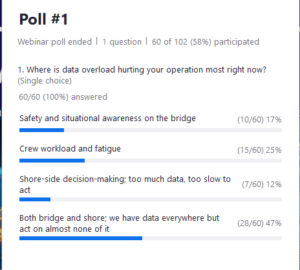
A first live poll set the scene, asking 60 of the professionals in the room where data overload is hurting their operation most right now. 47% chose “both bridge and shore — we have data everywhere but act on almost none of it.” The conversation that followed explained why.
Torleif put the problem plainly. At Grieg Star, which operates one of the world’s largest open-hatch dry bulk fleets, every new system arrived with good intentions. The pattern — adding without removing — is where the trouble starts.
“If the crew themselves has to integrate five different systems in their head,” he said, “have we actually digitalised anything at all?”
His team now asks tougher questions before deploying anything new: does this reduce workload, or add to it? And if something comes on board, can something else go?
A live poll during the session asked 60 of the professionals in the room where data overload is hurting their operation most right now. 47% chose “both bridge and shore — we have data everywhere but act on almost none of it.” The conversation that followed explained why.
What fragmentation actually costs
The word “fragmentation” came up repeatedly. When the moderator pushed for a concrete cost, the answers were specific.
Dor described Orca AI’s own safety data. “Two thousand alarms, reducing that into one very simple UI that basically talks in a very human way with the operators. We saw a dramatic reduction of near misses.” That reduction was validated by third-party auditors across an entire fleet.
Alena gave the other side. Odfjell ran a machine learning project to optimise spare parts management. It failed. “The data were lacking context. We had a lot of data in different systems — purchase orders, suppliers, spare parts — but none of these data are connected for AI to be able to consume them in a valuable way.” The savings weren’t realised. But the failure gave the team something useful: the mandate to fix the foundation. “Failing and quickly learning can be a very good upside,” she said.
Torleif framed the broader cost as an “illusion of situational awareness.” The crew believes the picture is complete. It might not be.
The office sees clean data. The bridge sees a situation.
The ship-to-shore divide was the most honest part of the conversation.
Torleif: “In the office we see clean data points. On board, they’re experiencing a situation.” Speed deviations, fuel consumption, port instructions — dashboards show all of it. But the bridge is also dealing with traffic, fatigue, and live conditions no dashboard captures.
Alena added a structural point. The office has many specialised functions, each with its own data needs. The crew is one team. What seems trivial ashore can be genuinely difficult to deliver at sea, especially where connectivity is still unreliable. IT and OT systems also have very different lifecycles — IT refreshes fast, OT runs for 25 to 30 years. “Two completely different universes,” she said.
Dor acknowledged that product design is part of the answer. Orca AI shares anonymous video recordings of incidents with shore teams so they can see what the crew actually experienced. “You never experience everything like the crew just experienced. But you need to find ways to close this gap.”
When crews quietly go back to Excel
An easy tell that a system isn’t working: the crew has a parallel process they trust more.
Alena found it during a dry-docking visit. “One of the six tools they are using is their old way of doing things in a fantastic Excel spreadsheet.” She spent time with the chief engineer to understand not just what was happening, but why the newer tool wasn’t replacing it. Often it’s not resistance — it’s that the modern tool adds strain rather than removing it.
The opposite is also true. Odfjell built an AI-based chatbot for reading procedures and preparing for audits. “That was an instant adoption by very experienced crew,” she said. No significant training investment required. “When the technology is good, you actually do not even have to invest so much into adoption.”
Dor made the same point with thermal imaging. A crew that previously used binoculars at night can now see all targets with AI-generated alerts overlaid. “This is just superior to what you already have.” The adoption followed.
Agentic AI: where it belongs and where it doesn’t
The panel was notably clear-eyed about where the line sits.
Dor described what current AI agents do well: summarising, understanding context, consolidating multiple data sources into a coherent answer. A crew member asking a chatbot about the latest IMO committee changes instead of reading 400 pages of manual — that’s exactly where it fits. The speed and accuracy gains are real.
For tactical, life-saving decisions on the bridge, the answer is different. “It will always be the captain’s decision. You can gain a lot of knowledge from AI, and it helps you organise very well what’s going on. But the sole decision is the captain’s discretion.”
Torleif was direct about the hard line: “Irreversible decisions should not be given to AI.” AI monitoring and filtering the information that reaches the bridge — yes. Acting independently on safety-critical navigation — no.
A second live poll put the question directly to the room: would you let an AI agent take a routine operational decision — a minor speed adjustment — without a human approving it? Of 62 respondents, 44% said only with full audit logging and explainability. 34% said not in the foreseeable future. Together, 78% placed a hard condition on any AI autonomy, even for something routine. The panel’s answer matched.

Alena added the governance prerequisite. Before any agentic system can be signed off, there needs to be a named business owner: “not IT, not the vendor.” One person who understands the consequences for the business. “This is where we start,” she said.
What to do in the next 12 months
Alena: identify your 10 most important data products and name a business owner for each. Start with the vessel — follow the data flow from ship to shore, not the other way around.
Dor: invest in the seafarers. Gen Z crews have better technology in their pocket than on most bridges. Ships that want to attract and retain talent need to close that gap. And take cybersecurity seriously — GPS spoofing, unreliable sensors, and increased connectivity make it a board-level concern, not an IT-only one.
Torleif: start with the decision you need to support, not with the dashboard. “Map out what you actually need and what you need to improve before diving into tools and platforms.” Many first movers learned that lesson the hard way.
Key takeaways
- Vessels generating 2,000+ alarms a day are not producing better decisions — volume is not clarity
- Fragmentation’s real cost shows up in near misses, eroded trust, and data projects that fail because context is missing
- Shore teams and bridge teams see the same data differently; closing that gap requires design, not more tools
- Crew adoption follows product quality; when technology genuinely reduces workload, training investment drops
- Agentic AI belongs in knowledge and procedure tasks; irreversible navigation decisions stay with the captain
- Before deploying any agentic system: name a business owner — one person, clear accountability