Contact us

Like everyone else, we use cookies. You can read about their use in our Privacy Policy

Enable all

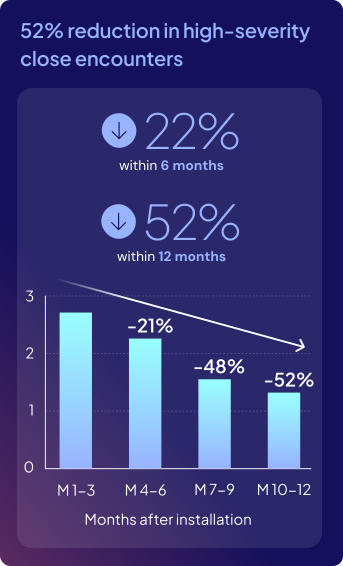
Orca AI helps reduce
high-severity close encounters
by 52%

Data is key to making our seas safer

Navigational risk is shifting. Owners and insurers are moving beyond rules and post-incident reviews toward continuous digital watchkeeping, AI decision support, and operational data to identify and reduce risk in real time.

The Orca AI and NorthStandard Navigational Safety Report analyzes anonymized data from 139 vessels, covering 139 ship-years and more than 10.8 million nautical miles of global trading, with performance tracked across each vessel’s first 12 months of AI-assisted watchkeeping.

The findings reflect the day-to-day reality of modern navigation, where increasing traffic density, operational complexity, and external disruptions are placing sustained pressure on bridge teams. In these conditions, earlier awareness and more consistent decision-making are no longer optional. AI-assisted watchkeeping is emerging as a critical foundation for managing risk with greater control and confidence.

Yarden Gross
CEO and Co-founder
Orca AI
Colin Gillespie
Head of Loss Prevention
NorthStandard

Key findings

Orca AI’s platform has an immediate and sustained impact on navigational safety

Vessels operating with Orca AI show a reduction in high-severity close encounters - tracked from Month 1 through Month 12 post-installation. High-severity close encounters declined from 2.7 per vessel per month in the early post-implementation phase to 1.3 by months 10–12 - a 52% reduction. Improvements hold across all vessel ages, from newbuilds to ships over 35 years old.

Explore the numbers behind safer navigation at sea.

Key findings

SMS adherence improves in open waters

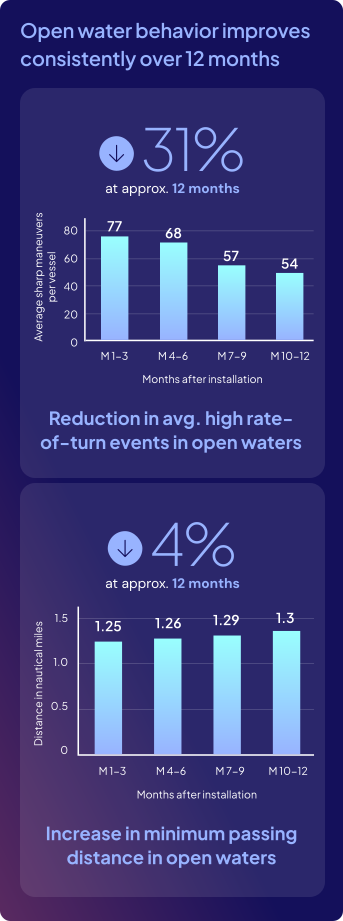
In open water, away from traffic separation schemes, port approaches and routing constraints, navigational behavior is a direct reflection of crew decisions. Both indicators improved consistently: high rate-of-turn events fell 31% and minimum passing distance increased 4%, reflecting earlier encounter management and greater separation in line with company SMS policies.

Key findings

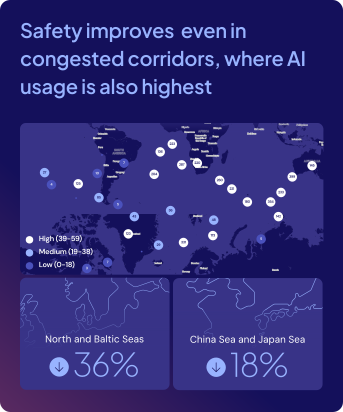
Safety gains extend to the most congested corridors

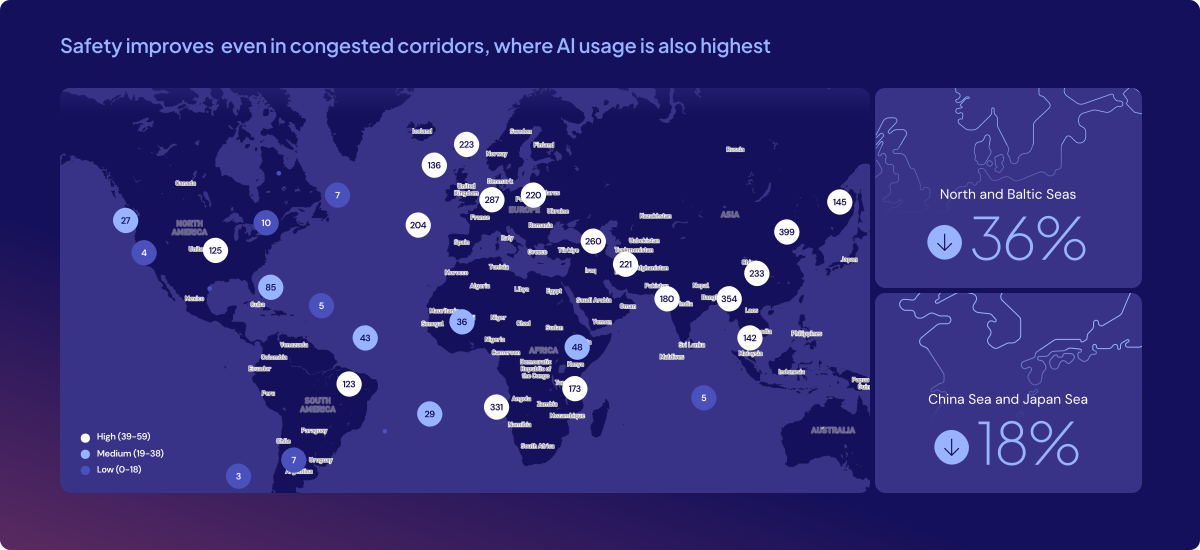
Improved SMS adherence in open water carries into congested environments, with high-severity close encounters falling 36% in the North and Baltic Seas and 18% in the China and Japan Seas. Platform engagement is highest in these same corridors, suggesting that AI-assisted watchkeeping is operationally relevant in high-complexity conditions, supporting earlier detection and more controlled responses to developing collision risk.

Key findings

The safety impact holds across mixed fleets

Safety improvements were observed across vessels of different ages and bridge configurations, including older tonnage and legacy bridge setups. This indicates that AI-assisted watchkeeping can raise the safety baseline across mixed fleets, not only newbuilds or highly standardized vessels.

Industry context: Navigational risk under pressure

The findings should be viewed against a backdrop of increasing structural pressure on maritime safety. Together, these factors are increasing navigational complexity at a time when margin for error is shrinking.
A larger and more active global fleet
Geopolitical disruption, route volatility and GNSS interference
Crew shortages, fatigue, and experience gaps
Aging vessels with uneven bridge capabilities
Rising asset values and insurance exposure

Get data-backed proof of AI’s impact on safety.