July 23, 2026

Noam Shirman Leibovitz, Customer Success Director
Share


Some of the best maritime training cases come from voyages that ended safely. A vessel clears a congested approach and the voyage report records no incident, yet a target may have become relevant earlier than anyone realized or a small course alteration may have prevented a difficult situation from developing.
Those details fade quickly as the officer of the watch remembers the target, the master remembers the maneuver, and the shore team sees the outcome. A replay brings the sequence back together, giving everyone a chance to study the decision while the operational context is still visible.
Human-centric maritime training starts from this lived experience. It connects formal knowledge with the conditions crews face at sea, then turns a completed voyage into preparation for the next one.
Maritime training needs the context of a real watch
Simulators, drills, classroom instruction, and onboard familiarization build the foundation for safe navigation. At sea, crews apply that knowledge while handling a particular vessel, navigating fishing traffic in the South China Sea, approaching Singapore through night-time backscatter, or managing fatigue after several demanding port calls.
Real-event replay preserves those conditions through synchronized video, vessel tracks, Radar, AIS, passing distance, encounter geometry, and a clear timeline. The crew can return to the exact point where a target became relevant, see what the bridge team saw, and examine the options available at that time.
The discussion stays close to the decision, allowing officers to work through incomplete or conflicting information from Radar, AIS, visual observation, and other sources.
Replay makes judgment visible
An outcome alone gives a limited picture of navigational performance. Two vessels may complete a close passage safely, even though one bridge team acted early and the other left itself a narrow margin.
Replay shows when the risk developed, how the officer interpreted it, and what changed after the first maneuver. The bridge team can examine whether the action was early, clear, and consistent with COLREGs, then discuss how another response would have changed the encounter.
Safe events can show junior officers what timely action looks like, while an encounter that ended safely after a late decision can expose a training need before the same pattern contributes to an incident. Crews can also identify strong decisions, explain why they worked, and repeat those behaviors on later watches.
Experienced judgment can travel further
Masters and senior officers often recognize risk through cues built up over years at sea. They notice a target holding an uncomfortable bearing, an alteration that creates ambiguity, or traffic behavior that differs from the expected pattern. Much of this knowledge is difficult to capture in a procedure.
Replay gives experienced officers a concrete case to teach from. A master can pause the event before the maneuver, ask a junior officer to describe the developing risk, and work through the likely effect of each available action. The junior officer practices making the decision with the information available at that moment.
Repeated exposure builds a larger library of situations, allowing junior officers to study encounter types they have yet to experience personally while experienced officers explain the observations behind their decisions.
Fleet cases also help crews manage rotations by giving officers with varied experience a shared reference for handling close encounters, restricted visibility, non-AIS traffic, and degraded positioning.
Trust strengthens maritime crew training
Replay creates useful evidence, but the company’s review process determines whether crews learn from it. Clear rules about who sees the data, why an event is selected, and how the findings will be used allow officers to participate honestly.
A productive debrief reconstructs the watch: what information was available, what else demanded attention, why the action made sense at the time, and which cue could prompt an earlier response next time.
The bridge team should explain the operational context before the shore team reaches a conclusion. Shore reviewers also need the skills to ask useful questions, separate coaching from formal investigation, and recognize the limits of hindsight.
When ship and shore review the same video, tracks, timeline, and encounter data, the evidence settles what happened. The discussion can focus on how the decision developed and how the lesson applies to a future watch.
Fleets are already bringing recorded events into pre- and post-embarkation briefings, safety meetings, refresher sessions, and maritime training centers. Event patterns can also identify a vessel or crew that would benefit from focused coaching.
One voyage can improve the wider fleet
Navigational experience has often stayed with the people who were present. Replay allows a useful encounter to reach crews that may face the same condition weeks or months later.
A case involving non-AIS fishing traffic can prepare vessels trading in the same region. A difficult night approach can support the next pre-boarding briefing, while an encounter during GNSS interference can help another bridge team recognize unreliable positioning and move to independent references confidently.
Training teams can group events by vessel, watch, route, congestion, passing distance, severity, or COLREG context. The patterns show where crews need more practice and help instructors select cases that fit the vessel’s work.
The same approach builds consistency across rotations because officers study common cases and see how the company’s navigational standards apply under different operating conditions.
Later voyages provide the proof
Attendance and assessment scores confirm that training took place, while later voyages show whether the crew changed how it operates.
Fleet teams can look for earlier recognition of risk, timely course or speed adjustments, clearer passing margins, and consistent decisions in similar conditions. They can also track whether officers report concerns and bring useful events forward for review.
The published TMS Cardiff Gas and Ionic case studies connect real-event coaching with earlier decisions, fewer close encounters, wider passing distances, and stronger crew engagement. Replay is one part of a wider safety system, and its contribution appears when the reviewed behavior changes on later voyages.
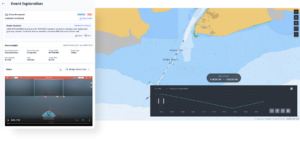
A replay combines bridge video, vessel tracks and passing-distance data, allowing crews to reconstruct how a close encounter developed.
Every voyage produces experience, replay turns selected moments into structured discussion, and future watches show whether the lesson became part of normal bridge practice.
Human-centric maritime training respects the judgment crews already bring to the vessel and gives them better material for developing it. A replay lets experienced officers teach what they saw, gives junior officers access to situations beyond their own sea time, and helps ship and shore learn from the same evidence.
The industry produces new training cases on every voyage. Keeping those lessons in circulation can make the next watch safer.