



Autonomous Shipping
Autonomous shipping: What it means for the future of maritime operations
Key takeaways box
- Autonomous shipping refers to the use of AI, computer vision, and sensor fusion to automate vessel navigation, either partially or fully, reducing reliance on continuous human input.
- Commercial deployments today operate on a spectrum — from AI decision support (Level 1) through to supervised open-sea autonomy (Level 4) — with most vessels currently at Level 1 or Level 2.
- The main drivers are safety, crew workload reduction, fuel efficiency, and alignment with decarbonization mandates.
- Orca AI is one of the world’s leading providers of autonomous navigation technology, with its platform installed on over 1,200 vessels globally.
What is autonomous shipping?
Autonomous shipping is the use of AI-powered systems, sensors, and computer vision to navigate vessels with reduced or no continuous human intervention. Rather than a binary crewed/crewless distinction, it exists on a spectrum of automation levels defined by the degree to which onboard systems can perceive, decide, and act independently. Maritime autonomous surface ships (MASS) encompass everything from AI-assisted watchkeeping on commercial cargo ships to fully unmanned vessels operating within defined operational envelopes.
Is autonomous shipping the same as an unmanned ship?
No. Autonomous shipping includes unmanned vessels, but it is broader than that. Many autonomous ship concepts still involve human oversight, onboard crew, or remote operators. The key distinction is the level of system independence, where control is located, and how much human intervention is required.
The term is widely misunderstood as meaning crewless. It does not. The industry is progressing through defined stages: some systems advise the crew; others support remote operation or supervised autonomy in open water. Fully autonomous ships, where the vessel makes and executes navigational decisions without any human in the loop, sit at the furthest end of that spectrum. They are not the current default, and for most of the commercial fleet, they remain some years away.
What are the IMO’s four degrees of vessel autonomy?
The IMO defines autonomy in shipping not as a binary state but as a spectrum of four degrees, established through its Regulatory Scoping Exercise for MASS (MSC.1/Circ.1638). These degrees are the internationally recognized reference framework and inform how existing conventions (SOLAS, COLREG, STCW) apply at each level of automation. Crucially, these degrees are not fixed for a given vessel: a ship may operate across multiple degrees within a single voyage, moving between higher autonomy in open water and direct crew control as conditions demand.
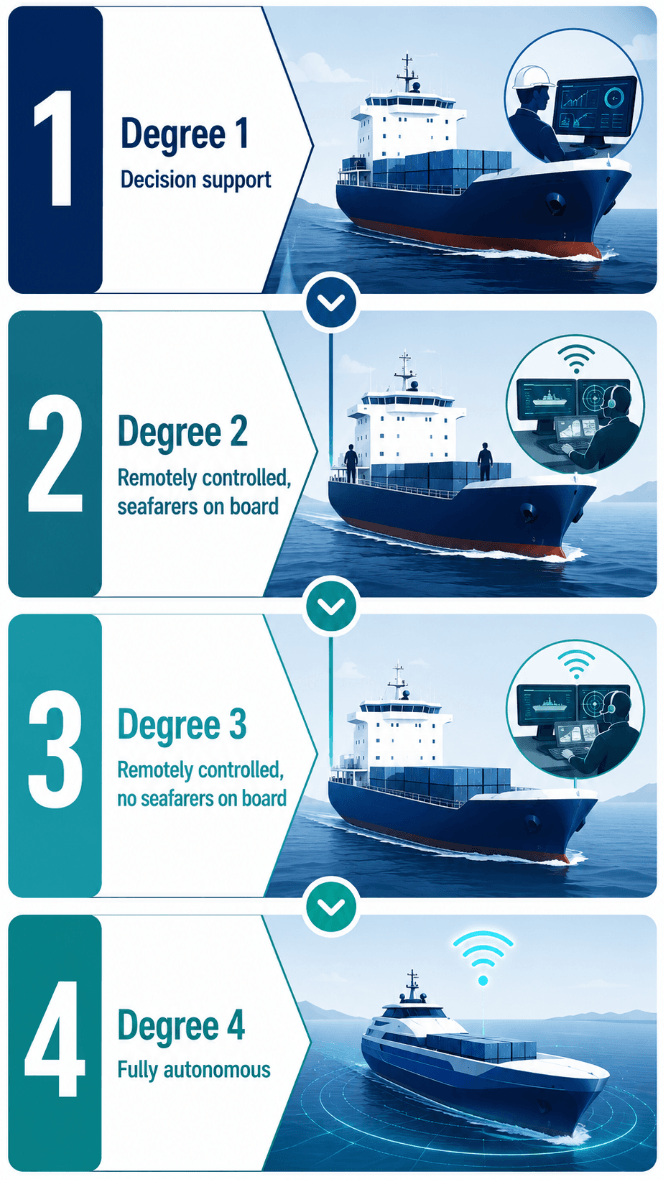
Degree 2, remotely controlled with seafarers on board: the ship is controlled and operated from a remote location, but seafarers remain on board as a safety backstop.
Degree 3, remotely controlled with no seafarers on board: the ship is operated remotely with no crew on board. Shore-based operators manage navigation and intervention.
Degree 4, fully autonomous: the ship’s operating system makes and executes decisions independently. Human intervention is by exception only.
Most commercial deployments today sit at Degree 1, with higher degrees beginning to emerge in defined operational envelopes: Norway’s Reach Remote 1 permit (October 2025) for uncrewed offshore support operations, and Japan’s GENBU (January 2026), the first ship to carry general cargo under Level 4-equivalent autonomous navigation.
Why does autonomous shipping matter for the maritime industry?
Three converging pressures are driving the industry toward greater automation: safety, operational efficiency, and decarbonization.
Human error and fatigue: human error is consistently identified as the primary cause of maritime incidents. Crew fatigue, reduced visibility, and cognitive overload in high-traffic situations are persistent risk factors on commercial bridges, and they are not easily solved by adding more crew or more conventional equipment.
- Manning constraints: available officer pools are shrinking while voyage complexity increases. Automation reduces bridge workload and improves situational awareness without removing the human from the equation; it changes what the human is being asked to do.
- Decarbonization: Orca AI’s own analysis of more than 50 million nautical miles of vessel operation data found that AI-assisted navigation could cut global commercial shipping CO₂ emissions by 47.6 million tonnes a year, primarily by reducing unnecessary maneuvering and route deviation caused by late hazard detection.
- Regulatory trajectory: the IMO MASS Code, non-mandatory, took effect on 1 July 2026, giving member states at least two years to test it before a mandatory version, targeted for adoption in 2030 and entry into force in 2032, brings autonomous operations fully under SOLAS. Japan’s domestic framework has moved in step: in January 2026, classification society ClassNK and Japan’s Ministry of Land, Infrastructure, Transport and Tourism certified GENBU, the flagship vessel of Japan’s DFFAS+ consortium, for commercial cargo operations under Level 4-equivalent autonomous navigation, demonstrating that high-degree autonomy is no longer theoretical.
How does autonomous shipping work?
An autonomous ship relies on sensor inputs, perception systems, decision-support software, connectivity, control systems, and human oversight. These systems may combine radar, AIS, cameras, GNSS, voyage plans, weather data, and vessel performance data to build a reliable operating picture and support safer navigation.
The core technology layers that make this possible are:
What are the main use cases for autonomous shipping today?
The core technology layers that make this possible are:
| Core technology layer | Description |
|---|---|
| Computer vision | Camera-based object detection and classification, operating across day, night, and adverse weather conditions |
| Sensor fusion | Integration of visual, radar, AIS, and LiDAR data into a single coherent picture of the vessel’s environment, compensating for the blind spots of any single sensor |
| AI and machine learning models | Trained on real-world voyage data to improve detection accuracy and predict risk over time |
| Ship-to-shore connectivity | Satellite (including LEO) and 5G links enabling real-time data streaming, remote monitoring, and intervention by shore-based operators |
| Remote Operations Centers (ROCs) | Onshore facilities where certified officers can monitor multiple vessels simultaneously and assume control on demand |
| Cybersecurity frameworks | Critical given the digital attack surface of fully networked vessels; GPS spoofing and sensor manipulation are active threat vectors |
AI watchkeeping and collision avoidance on commercial vessels
The most commercially mature application, and the one with the largest active fleet deployments today. Computer vision and ARPA-independent radar processing enable continuous, 24/7 object detection and risk prioritization, particularly valuable in low-visibility conditions and high-traffic corridors where human lookout performance is most likely to degrade.
Open-sea supervised autonomy on deep-sea cargo routes
The majority of deep-sea voyages are conducted in open water with sparse traffic, which is where supervised autonomy is most tractable today. In the absence of a single mandatory international framework, oversight is currently determined case-by-case by individual flag states rather than one global standard, and open water is where that patchwork is easiest to operate within while still delivering measurable gains in fuel efficiency through optimized pathfinding. It is also where the commercial case is clearest: fewer late maneuvers, less route deviation, lower fuel burn.
Short-sea and ferry routes with fixed operational envelopes
High-frequency, point-to-point routes are the proving ground for higher degrees of autonomy. Norway’s zero-emission requirement for its World Heritage fjords, which took effect in 2026 for vessels under 10,000 GT, is accelerating the shift to electric propulsion on Scandinavian short-sea routes. Combined with predictable operating conditions and strong regulatory support, that same shift is where higher degrees of autonomy are moving fastest from pilots into scheduled service.
Autonomous cargo ships for port logistics and inland waterways
Shorter, repeatable routes in controlled environments represent the next wave of commercial deployment. Autonomous cargo ships are gaining traction in container feeder and RoRo applications, where fixed schedules, known traffic patterns, and constrained geographies make the operational design domain easier to define and certify.
How is Orca AI advancing autonomous shipping?
Orca AI’s platform is built for the human-machine collaboration model that underpins safe, incremental autonomy, extending what bridge teams can perceive and respond to, without removing them from the equation.
24/7 AI watchkeeping with SeaPod
Orca AI’s SeaPod combines computer vision with ARPA-independent processing to deliver continuous object detection, classification, and risk prioritization. Three SeaPod lookout units, each fitted with high-sensitivity RGB and thermal cameras, work together to deliver a full 360° field of view around the vessel, a configuration Orca AI introduced in early 2026 to close blind spots caused by cranes, wind rotor sails, and other deck equipment. Where human lookout performance degrades (in fog, darkness, glare, or dense traffic), SeaPod maintains a consistent picture of the vessel’s surroundings and alerts the bridge to high-risk targets in real time.
Sensor fusion for complete situational awareness
No single sensor gives a complete picture. SeaPod fuses camera, radar, and AIS data into a unified operational view, which is particularly effective in target-rich environments where vessels, buoys, and other hazards may not transmit AIS signals or where GPS data has become unreliable. When GPS spoofing is detected, the system switches to visual mode and continues tracking targets independently of positioning data, keeping the bridge informed and the FleetView shore team updated simultaneously.
Fleet-scale learning from over 120 million nautical miles
Orca AI’s models are trained on more than 120 million nautical miles of real voyage data, the largest proprietary marine dataset of its kind. Each voyage adds to a feedback loop that improves detection accuracy and risk prediction over time. That depth of real-world exposure cannot be replicated in simulation.
ClassNK-qualified: Orca AI’s role in Japan’s DFFAS+ autonomous ship program
In 2022, SeaPod was the navigational backbone of the MEGURI2040 autonomous voyage between Tokyo Bay and the port of Tsu-matsusaka in Ise Bay: 40 hours of navigation at 98% autonomous operation, executing 107 collision avoidance maneuvers in congested Japanese waters, with live data streamed to a shore-based fleet operations center throughout.
That trial became the foundation for a bigger commitment. Orca AI is now the perception layer for DFFAS+ (Designing the Future of Fully Autonomous Ships Plus), the 51-company consortium led by NYK’s technology arm, MTI, that forms the second stage of the Nippon Foundation’s MEGURI2040 program. In March 2026, Japanese classification society ClassNK granted Orca AI’s perception platform official Technology Qualification, confirming its real-time AI and computer vision meet the performance requirements for autonomous navigation, a qualification Orca AI describes as a world first for this category of technology.
The consortium’s flagship vessel, GENBU, is the proof point: a container ship purpose-built for Level 4-equivalent autonomous navigation. GENBU obtained autonomous ship certification from ClassNK on January 26, 2026, and inspection approval from Japan’s Ministry of Land, Infrastructure, Transport and Tourism two days later. On January 30, 2026, GENBU began regular commercial operations on a fixed cargo route, becoming the world’s first ship to carry general cargo under Level 4-equivalent autonomous navigation, and demonstrating Orca AI’s approach to autonomous shipping at commercial scale.
Independently verified: Lloyd’s Register live trial
Perception is the foundation autonomy is built on: a ship can’t act independently on what it can’t reliably see. Lloyd’s Register put that foundation to the test with an independent five-day trial of Orca AI aboard a feeder containership through the Mediterranean’s busiest shipping lanes, benchmarking 739 target detections against radar, AIS, and visual observation. SeaPod achieved 94% precision and 98.6% recall, with zero system downtime, and caught targets radar missed entirely, including an unlit boat adrift at night. For regulators, insurers, and class societies weighing whether AI perception is reliable enough to support higher degrees of autonomy, that’s the kind of independently verified data point they’re asking for.