




Shadow Fleet
Shadow fleet explained: how sanctioned tankers operate, and what they mean for the ships sailing around them
Key takeaways
- The shadow fleet is what IMO also calls the dark fleet. Both terms describe ships that evade sanctions, safety rules or insurance, often by switching off AIS.
- It’s a large slice of the tanker market. S&P Global counted 978 shadow fleet tankers in September 2025, about 18.5% of the global oil tanker fleet.
- The risk lands on everyone nearby. Dark ships are old, often uninsured by mainstream P&I clubs, and broadcast nothing about who they are or where they’re going.
- Orca AI helps the bridge see dark vessels that AIS doesn’t show. Day and thermal cameras detect and track targets with no AIS signal. Identifying a ship’s sanctions status stays with the authorities.
What is the shadow fleet?
The shadow fleet is a group of ships operating outside the rules that normally govern commercial shipping: sanctions, flag and port State inspections, liability insurance and AIS transmission. It’s mostly made up of tankers moving sanctioned Russian, Iranian and Venezuelan oil, and IMO uses “dark fleet” for the same thing.
IMO set out the definition of the “dark fleet” or “shadow fleet” in Resolution A.1192(33), adopted on 6 December 2023. It describes “ships that are engaged in illegal operations for the purposes of circumventing sanctions, evading compliance with safety or environmental regulations, avoiding insurance costs or engaging in other illegal activities.”
Among the behaviors the resolution lists: unsafe operations, avoiding port State control, no adequate liability insurance, opaque corporate governance, and “intentionally taking measures to avoid ship detection such as switching off their AIS or LRIT transmissions.”
The UK’s Shadow Fleet: A Call to Action, which has 50 endorsers including the EU, uses the same definition.
Shadow fleet, dark fleet, dark vessels: what’s the difference?
| Term | What it means | Can it be legitimate? |
|---|---|---|
| Dark fleet | IMO’s term, same meaning as shadow fleet in IMO and UK usage | No |
| Shadow fleet | Ships operating illegally to evade sanctions, safety rules or insurance; most often used for tankers carrying Russian oil | No |
| Dark vessel / dark ship | Any vessel not broadcasting AIS at a given moment | Sometimes. A master may switch AIS off if transmitting would compromise the ship’s safety or security, and must log the reason |
That last row matters. Under IMO’s AIS guidelines, Resolution A.1106(29), AIS “should always be in operation when ships are underway or at anchor.” The exception is a credible security threat, such as piracy. So every shadow fleet tanker can go dark, but not every dark vessel belongs to the shadow fleet. Fishing boats and small craft often carry no AIS at all.
How big is the shadow fleet?
S&P Global’s September 2025 count put the shadow fleet at 978 tankers and 127 million dwt, up from 889 tankers in November 2024. By trade:
- Russia: 561 tankers
- Iran: 170 tankers
- Venezuela: 54 tankers
- Flexible: 193 tankers serving more than one of these trades
The ships are old. S&P Global put the average age of sanctioned or high-risk tankers at about 20 years.
How do shadow fleet ships operate?
Shadow fleet operators, and the dark ships they run, use a recurring set of methods to keep cargo moving and ownership hidden.
- AIS switch-off. The ship stops transmitting, often near loading terminals or transfer areas, then reappears days later somewhere else.
- Position manipulation. Some ships broadcast false AIS positions, so the track on public screens doesn’t match where the vessel is. Reuters, citing Lloyd’s List Intelligence and the Finnish Coast Guard, also reported fake IMO numbers.
- Ship-to-ship transfers. Cargo moves between tankers in international waters, which disguises its origin.
- Flag-hopping and false flags. Ships move to registries with little oversight, or claim flags they aren’t entitled to. Belgian and French forces seized the tanker Ethera in February 2026 while it sailed under a false Guinea flag.
- Opaque ownership. Single-ship companies, often registered in third countries, sit between the vessel and its beneficial owner.
- Non-standard insurance. Many tankers carry no cover from an International Group P&I club, which leaves coastal states exposed if a spill happens.
The tactics overlap with GPS spoofing, which also corrupts the position picture other ships depend on.
Why does the shadow fleet matter to commercial shipping?
Because shadow fleet tankers share the same lanes, anchorages and straits as everyone else. When one of them goes dark, the ships around it lose the information AIS normally gives them.
On the bridge
An AIS-dark tanker gives no name, destination, course or intent. The officer of the watch has Radar and what they can see. COLREGs Rule 5 requires a lookout “by all available means,” and Rule 7 warns against assumptions based on “scanty radar information”. A loaded tanker that doesn’t appear on AIS is exactly that kind of target, and it’s harder still to read at night or in restricted visibility.
Ashore
For owners and insurers, the exposure is a collision with a ship that may have no mainstream P&I cover and no traceable owner. For coastal states, it’s pollution and damage to undersea infrastructure.
Incidents linked to the shadow fleet
| Date | Incident | What happened |
|---|---|---|
| May 2023 | Pablo, off Malaysia | Explosion and fire on a Gabon-flagged tanker with no confirmed insurance. 3 crew missing |
| 19 July 2024 | Ceres I and Hafnia Nile, off Singapore | Collision and fire. Ceres I had previously carried Iranian oil, and its P&I cover was outside the International Group |
| 25 December 2024 | Eagle S, Gulf of Finland | Finnish police investigated the tanker after its anchor was linked to damage to the Estlink 2 power cable and telecom cables |
| January 2025 | Eventin, off Rügen | Tanker adrift with about 100,000 tonnes of oil. Germany later ordered it confiscated |
| 17 June 2025 | Adalynn and Front Eagle, off Fujairah | Collision and fire. Lloyd’s List linked Adalynn to the shadow fleet; JMIC and the owner attributed the collision to navigational error |
How does dark vessel detection work?
Dark vessel detection combines sources that don’t depend on a ship choosing to transmit. Satellites find dark ships across an ocean basin. Sensors on nearby ships find them at the range where a collision can happen.
| Method | Who uses it | What it detects | Limit |
|---|---|---|---|
| Satellite radar (SAR) and optical imagery | Governments, researchers | Vessels at sea regardless of AIS, matched against AIS records | Revisit times measured in hours or days |
| AIS gap and track analysis | Analysts, sanctions teams | Gaps, impossible jumps and spoofed tracks | Needs AIS data to analyze |
| Patrols | Navies, coast guards | Aircraft, drones and ships watching specific areas | Coverage limited to patrolled zones |
| Onboard Radar and cameras | The bridge team | Targets within sensor range, in real time | Range-limited to the ship’s surroundings |
The scale of untracked activity is large. A 2024 study in Nature, using satellite imagery and machine learning, found that 72% to 76% of the world’s industrial fishing vessels aren’t publicly tracked, and that 21% to 30% of transport and energy vessel activity is missing from public tracking systems.

Space-based detection is how authorities build the picture of the shadow fleet. That’s maritime domain awareness, and it’s a state-level job. The ship sailing past a dark tanker at 03:00 needs something faster.
How are governments responding to the shadow fleet?
- Sanctions listings. The EU’s 21st sanctions package in July 2026 brought the number of listed vessels to over 670. The UK has sanctioned almost 600. The US Treasury listed 183 vessels in a single action in January 2025.
- Patrols. NATO launched Baltic Sentry in January 2025, after the Estlink 2 damage.
- Boardings and seizures. France boarded the tanker Boracay in September 2025. Sweden, Belgium and France seized suspected shadow fleet tankers in 2026.
- Inspections at chokepoints. Denmark tightened checks on tankers passing Skagen in October 2025.
How Orca AI supports ships sailing near the shadow fleet
Orca AI works at the vessel level. Its job is to make sure the bridge sees every target around it, including the ones that broadcast nothing, so the officer of the watch can apply COLREGs on a complete picture. Sanctions screening and judging a vessel’s intent stay with the authorities. Radar, AIS and ECDIS stay where they are, and the master stays in command.
-
- Detection that doesn’t depend on AIS. SeaPod combines day and thermal cameras with the ship’s Radar, AIS, GPS and gyro. It detects, tracks and classifies targets with no AIS signal and derives CPA and TCPA, so a dark tanker crossing ahead is a tracked target with a risk indicator.
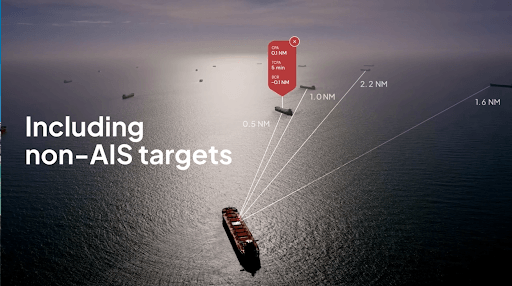
- Targets Radar can miss. In a live vessel trial assessed by Lloyd’s Register, several close-range targets produced no meaningful Radar signature but were detected by the cameras. The full Lloyd’s Register evaluation sets out the method.
- Visibility ashore. FleetView records close encounters, so safety teams can see where their vessels met dark targets and how the watch handled them.
- Shared hazard alerts. Co-Captain relays verified alerts, including GPS interference zones, to Orca-equipped vessels on intersecting routes. It’s advisory. Humans stay in command.

The shadow fleet is a sanctions and enforcement problem for states. For the ships sharing the water with it, it’s a navigation security problem, and the first step is seeing it. We looked at the European picture in more depth in the shadow fleet: Europe’s invisible maritime threat, and at what happens when two ships fail to read each other in the ship collision glossary.