



Maritime Domain Awareness
How is Maritime Domain Awareness used across the maritime domain?
Key Takeaways
- Maritime Domain Awareness (MDA) is a coordinated, domain-level construct. It integrates surveillance systems, regulatory data, and cross-agency intelligence to maintain structured visibility across the maritime environment at national and regional scales.
- The growing concentration of global trade has made domain-level visibility economically critical. With seaborne cargo volumes rising from roughly 4 to 11 billion tons annually and chokepoint disruptions costing an estimated USD 10.7 billion per year, MDA underpins trade resilience and strategic stability.
- Modern maritime domain awareness systems depend on data fusion and cross-border coordination. Satellite AIS, radar, satellite imagery, AI-driven anomaly detection, and enforcement networks combine to monitor piracy, sanctions evasion, infrastructure threats, environmental incidents, and congestion across the wider maritime ecosystem.
- Orca AI operates at the vessel level of maritime situational awareness. By improving detection accuracy, target tracking, and structured event logging, it enhances onboard data quality and strengthens internal fleet oversight.
What is Maritime Domain Awareness?
According to the International Maritime Organization (IMO), Maritime Domain Awareness (MDA) is “the effective understanding of anything associated with the maritime domain that could impact security, safety, the economy or the marine environment.”
In operational terms, MDA refers to the ability of states and maritime authorities to maintain a shared picture of activity across a defined maritime area in order to manage safety, security, environmental exposure, and economic risk.
Within the IMO framework, MDA is typically described through three components:
- Maritime Situational Awareness – gathering static and dynamic data to build a picture of current activity in the maritime domain.
- Maritime Threat Awareness – identifying potential threat vectors operating within the area of interest.
- Maritime Response Awareness – tracking available response resources and their readiness for deployment.
How is Maritime Domain Awareness maintained?
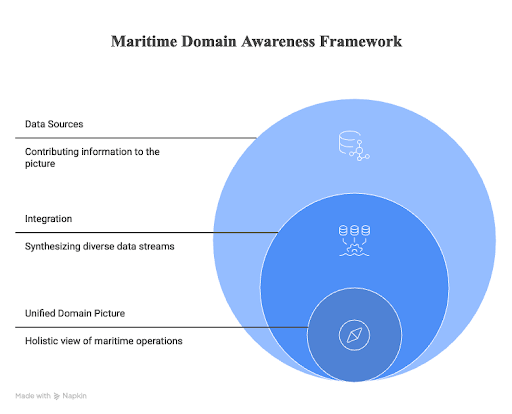
MDA is sustained through coordinated surveillance, reporting, and information-sharing systems that operate across jurisdictions. No single sensor or authority maintains it alone. It depends on layered data collection and structured integration across civil, regulatory, and defense bodies. A modern maritime domain awareness system typically integrates:
- Satellite AIS and terrestrial AIS networks. Provide tracking of vessel identity, position, course, and speed across both coastal and open-ocean environments. Terrestrial AIS supports high-resolution coastal monitoring, while satellite AIS extends visibility into offshore corridors and remote regions.
- Coastal radar systems. Enable detection of non-cooperative or non-AIS transmitting vessels within territorial waters. Radar strengthens oversight in congested approaches and near sensitive infrastructure, particularly where AIS compliance may be inconsistent.
- Satellite imagery and remote sensing. Used to detect dark vessels, confirm activity patterns, monitor offshore installations, and assess large-area maritime traffic behavior beyond line-of-sight coverage.
- Port authority and customs reporting systems. Contribute port call records, cargo declarations, inspection data, and vessel movement logs. These administrative layers add compliance and trade transparency to raw positional tracking.
- Naval and coastguard surveillance operations. Include patrol vessels, maritime patrol aircraft, and coordinated enforcement activity. These assets validate anomalies detected through digital systems and provide response capability.
- Environmental monitoring systems. Track pollution incidents, oil spills, protected marine zones, and sensitive coastal ecosystems. Environmental intelligence forms part of the broader domain risk awareness.
Modern maritime domain awareness technology does not replace institutional coordination; it strengthens it by enabling structured data fusion across these layers. Fusion centers, regional coordination bodies, and national maritime authorities combine surveillance data, regulatory reporting, and intelligence feeds into a unified operating picture.
Why has Maritime Domain Awareness become more critical?
Maritime Domain Awareness has grown in importance because the maritime system itself has become larger, more concentrated, and more exposed. Since the early 1990s, annual seaborne trade has increased from roughly four billion tons to nearly eleven billion tons. That growth has intensified vessel traffic across major trade corridors and amplified the consequences of disruption.
Shipping flows are increasingly concentrated through strategic chokepoints such as the Suez Canal, the Strait of Malacca, the Panama Canal, and the Strait of Hormuz. Recent estimates place annual losses from chokepoint disruptions at approximately USD 10.7 billion, driven by delays, rerouting, insurance premiums, and trade interruption, with an additional USD 3.4 billion attributed to increased freight costs. In this context, domain-level visibility is directly linked to trade resilience.
Offshore energy expansion has added further complexity. Oil platforms, LNG facilities, and offshore wind installations create fixed assets that require monitoring alongside vessel traffic. At the same time, geopolitical tension, sanctions enforcement, and maritime boundary disputes have increased the need for coordinated oversight across jurisdictions.
What types of risk does Maritime Domain Awareness address?
Piracy and armed robbery
MDA supports monitoring of piracy-prone regions by identifying unusual routing patterns, loitering behavior, and vessel proximity trends in high-risk corridors. By maintaining visibility into traffic density and vessel interactions at a regional scale, authorities can assess threat concentration, deploy patrol assets strategically, and coordinate responses across jurisdictions.
Illegal, unreported, and unregulated (IUU) fishing
IUU fishing undermines fisheries management, coastal economies, and environmental sustainability. MDA enables detection of suspicious fishing patterns, AIS manipulation, unauthorized activity within exclusive economic zones (EEZs), and abnormal rendezvous behavior. Cross-referencing tracking data with licensing and regulatory records strengthens enforcement and supports international compliance frameworks.
Sanctions evasion
Maritime Domain Awareness plays a role in identifying vessel identity manipulation, AIS spoofing, ship-to-ship transfers in restricted waters, and irregular routing associated with sanctions circumvention. By integrating vessel history, ownership data, and movement analysis, authorities can flag anomalies that warrant further investigation.
Smuggling and trafficking
Smuggling of goods, narcotics, weapons, or people often relies on deviations from declared routes, dark vessel operations, or irregular port activity. MDA enables monitoring of vessel behavior across regions, detection of unexplained gaps in tracking, and correlation between movement patterns and intelligence indicators.
Environmental incidents
Oil spills, illegal discharges, and pollution events require rapid identification and attribution. Maritime Domain Awareness integrates vessel tracking, environmental monitoring systems, and satellite observation to determine potential source vessels and assess risk exposure to sensitive coastal zones or protected marine areas.
Maritime infrastructure threats
Offshore energy installations, subsea cables, and port facilities represent critical economic infrastructure. MDA supports monitoring vessel activity near these assets, detecting unauthorized approach patterns, and assessing unusual anchoring or loitering behavior in restricted zones.
Congestion and chokepoint monitoring
Strategic chokepoints and high-traffic corridors concentrate economic risk. MDA enables authorities to monitor traffic density, vessel clustering, and flow disruptions in areas such as major canals, straits, and port approaches. This system-level visibility supports contingency planning and trade continuity in the event of disruption.
How is technology evolving Maritime Domain Awareness?
Advances in satellite coverage, analytics, and cross-border coordination have expanded the scope and precision of maritime domain awareness technology.
- Satellite-based AIS with near-global coverage. Satellite AIS has extended vessel tracking beyond coastal radar range, enabling monitoring of remote ocean corridors, high-seas fishing grounds, and transoceanic routes. This has reduced blind spots and strengthened oversight in areas previously dependent on voluntary reporting.
- Dark vessel detection through satellite imagery and RF analysis. Synthetic aperture radar (SAR), optical imagery, and radio-frequency detection tools are increasingly used to identify vessels operating without AIS transmission. These capabilities are critical in detecting IUU fishing activites, sanctions evasion, and unauthorized activity in remote waters.
- AI-driven behavioral anomaly detection. Modern domain monitoring platforms apply machine learning models to large-scale vessel data to flag abnormal speed profiles, unusual loitering patterns, AIS inconsistencies, and suspicious rendezvous behavior. The emphasis is on deviation from expected routing rather than isolated position tracking.
- Pattern analysis across fleets and regions. Aggregated historical movement data allows authorities to identify recurring trends – such as repeated congestion buildup, high-risk transfer zones, or vessel clusters associated with compliance concerns. This shifts MDA from reactive monitoring to structured risk assessment.
- Identification of suspicious routing and compliance irregularities. Data fusion systems now correlate vessel ownership records, port call history, cargo declarations, and routing patterns to detect potential sanctions circumvention or regulatory breaches.
- Regional coordination and information-sharing platforms. Maritime coordination centers and multinational task forces increasingly share tracking data, enforcement alerts, and intelligence feeds across borders. This integration strengthens oversight in piracy-prone regions and congested trade corridors.
- Cross-border enforcement networks and fusion centers. National maritime authorities are investing in centralized fusion hubs that combine surveillance feeds, regulatory databases, and intelligence inputs into a single operating picture. The effectiveness of modern MDA depends as much on structured information exchange as on sensor capability.
The relationship between MDA-level awareness and vessel-level systems
MDA addresses the wider maritime environment and remains an institutional construct. Vessel-level situational awareness addresses the immediate operating environment around a single ship.
- Improved onboard data integrity. Accurate AIS transmission, consistent identity reporting, and reliable position data improve the quality of information generated at vessel level. While MDA systems rely on multiple independent data sources, stronger onboard data supports clearer reporting and regulatory transparency through established compliance channels.
- Enhanced object detection supporting reporting accuracy. Improved onboard detection of surrounding traffic and environmental conditions can contribute to more precise incident reporting and voyage documentation. This strengthens the quality of evidence available during investigations or audits.
- Structured navigational event logging. Digitally recorded voyage data, including deviations, encounters, and safety-related events, creates verifiable records that support internal review processes and formal investigations where required..
- Fleet-level data aggregation contributing to transparency. When operational data is aggregated across a company’s fleet, patterns can be identified that strengthen internal risk management and compliance oversight. This may support structured information exchange with maritime authorities when formally requested.
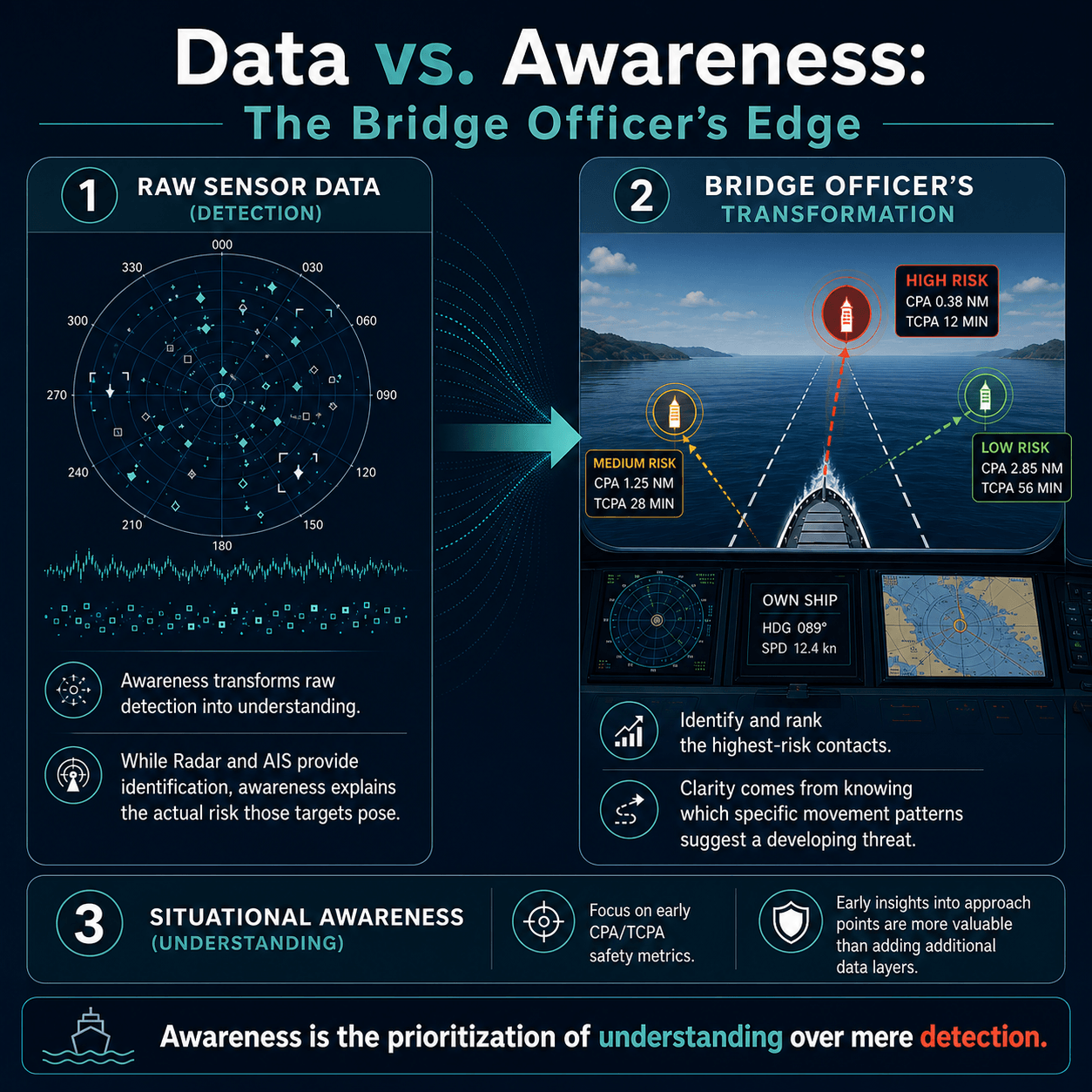
How Orca AI strengthens vessel-level awareness
Orca AI applies AI-driven detection and tracking to the same sensor inputs officers already rely on. Instead of adding another screen to monitor, it continuously analyzes motion, relative vectors, and proximity changes in the background, drawing attention to developing risk before it demands action through:
- Multi-sensor fusion (camera, thermal, radar, AIS) – Aligns what you see visually with what radar and AIS are showing, reducing cross-checking between systems.
- SeaPod automated watchkeeper – Continuously monitors the surroundings, even when attention shifts to another task or radio exchange.
- Non-AIS object detection – Identifies small craft, fishing vessels, and low-profile targets that may not be transmitting.
- Continuous target tracking – Maintains stable tracking even in glare, clutter, or traffic congestion.
- Early CPA/TCPA alerts – Surfaces tightening trends earlier before they force reactive maneuvering.
Collision risk prioritization – Highlights which contact is most likely to develop into a close-quarter situation.