October 8, 2026

Marina Drosou, Customer Enablement Specialist
Share


For young seafarers, learning to work with AI can become a practical career advantage. Understanding its output and knowing how to question it gives them more to contribute to a bridge team. How they develop that judgment deserves attention.
A skill worth teaching
Being comfortable with technology is a useful starting point. Assessing its advice in an operational setting takes training.
An officer working with AI needs to understand what information supports an output, where context may be missing and how to check it against other sources. That means comparing it with visual observations, Radar, ECDIS, AIS and approved operational information, then being able to explain the decision.
Seamanship provides the foundation for those checks. Navigation knowledge gives an officer an independent basis for assessing what a tool is saying, while responsibility remains with the officer of the watch and the master.
I think this is where AI literacy earns its place in maritime education. Young officers should have opportunities to practice that reasoning, with guidance, before they’re expected to apply it under pressure.
The academy gives cadets a framework
Maritime academies can teach how incomplete inputs affect AI outputs and why a confident answer can still be wrong. Simulator exercises give cadets a place to examine those limits.
Research from the i-MASTER project at Aboa Mare illustrates the need. An AI assessment tool performed well when judging clear parameters, such as whether students stayed on a planned route. It struggled with the wider context of more complex maneuvers.
During a Williamson turn exercise, a student could begin slightly outside a predefined time window and still complete the maneuver successfully, yet receive a low score. An instructor could consider why the student acted as they did and assess the performance more fully.
That’s a useful lesson for anyone learning to work with AI: a precise output still needs interpretation. Discussing where the assessment fell short can be as instructive as the score itself.
The mentor teaches context
An experienced officer can explain why one contact deserved attention earlier than another, or why local traffic behavior affected a decision. For a trainee encountering that situation for the first time, the reasoning matters.
A study in the WMU Journal of Maritime Affairs examined AI-generated feedback in maritime simulator training. Instructors described drawing on experience and contextual knowledge to interpret student behavior. The researchers recommended using AI feedback to inform the instructor’s judgment, with responsibility for assessing competence remaining with the instructor.
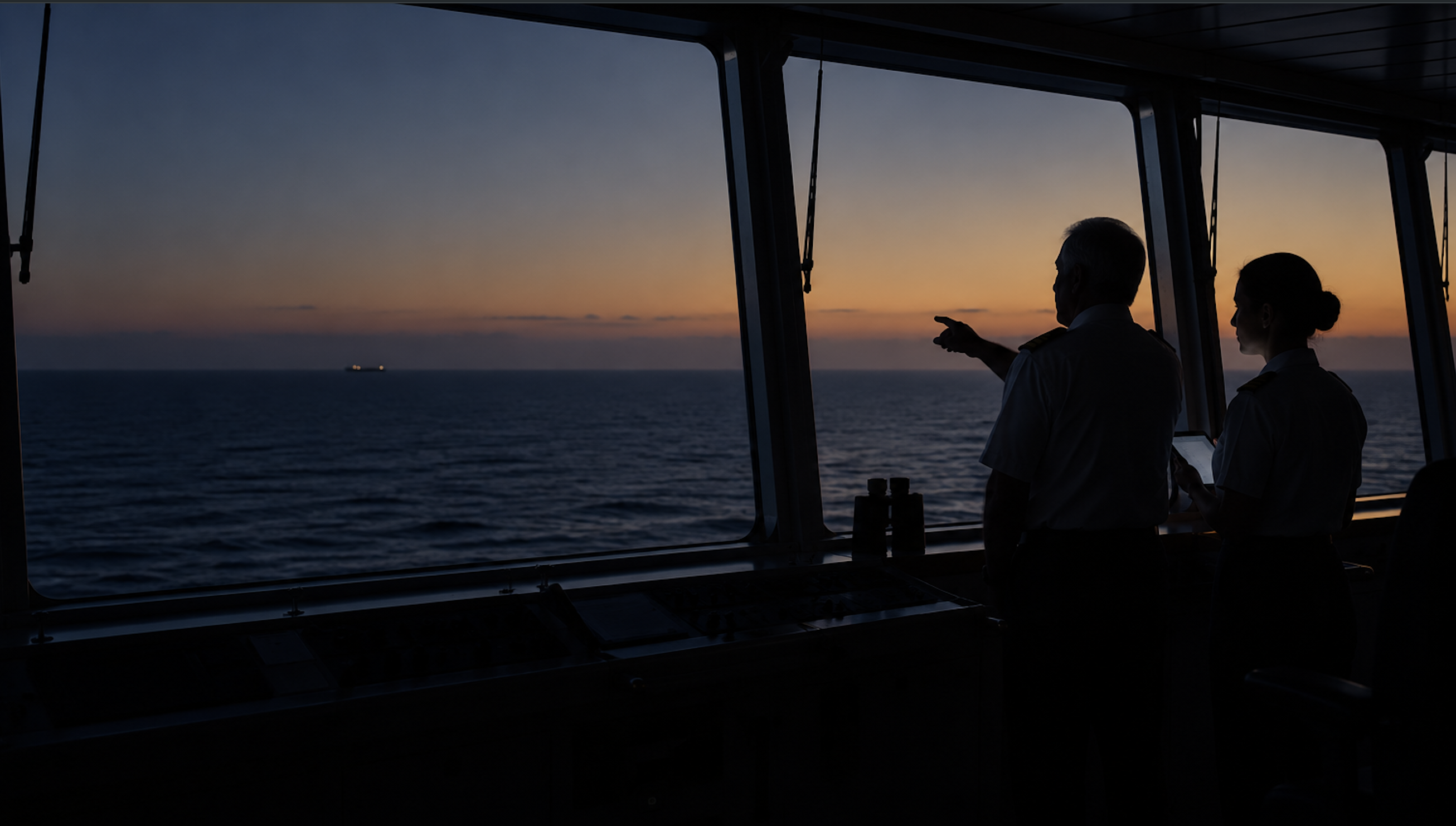
Onboard, the debrief creates room for the same exchange. What did the tool detect? What did the bridge team observe? Why did the final decision make sense?
Working through those questions helps a junior officer turn uncertainty into a clear explanation. They can learn to raise a concern, support it with evidence and listen to the experience behind another assessment.
A place in maritime training
The IMO’s comprehensive review of the STCW Convention and Code includes emerging technologies and their implications for seafarer competence. That gives the industry an opportunity to consider how AI literacy belongs in maritime education.
Academies and onboard mentors can contribute practical experience to that conversation: what trainees struggle to interpret, which checks help them assess an output, and how their judgment develops with guidance. Those lessons can help shape what future officers are taught.
Giving young officers more to contribute
For fleet operators, there’s a practical reason to invest in this learning. An officer who can explain an inconsistency gives the bridge team something specific to investigate. Their contribution becomes more useful as their technical understanding and operational judgment develop together.
That takes time for familiarization and discussion. A young officer may bring curiosity about a new tool; an experienced mentor can help them examine its usefulness in the conditions they’re facing. Both should have room to ask questions.
What interests me most is where that exchange could lead. Today’s trainee will eventually be the officer explaining a decision to someone standing their first watches. With experienced mentors helping them build judgment now, what might this generation learn to notice and question through working with AI? And what will they have to teach the seafarers who come after them?