September 23, 2026

Noemie Ifrah, Marketing & Communications Manager, Orca AI
Share


Key takeaways
- Start with a defined fleet risk and involve masters and officers in choosing what to trial.
- Assess whether the technology helps during real encounters and whether crews keep it in use.
- Agree on a baseline, event definitions and a review date before deployment.
- Present measured operating savings and modeled incident cost avoidance separately.
On December 13, 2021, Scot Carrier collided with Karin Høj near the Bornholmsgat traffic separation scheme in the Baltic Sea. The barge capsized, and both crew members died. The subsequent Marine Accident Investigation Branch investigation found that alarms capable of warning Scot Carrier’s watchkeeper of the danger had been disabled. No lookout was posted on either vessel.
For fleet operators evaluating maritime safety solutions, the case raises a difficult purchasing question: how do you know a safety investment will remain effective in daily operation?
Maritime safety solutions include the procedures, equipment and software used to reduce operational risk. When choosing vessel safety solutions, assess how well they address a fleet’s exposure, how crews use them, and whether the operator can measure a change after deployment.
That makes the investment decision an ongoing responsibility. Installation is the beginning.
Start with the risk your fleet needs to reduce
Risk-based maritime safety solutions start with a specific operational problem.
Review where close encounters occur, which situations lead to late action, and what crews report about the equipment they use. Look at the conditions around those events: traffic density, visibility, passage stage and time of day.
An overall fleet incident count gives you limited guidance on where to invest. Reviewing encounters by operating area can help you identify whether the priority is supporting detection in congested approaches, improving passage planning or addressing a recurring watchkeeping practice.
Bring masters and officers into that assessment early. Ask which alerts help them, which require repeated checking, and where the traffic picture becomes difficult to interpret. Their answers should influence both the purchasing criteria and the trial.
Write the intended improvement into the brief. “Reduce high-severity close encounters during congested transits” gives a supplier something concrete to address. It also gives your safety team an outcome to evaluate.
Keep the scope clear. A tool selected to support collision avoidance should be assessed against navigational risk. Machinery reliability, fire protection and other safety priorities need their own controls and investment decisions.
Evaluate what changes for the officer on watch
A capability list can tell you what a product does. A bridge trial should establish whether that capability helps an officer understand a developing situation and act in time.
For situational awareness solutions, assess the information presented during actual encounters:
- Can the officer identify the target that needs attention?
- Is the information clear enough to cross-check against the view outside and existing instruments?
- How much additional work does using it create?
Alert behavior deserves particular attention. In the Scot Carrier investigation, the MAIB found that disabling alarms had become routine. That makes alert configuration and continued use part of the safety assessment.
During a trial, record nuisance alerts and ask officers to explain when an alert was useful, unclear or repetitive. An acknowledgment rate alone won’t tell you whether they trust the information.
When assessing AI for maritime safety, ask suppliers to document detection limits and performance under the conditions your vessels encounter. Daylight and thermal imaging have different characteristics; avoid treating “24/7 operation” as evidence of identical detection performance in every condition.
When comparing GPS spoofing solutions, separate the capabilities being assessed. Detecting suspicious position data, maintaining visual awareness of surrounding traffic and establishing the vessel’s position are different tasks. Have the supplier explain which functions continue when an input becomes unreliable.
Build the measurement plan before the trial
To measure the return on maritime safety technology, you need an agreed starting point.
Set up the trial in four steps:
- Choose the vessels and operating areas.
- Agree on event definitions and how much usable data the assessment needs.
- Assign who will review the data and set a review date.
- Record changes in trading patterns or crew assignments that could affect the comparison.
Where possible, use the same measurement method before and after deployment. If the trial introduces automatic event detection for the first time, treat the initial recording period as a baseline-building phase. Comparing newly detected events directly with historical voluntary reports can produce a misleading result.
A compact scorecard can keep the trial focused:
| Measure | What to assess |
|---|---|
| Close encounters per 1,000 nautical miles | Whether encounter frequency changes, with traffic density and operating area considered |
| High-severity close encounters | Whether the most concerning events become less frequent under a consistent definition |
| Timing of avoidance action | Whether officers have more time to assess and respond to developing encounters |
| Event review coverage | Whether shore teams and crews are examining the events selected for review |
Review the underlying encounters alongside the numbers. A change in average passing distance needs context, including the available sea room and traffic conditions.
Treat reporting quality separately, too. More reported near misses may reflect better reporting after deployment. Investigate what changed before interpreting the increase as deteriorating safety.
Measure the ROI of maritime safety solutions in separate parts
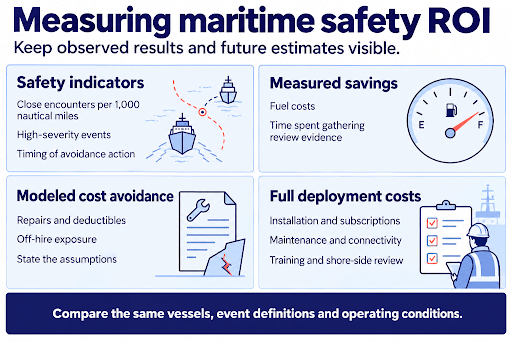
The financial case becomes clearer when you distinguish measured operating savings from estimated reductions in future loss.
Start with costs you can observe. These may include fuel consumption associated with avoidance maneuvers or time spent gathering evidence for navigational reviews. Include the full cost of deployment: installation, subscriptions, maintenance, connectivity and the time required for training and shore-side analysis.
For fuel comparisons, account for operating conditions such as speed, draft, weather and route. Otherwise, savings associated with a change in voyage conditions may be attributed to the technology.
Then assess potential incident cost avoidance. Use your fleet’s claims and operational history to model repair costs, deductibles and off-hire exposure with the relevant internal teams and insurance advisers. Label those estimates clearly and show how the result changes under different assumptions.

A reduction in close encounters supports a safety case. It doesn’t translate directly into the same percentage reduction in claims. Claims are a separate outcome, affected by incident severity, coverage and other factors.
Published customer results can help establish what to investigate. Orca AI’s March 2025 Seaspan announcement reported a 37% decrease in close encounters in an analysis of fleet performance from 2023–2024, alongside annual fuel savings of $100,000 per vessel. Those are reported results from that deployment; your business case needs its own operating assumptions and cost data.
Present measured savings and modeled cost avoidance separately. Decision-makers should be able to see which benefits have already been observed and which depend on future outcomes.
Read safety evidence beyond the headline percentage
When comparing maritime AI solutions, examine the population and period behind every result.
Ask how many vessels were included, how events were defined and whether performance was tracked over comparable operating conditions. Establish what was independently assessed and what comes from the supplier’s own analysis.
The Orca AI and NorthStandard Navigational Safety Report analyzes 139 vessels across 139 ship-years and more than 10.8 million nautical miles. It tracks each vessel’s first 12 months of AI-assisted watchkeeping and reports a 52% reduction in high-severity close encounters.
That scope helps readers assess the finding. It also defines its limits: the reported change concerns high-severity close encounters within the study population. A financial forecast for another fleet requires further assumptions.
Use the same discipline with technical assessments. Detection performance during a live trial and operational improvement over a year answer different questions. Both can inform a purchasing decision when their scope is clear.
Make event review part of daily operations
Make each safety investment part of daily maritime safety management, with a named owner after commissioning.
Agree who checks that equipment remains in use, who reviews selected events and how findings reach crews. Include familiarization for joining officers and a process for resolving recurring problems with settings or alerts.
This is where bridge support and shore-side analysis can work together. Orca AI’s SeaPod uses day and thermal cameras alongside navigation data to support target detection and assessment on the bridge. FleetView gives shore teams access to navigational events, including video and playback, for review and training.
The practical value depends on what happens next. An event review should help the crew and safety team understand the conditions, discuss the decisions taken and agree whether a change is needed.
Set a review date before expanding deployment. Assess safety performance alongside officer feedback, equipment availability and the effort required ashore. Resolve recurring issues while the trial is still small enough to manage closely.
The strongest case for expanding maritime safety solutions is evidence that the equipment stays in use, crews find it helpful, and the targeted risk is declining under comparable operating conditions.
Questions fleet operators ask before investing
How can you measure safety ROI without waiting for an accident?
Track defined risk indicators, such as high-severity close encounters, alongside measurable operating costs. Use incident and claims data over longer periods, and identify any cost-avoidance estimates as modeled benefits.
How long should a maritime safety technology trial run?
Allow enough time to capture representative voyages and routine use after familiarization. Set the trial around operating exposure and usable data, with a review date agreed before deployment.
What should a supplier provide before a fleet-wide rollout?
Request the trial methodology, operating limits, full deployment costs and support arrangements. Review the underlying safety results with crew feedback and confirm how performance will be monitored after rollout.
What should maritime safety software solutions record?
For navigational reviews, ask what encounter data the software captures, how reviewers can examine individual events, and how findings reach crews. Assess maritime safety software against the review and training tasks your team needs to carry out.
How should maritime safety systems fit into bridge routines?
Test whether officers can cross-check the information against the view outside and existing instruments. Include familiarization for joining officers, review nuisance alerts, and agree who checks that equipment remains in use.
How should operators compare AI shipping solutions?
Assess them alongside other marine operations solutions using the same fleet priorities and cost assumptions. Define the operational problem, test performance under representative conditions, and review crew feedback before expanding deployment.
What should a trial of GPS spoofing solutions establish?
Ask the supplier to distinguish detecting suspicious position data, maintaining awareness of surrounding traffic and establishing the vessel’s position. Confirm which functions continue when an input becomes unreliable and what the officer must cross-check.