January 8, 2026
Yarden Gross, Co-Founder & CEO, Orca AI
Share


The Singapore Transport Safety Investigation Bureau (TSIB) report into the July 2024 collision between the product tanker Hafnia Nile and VLCC Ceres I makes for unsettling reading precisely because of how ordinary the sequence of events was.
A second mate joins the vessel after overnight international travel. He spends his first hours onboard in handover, gets little meaningful rest and then starts a midnight watch in congested waters having had less than two hours of uninterrupted sleep over nearly 40 hours. Fire-alarm testing disrupts what little rest was possible. Administrative reports need completing and he exits the bridge to complete them. An AB is left alone on the bridge. Radar alarms are silenced or deactivated.
At the same time, an anchored VLCC detects the approaching tanker, assesses the situation as non-critical and does not initiate early communication – a missed opportunity, as the report later describes it.
Compliance is not enough
Individually, none of these details are dramatic but together, they show how little room there was for anything to go wrong. This was not a failure of technology, nor a case of blatant non-compliance. The rest hours technically met STCW requirements, the ship was properly equipped, procedures existed. On paper, the system functioned as intended.
In reality, it relied primarily on a fatigued human being to act as the final line of defence.
Crew fatigue as a structural risk
What the report exposes very clearly is the gap between compliance and cognition. Fatigue is not an edge case in shipping, it is a structural condition. Minimum crewing levels, tight port calls, overnight crew changes, administrative load and commercial pressure all combine to push alertness to its limits, especially on night watches.
When we normalise single-person bridges, muted alarms and administrative work competing with navigation, safety becomes fragile. Not because people don’t care, but because they are being asked to operate beyond sustainable human limits.
And when something finally goes wrong, the industry’s instinct is still to focus on the last decision made on the bridge. The TSIB report takes a more honest view. It shows how the conditions for failure were created long before the collision course ever developed.
The fact that individual seafarers now reportedly face criminal charges underscores what is at stake when systems rely almost entirely on human vigilance at the point of failure. Accountability matters, but accountability alone does not address the conditions that make these failures more likely in the first place.
Designing for human limits
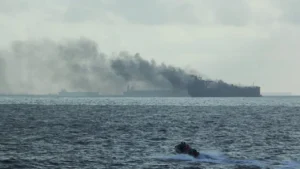
The Ceres I on fire following the collision Photo: Republic of Singapore Navy
This is where technology has a responsibility – not as a replacement for seamanship, and not as another source of distraction, but as a constant, independent layer of situational awareness that never gets tired. One that continues to monitor traffic behaviour, CPA trends and developing risk even when human attention is stretched.
In this case, the warning signs were there: converging traffic, reducing CPA and an anchored vessel ahead. But they did not surface in a way that cut through fatigue early enough to change the outcome. By the time the risk was fully perceived, recovery was no longer possible.
The report also highlights a deeper issue the industry has yet to confront fully. Safety management systems (SMS) often assume ideal conditions: rested crews, uninterrupted watches, clean handovers. Operational reality is rarely that clean. If safety frameworks don’t reflect how ships actually operate, they will continue to fall short.
This collision illustrates the consequences of operating complex vessels with minimal margins for fatigue, attention and recovery. When safety depends on a single individual maintaining perfect vigilance under imperfect conditions, the system is already exposed.
We will not improve safety by telling exhausted seafarers to be more careful. We will improve it by acknowledging human limits and building systems that support crews before those limits are breached.
This is, to my mind, not a future aspiration but a responsibility we already have.