August 6, 2026
Omar Arce, Implementation Specialist
Share


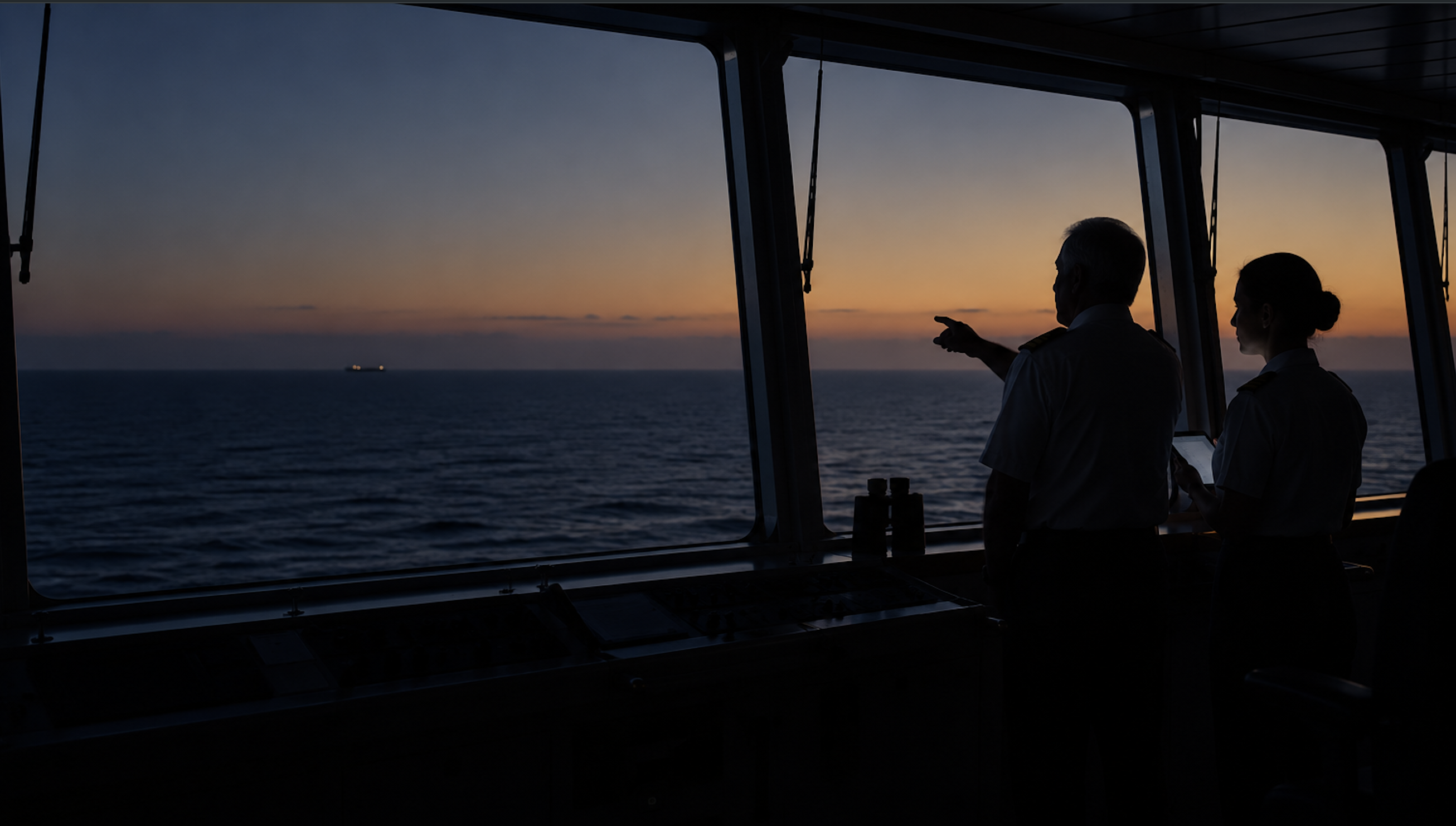
A watch rarely begins with a blank slate. You carry whatever came before it: interrupted sleep, a handover that ran long, paperwork, drills or work that continued after the previous watch ended.
By the time the traffic picture becomes demanding, the real question is how much attention you still have available.
The latest Seafarers Happiness Index reflects that pressure. The overall score fell from 7.18 to 6.87, with workload among the weakest areas. Seafarers described unreasonable watchkeeping hours and rest records that satisfy paperwork more reliably than they deliver recovery.
I read these findings as an operational signal as much as a welfare survey. They describe the condition in which people are being asked to make decisions on the bridge.
Connectivity is gaining ground at the same time. More seafarers can remain in contact with their families, and ships can exchange information with shore faster. I think these developments belong in the same conversation. The human value of that connection depends on what it gives back to the crew.
Rest on paper and rest in practice
A seafarer can meet the recorded rest-hour requirement and still arrive on the bridge tired. A scheduled rest period may include time spent trying to sleep after a demanding watch, responding to an interruption or thinking about unfinished work. On a busy ship, these small intrusions accumulate.
International Maritime Organization guidance recognizes this. Minimum rest periods were designed to prevent fatigue. They do not imply that every other hour can be filled with watchkeeping or additional duties.
The distinction is easy to understand when you have worked at sea. Ten recorded hours of rest and 10 hours of genuine recovery can feel very different!
On the bridge, that difference appears in how much mental reserve a person has left. An officer may need to follow several targets, compare radar and AIS information, maintain a visual lookout and respond to a change in the traffic picture. The professional knowledge is still there. Fatigue leaves less capacity to apply it when several things demand attention at once.
This is why seafarer happiness matters to safety. When seafarers consistently say that workload and rest are getting worse, the industry is receiving an early warning about the conditions surrounding bridge decisions.
Connectivity has changed life at sea
During my time at sea, contact with home could affect the mood of an entire week. A conversation with family gave you a sense of normal life outside the ship. Poor connectivity made the distance feel much greater.
That experience is reflected in the Happiness Index, where connectivity scored 7.65 out of 10, making it one of the Index’s strongest categories. In its Q1 2026 report, one seafarer described speaking to family as a source of relief, energy and motivation. Better internet access has reduced some of the emotional distance between seafarers and the people they care about.
Connectivity has also changed the operational relationship between ship and shore. Information can move faster. A crew can reach technical expertise without waiting for the next port, and shore teams can receive updates while a situation is still current.
A faster connection can coexist with the same heavy workload. A connected ship is easier to support, and it is easier for every shore department to contact. Operations wants an update. Safety needs clarification. Technical teams ask for more information. Each request may be reasonable on its own. The crew experiences their combined weight.
The connection can then become another source of interruption, especially when every request expects a quick response.
The disconnect between technology and operations
Having worked at sea and ashore, I have learned that installing new technology is usually the easy part. The harder work is bringing day-to-day operations and the people behind them with it.
Even good technology can sit outside the way a company actually works. I have seen onboard systems become another screen on the bridge. I have also seen capable shore-side platforms go underused because they never became part of everyday processes. The disconnect sits between technology and operations.
My view is that the learning needs to begin before new rules or industry standards force the change. Companies building practical procedures and incorporating new technology into daily operations today will be better prepared for what comes next.
That is where a good Safety Management System adds value. It turns useful ideas into consistent practice while keeping the bridge team in command of navigational decisions.
Crews tend to judge a new system through simple, practical questions. What does this add to the watch? What work does it remove? Who can see the information? What will the office expect once it is available?
Those questions are connected to fatigue. Every new screen, alert and reporting pathway competes for attention. A tool can have a sound technical purpose and still increase pressure if it creates another task for the officer of the watch.
For me, connectivity is most useful when it creates shared operational context. When the shore team can understand the sequence surrounding an event, the crew spends less time reconstructing it from memory. Support can arrive without another long call from the ship, and both sides can discuss the same situation with fewer gaps between them.
The bridge still holds responsibility for navigation. Shore support becomes more useful because it has enough context to help without repeatedly pulling attention away from the watch.
Human capacity is a connectivity metric
Bandwidth, latency and uptime tell us whether the technical connection is working. I believe the attention returned to the crew tells us whether it is working for people.
Does the connection reduce the number of times a watchkeeper has to explain the same event? Can the office build an accurate understanding from the available facts? Does information reach the right person ashore while it can still help? Does the process protect the hours meant for rest?
When operational demands follow seafarers into every scheduled rest period, connectivity carries the working day into the cabin. When information can move without another manual action from the crew, the connection begins to protect recovery.
Several years ago, while working in maritime training and quality, I wrote that a safe ship is a happy ship. I still believe that. Safety and happiness reinforce each other because both depend on people feeling supported, respected and able to do their work well.
The industry has proved that it can close the technical distance between ship and shore. Its next measure is the human capacity that connection returns. A connected ship earns its value when the crew can feel the difference during the watch and during the hours meant for rest.