June 20, 2025

Yarden Gross, Co-Founder & CEO, Orca AI
Share


The recent collision between the tankers Front Eagle and the Adalynn in the Strait of Hormuz is more than a tragic incident – it’s a stark warning to the maritime industry. Both vessels were operating in an area reportedly impacted by intense satellite jamming and AIS spoofing in the days leading up to the crash. The Adalynn is allegedly part of the so-called ‘dark fleet’ — a loosely connected group of tankers that operate without AIS transponders, often to obscure their movements and evade sanctions. Meanwhile, the VLCC Front Eagle was apparently shown in vessel tracking data to be onshore in Iran two days before the collision, in a strong indication of GPS interference.
This event illustrates just how fragile maritime situational awareness has become in high-risk regions. The digital infrastructure we’ve long relied on – GPS, AIS and electronic charts – is increasingly vulnerable to manipulation, especially in geopolitically tense chokepoints like the Strait of Hormuz. Bridge crews are being asked to navigate in a kind of digital fog, where position data can be corrupted, nearby ships may be invisible by design and critical seconds for decision-making are lost to uncertainty.
We cannot continue to expect human watchkeepers to bear that burden alone.
It’s time to rethink navigation resilience. AI-powered situational awareness systems, especially those based on computer vision, offer a critical second layer of perception. These tools can detect, classify and track vessels (and other objects) in real time, regardless of whether they are transmitting AIS or whether GPS is functioning accurately. They act as a digital co-pilot, alerting the crew to nearby threats and enabling faster, more confident decisions even when traditional tools fail.
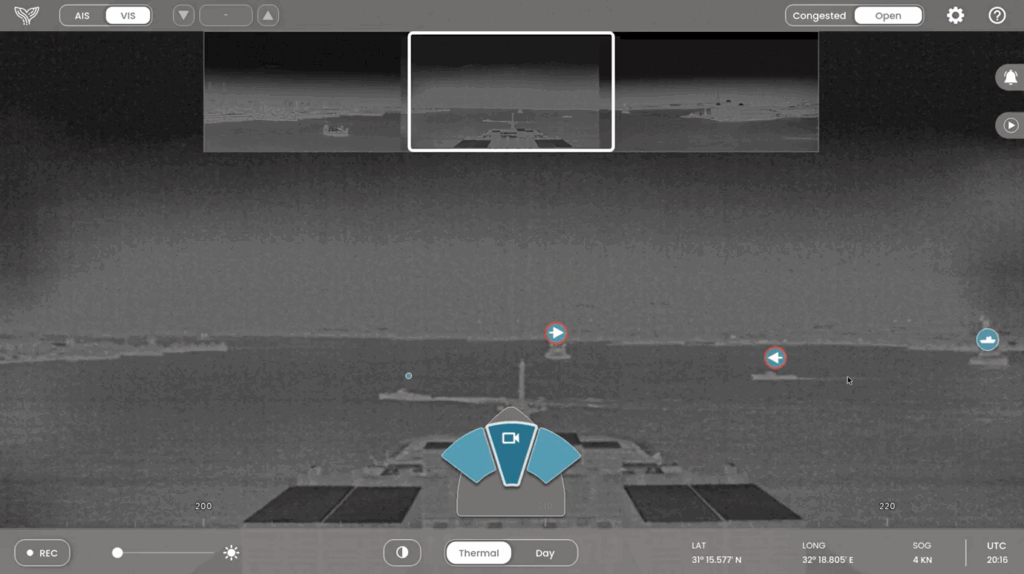
Radar, of course, remains the primary and most trusted anti-collision tool, and its importance cannot be overstated. In fact, when AIS and GPS are degraded, Radar often becomes the only reliable means of detecting surrounding traffic. But even Radar has limitations: interpreting Radar returns can be challenging in heavy-trafficked waterways, small targets may be lost in noise and there is no automatic identification. This is where advanced technologies like AI-powered situational awareness based on highly sensitive computer vision can play a vital supporting role.
These systems offer a second layer of perception, working in parallel with Radar to detect, classify and track vessels and obstacles in real time, regardless of whether AIS and/or GPS are functioning.
According to tracking data reconstructions, the Front Eagle made a sharp starboard turn just before the collision. In that kind of moment – when an unreported or unidentified vessel suddenly emerges in close quarters – the value of a redundant, independent perception system becomes obvious. Computer vision sees what’s physically there, not what compromised data might suggest.
This isn’t about replacing Radar or human vigilance – it’s about strengthening both. In areas where spoofing and jamming are increasingly common, and where there is dark-fleet activity more specifically, AI and computer vision can serve as a vital safeguard to detect the undetectable, confirm the uncertain and ensure crews remain situationally aware when traditional inputs are in doubt.
We’ve long accepted redundancy in mechanical systems as a maritime safety principle. We double up critical systems, train for worst-case scenarios and insist on backup plans. It’s time to apply the same logic to navigational awareness. Because when the digital map becomes unreliable – when GPS falters and AIS goes dark — the ship still moves forward. And what’s needed then is intelligent vision that helps bridge navigators see, and take appropriate action, with clarity.
This article was originally published on Ajot.
Questions and Answers:
Why is it difficult to attribute an incident solely to GPS interference?
Maritime incidents typically result from a combination of factors, including human decision making, environmental conditions, traffic density, and technical inputs. GPS interference often acts as a contributing factor rather than the sole cause of an incident. This complicates investigations and creates gray areas in incident analysis and insurance claims, particularly when determining whether malicious intent was involved.
Are there insurance solutions specifically designed for cyber related maritime risks?
Yes. Some insurers offer cyber buybacks or standalone marine cyber policies that provide affirmative coverage for cyber related losses, including malicious electronic interference and third party errors. These solutions are intended to address gaps created by cyber exclusions in traditional marine policies, but they require careful review to ensure alignment with a vessel’s operational risk profile and trading patterns.
How widespread is GPS jamming at a global fleet level, based on recent data?
Recent maritime intelligence indicates that GPS interference has evolved into a systemic operational risk. Analysis from Windward shows that approximately 38,500 vessels were affected by GPS jamming between April 1 and November 30. At this scale, GPS disruption should be treated as a recurring navigational risk factor in voyage planning, rather than as an isolated or exceptional event.
What do recent high profile incidents indicate about the operational severity of GPS interference?
Several significant incidents in 2024 have been linked to GPS spoofing or jamming, including the grounding of the large containership MSC Antonia near the Red Sea in May, a collision between two tankers near the Strait of Hormuz in June, and an oil tanker seized off the coast of Venezuela in December that was broadcasting a false location. These events, spanning multiple vessel classes and regions, demonstrate that GPS interference can materially contribute to high consequence navigational failures across global trade lanes.