



AI Navigation
What does AI Navigation mean in maritime operations?
Key Takeaways:
- AI (Artificial Intelligence) navigation turns existing bridge data into earlier risk awareness. By analyzing inputs from radar, AIS, GNSS, charts, and environmental data together, machine-learning models help interpret vessel trajectories, traffic patterns, and relative motion, allowing bridge teams to detect developing collision risks sooner.
- The technology supports navigation decisions rather than replacing them. AN AI navigation system acts as decision-support tools that help crews monitor multiple targets, assess CPA and TCPA trends, and interpret traffic flow in congested areas such as traffic separation schemes and port approaches.
- AI navigation relies on sensor fusion and pattern recognition. By analyzing large volumes of vessel movement data, AI models can identify trajectory trends, detect abnormal vessel behavior, forecast traffic density, and surface navigational risks that may otherwise be difficult to detect.
- Orca AI applies AI Navigation directly to vessel operations and fleet learning. Its SeaPod system combines optical and thermal cameras with bridge sensors to detect and track vessels and objects – including non-AIS targets – while surfacing collision-risk indicators such as CPA and TCPA. FleetView, MasterView, and Co-Captain extend this awareness across ship and shore.
What is AI Navigation?
AI navigation refers to the application of machine learning, computer vision, and sensor fusion to navigational data in order to interpret vessel traffic, relative motion, and environmental conditions. In maritime operations, the term generally refers to systems that analyze inputs from bridge sensors, such as AIS, radar, GNSS, electronic charts, and weather data, to detect traffic patterns and highlight developing navigational risks.
By learning from large volumes of historical vessel movement and traffic behavior, AI-assisted navigation can recognize trajectory trends and support earlier interpretation of complex traffic situations. These capabilities can contribute to safer navigation, improved voyage efficiency, and more optimized fuel use across maritime operations.
What navigational tasks can AI support?
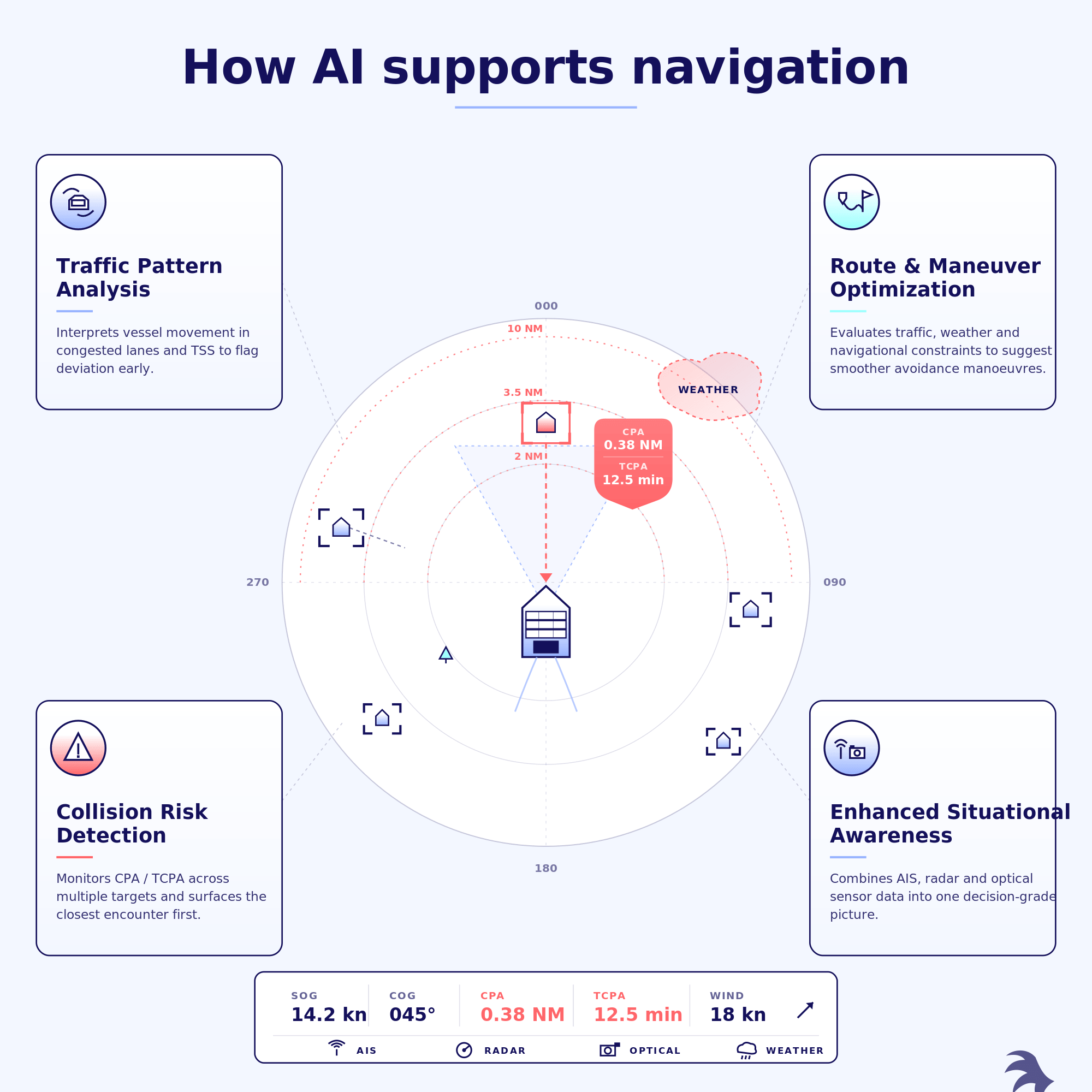
- Traffic behavior analysis, particularly in congested shipping lanes, traffic separation schemes (TSS), and port approaches, where multiple vessels are maneuvering simultaneously. AI models can analyze vessel trajectories and historical traffic patterns to identify typical flow behavior and highlight movements that deviate from expected traffic dynamics.
- Collision risk assessment through continuous evaluation of vessel trajectories, speed, and relative motion. By monitoring Closest Point of Approach (CPA) and Time to Closest Point of Approach (TCPA) development across multiple targets simultaneously, AI systems can flag developing close-quarters situations earlier than the threshold-based CPA alarms generated by Electronic Chart Display and Information Systems (ECDIS) and Automatic Radar Plotting Aid (ARPA) radar.
- Route and maneuver planning support by evaluating traffic density, weather conditions, currents, and navigational constraints along a planned route. In some cases, AI models can suggest safer or more efficient routing alternatives based on historical traffic behavior and environmental conditions.
- Situational awareness enhancement through the integration and interpretation of multiple sensor inputs, such as AIS, radar, and optical systems. By correlating these data streams and prioritizing targets by threat level and proximity, AI systems can help crews maintain a clearer picture of surrounding vessel activity and potential hazards.
How does AI navigation work?
AI navigation systems combine data from multiple bridge sensors and external sources to interpret the vessel’s operating environment. While the underlying algorithms can be complex, the operational logic typically follows three main steps: collecting navigational data, analyzing vessel behavior and environmental conditions, and presenting insights that support decision-making on the bridge.
Sensor and data inputs
Instead of replacing existing equipment, the AI navigation system aggregates and analyzes inputs from multiple sources to build a unified picture of the vessel’s operating environment, including:
- Radar targets, which provide range, bearing, and movement data for nearby vessels and objects
- AIS transmissions, supplying identity, position, course, speed, and voyage information for vessels broadcasting AIS data
- Optical or infrared cameras, which can support visual detection of vessels, small craft, or floating objects
- GNSS positioning data, providing continuous information about the vessel’s own position, speed, and course over ground
- Weather and oceanographic data, including wind, visibility, currents, and sea state
- Electronic chart data from ECDIS, which provides geographic context such as traffic separation schemes, restricted areas, and navigational hazards
AI models combine these inputs through a process often described as sensor fusion, creating a machine-interpreted view of the surrounding environment that integrates information from multiple systems simultaneously.
Data processing and pattern recognition
Once these inputs are combined, AI models analyze vessel behavior and environmental conditions in order to detect patterns and assess developing situations based on:
- Vessel trajectories and course development
- Relative motion between nearby vessels
- Maneuvering behavior in different traffic environments
- Environmental conditions that may affect navigation
Examples include:
- Identifying vessels on potential collision or close-quarters courses based on trajectory development
- Detecting abnormal or unexpected vessel behavior, such as sudden course changes or unusual speeds
- Forecasting traffic density along a planned route, particularly in congested corridors or port approaches
The goal isn’t to predict every maneuver, but to highlight developing situations that may require closer attention from the bridge team. By surfacing potential risks earlier, these systems can also help reduce the likelihood of human error when crews are interpreting multiple targets and rapidly evolving traffic situations.
Decision support and recommendations
The final stage of the process is presenting the analysis in a way that supports practical decision-making during navigation. In this context, an AI navigator functions as a decision-support layer that interprets vessel traffic patterns and risk indicators while leaving navigational authority with the bridge team. Depending on the system design, outputs may include:
- Collision risk alerts based on evolving vessel trajectories and CPA/TCPA development
- Suggested course or speed adjustments intended to reduce collision risk or improve traffic separation
- Route optimization insights based on traffic patterns, weather conditions, and navigational constraints
- Early warnings about navigational hazards, such as dense traffic zones or complex maneuvering environments
These outputs are intended to assist situational awareness rather than automate vessel control. Responsibility for navigation remains with the bridge team, and all maneuvering decisions must still be made in accordance with seamanship practices and the International Regulations for Preventing Collisions at Sea (COLREGs).
How does AI navigation relate to autonomous shipping?
The IMO’s MASS (Maritime Autonomous Surface Ships) Code defines four levels of autonomy, providing a formal regulatory structure for how the industry is progressing toward fully autonomous vessel operation. AI navigation sits at the entry point of this spectrum( already commercially deployed today) and provides the foundational capabilities on which higher levels of autonomy are built.
| MASS Level | Description | Human Role | Where AI Navigation Fits |
|---|---|---|---|
| Level 1 | Automated processes and decision support with crew on board | Crew in full control | AI provides analytical support, AI-assisted watchkeeping, collision risk detection, situational awareness. Operational today |
| Level 2 | Remotely controlled with crew on board | Crew present but supported by remote operators | Advanced sensor fusion, reduced bridge workload, remote monitoring integration |
| Level 3 | Remotely controlled without crew on board | Shore-based operators manage navigation | AI handles real-time decisions, remote operators intervene as needed |
| Level 4 | Fully autonomous operation | No human intervention required | Full autonomous navigation, collision avoidance, and route execution |
What are the benefits of AI-powered navigation?
- Earlier visibility of collision risk. Continuous analysis of vessel trajectories, speed, and relative motion allows developing close-quarters situations to become visible earlier. Instead of reacting only when CPA or TCPA alarms trigger, bridge teams can see how traffic situations are evolving and identify vessels that may become problematic well before the encounter reaches a critical stage.
- Clearer interpretation of complex traffic environments. Dense shipping corridors, port approaches, and traffic separation schemes often involve dozens of vessels moving at different speeds and courses. AI-based traffic analysis can highlight patterns within that flow, such as typical traffic lanes, merging behavior, or irregular vessel movements, helping crews understand the broader traffic picture rather than focusing only on individual targets.
- Reduced cognitive workload on the bridge team. Modern bridge operations require constant monitoring of radar, AIS, charts, weather, and surrounding traffic. When multiple alerts and targets demand attention simultaneously, the workload can quickly escalate. Tools that help prioritize relevant information can ease that burden and help manage crew fatigue, particularly during long watches or in congested waters.
- More coherent interpretation of sensor data. Radar, AIS, cameras, and chart systems each provide their own view of the navigational environment. AI systems can correlate these inputs and present a more unified interpretation of what is happening around the vessel, helping crews reconcile differences between sensor readings and maintain a clearer situational picture.
- Support for more efficient voyage execution. Traffic conditions, weather systems, and ocean currents all influence how a voyage unfolds in practice. AI-based analysis can help highlight routing options or traffic conditions that may affect efficiency, supporting decisions that reduce unnecessary maneuvering, delays, or fuel consumption.
How does Orca AI apply AI navigation in commercial vessel operations?
Orca AI advances AI navigation by embedding real-time risk awareness directly into how vessels plan, execute, and adjust their routes. Orca AI’s onboard digital watchkeeper, the SeaPod system combines optical and thermal cameras with standard bridge sensors, including AIS, radar, GPS, gyro, depth, and wind data, to detect, track, and classify surrounding targets, including non-AIS objects. These inputs are used to continuously surface collision-risk indicators such as CPA and TCPA during navigation and support several operational improvements, such as:
- Safer route execution, with continuous monitoring of surrounding traffic and early identification of developing collision risks so crews can adjust course or speed in a controlled manner.
- Reduced reactive maneuvering, as emerging risk trends are surfaced before situations escalate, allowing vessels to maintain planned tracks rather than making last-minute deviations.
- Clearer maneuvering decisions in congested or restricted waters, by highlighting which targets require action and which do not.
- More stable navigation, helping crews manage speed and course changes more smoothly and reducing the likelihood of close-quarters situations.
Beyond the bridge, Orca AI extends AI navigation to fleet-level learning. FleetView allows fleet operators to review encounter handling and route execution across all vessels in their fleet, while MasterView gives Masters structured visibility into navigational events and vessel handling patterns at the individual ship level. Through Co-Captain, verified route-relevant alerts are shared across all Orca AI-equipped vessels globally, extending situational awareness beyond any single ship’s sensor range.