



Maritime Training
Building Safer, Smarter Crews Through Maritime Training
Key takeaways
- Maritime training is the certification, drills, and day-to-day instruction that qualify seafarers to run a vessel safely, from STCW basic safety courses to a fleet’s own bridge procedures.
- The IMO’s STCW Code sets the floor, not the ceiling. Every certified seafarer meets the same minimum standard, but the quality of maritime training still varies by flag state, training provider, and company.
- Training gaps show up as risks. EMSA ties the human element to most investigated marine casualties, and the industry is short tens of thousands of certified officers.
- Orca AI supports maritime crew training by turning a vessel’s own navigational events into structured review, so bridge teams learn from real watches, not only simulators.
What is maritime training?
Maritime training is the combination of certification, drills, and ongoing instruction that prepares seafarers to operate a vessel safely and in line with international law. The baseline is set by the International Maritime Organization’s STCW Convention, first adopted in 1978, which defines the minimum competence every certified officer and rating must demonstrate.
Fleets then build their own crew training programs on top of that baseline, covering ship-specific procedures, company standards, and lessons pulled from their own operations. STCW covers officers and ratings on internationally trading ships; it doesn’t extend to shore-based logistics or port roles, which fall under separate national frameworks. A large tanker or container fleet, for instance, layers vessel-type endorsements and company-specific bridge procedures on top of the STCW minimum, since a VLCC transit through the Strait of Hormuz asks more of an officer than the certificate alone covers.
Why does quality maritime training matter for shipping safety?
Quality maritime training matters because most investigated marine casualties involve the human element in some way. According to EMSA, the human element was present in 78.8% of marine casualties and incidents investigated across EU member states from 2015 to 2024, either as a direct action (64.5%) or a contributing factor (50.5%).
That doesn’t mean crews are careless. It means the conditions officers work in, fatigue after a string of port calls, degraded visibility, a cluttered radar picture in a crossing situation, are exactly what training has to prepare them for. A course that only covers procedures on paper leaves a gap between what an officer knows and what they can do at 03:00 in a busy anchorage.
What are the main types of maritime training?
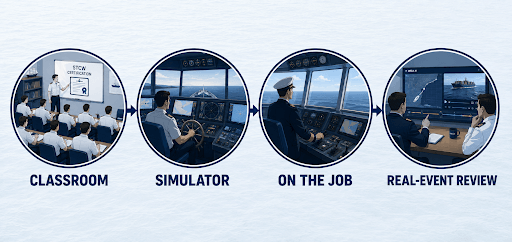
Maritime professional training isn’t one thing. It spans certification, safety, security, and hands-on practice, and each covers different ground.
STCW certification and basic safety training
- STCW basic safety training is the mandatory floor for anyone serving on an internationally trading vessel. It covers personal survival techniques, fire prevention and firefighting, elementary first aid, and personal safety and social responsibilities.
- The 2026 update. As of 1 January 2026, that last course also covers preventing and responding to violence and harassment onboard, following an IMO amendment approved in 2024.
Maritime safety training and emergency response
- Maritime safety training goes beyond the STCW basic course into ship-specific and role-specific emergency response: advanced firefighting, survival craft and rescue boats, medical care, and enclosed space entry and rescue.
Maritime security training
- Maritime security training covers the ISPS Code: recognizing security threats, understanding a ship’s security plan, and knowing a crew member’s specific duties during a security incident or port state inspection.
Simulator and on-the-job training
- Simulator training lets officers practice bridge and engine room handling under realistic, repeatable conditions before they face the same situation at sea.
- Cadetship and on-the-job training add supervised sea time, the practical counterpart to classroom instruction.
Tanker, gas, and cargo-specific training
- Vessel-type endorsements sit on top of the STCW baseline for crews handling oil, chemical, or liquefied gas cargoes, covering cargo handling, inert gas systems, and the specific hazards of that cargo type.
- Company-specific familiarization covers the particular bridge layout, equipment, and procedures of the vessel a seafarer is joining, since STCW certification confirms competence in general, not on that specific ship.
| Training type | Focus | Typical setting |
|---|---|---|
| STCW certification | Baseline competence for a certificate of competency | Approved training center, exam |
| Safety and emergency drills | Firefighting, survival craft, medical response | Classroom and physical drill |
| Security training | ISPS Code compliance, threat recognition | Classroom, port facility briefing |
| Simulator training | Bridge and engine handling under realistic conditions | Simulator center, cadetship |
| Data-driven post-voyage review | Learning from the vessel’s own navigational events | Onboard and shore debrief |
Naval training vs. commercial maritime training
Naval training follows a different track. Navies train personnel under military doctrine and command structure rather than the STCW framework, and the focus extends to combat readiness alongside seamanship. This space sits under defense and government rather than commercial crew training, though the underlying need, building confident, well-prepared watchkeepers, carries across both.
Who provides maritime crew training?
Maritime crew training comes from several sources working together. Flag state administrations set and enforce the STCW requirements for ships under their registry. Maritime education and training (MET) institutes and academies deliver the certified coursework. Classification societies such as DNV, Lloyd’s Register, and ClassNK audit training records as part of vessel and company certification. And shipping companies run their own onboard and shore-based programs on top of the STCW minimum, often shaped by their fleet’s specific trades and incident history.
Private training providers and maritime academies increasingly deliver this mix through blended learning, e-learning modules paired with in-person simulator or drill sessions, so a fleet spread across several flag states can hold everyone to the same standard.
How often does seafarer training need to be renewed?
STCW certificates of competency require revalidation, typically every five years, alongside proof of recent sea service or refresher training. Beyond that formal cycle, most companies run familiarization and refresher training whenever a seafarer joins a new vessel, trade route, or piece of equipment.
What’s changing in maritime training and education?
Maritime professional training and education faces a supply problem before it faces a technology one. The Seafarer Workforce Report 2026 from BIMCO and the International Chamber of Shipping estimates a 2026 shortage of 39,100 STCW certified officers, with demand for certified seafarers up 35% since the previous report in 2021. To close that gap by 2030, the report estimates the industry needs 113,735 additional officers.
Training providers are responding with more simulator capacity and shorter, more targeted refresher courses. But the harder problem is depth of experience: a newly certified officer meets the STCW standard on paper, without necessarily having handled a foggy port approach or a GNSS outage. That’s one reason a growing number of fleets are turning to their own voyage data, reviewing real navigational events instead of relying only on generic simulator scenarios.
The certification process itself is also changing. Under IMO amendments MSC.540(107) and MSC.541(107), in effect since January 2025, maritime administrations can issue fully digital STCW certificates, and from 2026 new or revalidated certificates increasingly carry a QR code for instant verification instead of a paper document. It’s a smaller shift than the workforce gap, but it points the same direction: less time spent proving training happened, more spent on the training itself.
How Orca AI supports maritime crew training
Orca AI’s role in maritime crew training starts after the STCW course and the simulator session, with the vessel’s own voyage. SeaPod records synchronized video, vessel tracks, timelines, and sensor data for navigational events, then FleetView lets shore teams and instructors turn that record into structured review.
- Real-event replay. Officers return to the exact point a target became relevant and examine what the bridge team saw and the options available at that time, rather than relying on memory or a written report.
- COLREGs-context debriefs. Reviews analyze passing distance, encounter geometry, and COLREG context, so a discussion can focus on whether an action was early, clear, and consistent with the rules, not just whether the outcome was safe.
- Bridging the experience gap. Junior officers get exposure to encounter types they haven’t faced personally, while senior officers get a concrete case to teach from instead of a hypothetical one.
- Fleet-wide pattern review. Training teams can group events by vessel, crew shift, route, congestion, passing distance, and severity to see where a fleet’s training needs actually sit.
- Fleet audits and safety scoring. FleetView aggregates reviewed events into safety scores and trends across vessels, so operations teams can spot which ships or crews would benefit from focused coaching.
- In the published TMS Cardiff Gas and Ionic case studies, real-event coaching has been linked to earlier decisions, fewer close encounters, and wider passing distances on later voyages.
Here I’d insert this testimonial:
Orca AI doesn’t replace STCW certification, simulator training, or a company’s classroom program. It adds the part those methods can’t fully cover: structured human-centric maritime training learning from what a fleet’s own crews actually did at sea.