



Watchkeeper
Watchkeeper duties, STCW requirements, and how bridge watchkeeping works at sea
Key takeaways
- The watchkeeper is the master’s representative on the bridge. STCW Code section A-VIII/2 makes the officer in charge of the navigational watch primarily responsible at all times for the safe navigation of the ship and for complying with COLREGs.
- The bridge is never left unattended. The officer of the watch must “in no circumstances leave the bridge until properly relieved.”
- Sole lookout is a daylight provision with three conditions attached, and assistance must be immediately available to be summoned to the bridge.
- Orca AI runs continuous digital watchkeeping alongside the officer of the watch. SeaPod detects and tracks in parallel with the watch. The OOW stays in command.
What is a watchkeeper?
A watchkeeper is a certificated officer or rating responsible for maintaining a continuous watch on a ship’s bridge, in its engine room, or in port. On the bridge, the officer in charge of the navigational watch is the master’s representative and is primarily responsible for the safe navigation of the ship and for compliance with the International Regulations for Preventing Collisions at Sea, 1972, as amended.
The duty is continuous by design. A ship at sea has someone accountable for what is happening around it every minute of every day, and the handover between watches is the point at which that accountability transfers. Orca AI’s SeaPod was built as a digital watchkeeping layer that supports the officer holding that responsibility, which is why the term matters to us beyond its dictionary meaning.
What are the duties of the officer of the watch?
STCW Code section A-VIII/2, part 4-1, sets out bridge watchkeeping duties in detail. The core provisions read as follows.

- Primary responsibility. Paragraph 13: the OOW “is the master’s representative and is primarily responsible at all times for the safe navigation of the ship and for complying with the International Regulations for Preventing Collisions at Sea, 1972, as amended.”
- Continuous presence. Paragraph 18.1: “at no time shall the bridge be left unattended.” Paragraph 24.2 puts it on the individual: the OOW shall “in no circumstances leave the bridge until properly relieved.”
- Undivided attention for the lookout. Paragraph 15: “The lookout must be able to give full attention to the keeping of a proper lookout and no other duties shall be undertaken or assigned which could interfere with that task.”
- No competing tasks. Paragraph 27 requires that the OOW not be assigned or undertake any duties that would interfere with the safe navigation of the ship.
- Short absences only. Paragraph 32 permits chartroom visits “when essential, for a short period.”
At Convention level, Regulation VIII/2 paragraph 2.1 is the cleanest statement of the principle: officers of the navigational watch “shall be physically present on the navigating bridge or in a directly associated location such as the chartroom or bridge control room at all times.”
Layered on top of STCW is COLREGs Rule 5:
“Every vessel shall at all times maintain a proper look-out by sight and hearing as well as by all available means appropriate in the prevailing circumstances and conditions so as to make a full appraisal of the situation and of the risk of collision.”
“All available means” pulls Radar, AIS, ARPA and any other detection capability on board into the scope of the duty.
When can a watchkeeper act as sole lookout?
Only in daylight, and only when three conditions are met.
STCW Code A-VIII/2 paragraph 16 permits the OOW to be the sole lookout in daylight provided that:
- the situation has been carefully assessed and it has been established without doubt that it is safe to do so;
- full account has been taken of all relevant factors, including the state of weather, visibility, traffic density, proximity of dangers to navigation, and the attention necessary when navigating in or near a traffic separation scheme; and
- assistance is immediately available to be summoned to the bridge when any change in the situation so requires.
Note the bar condition 3 sets. Assistance has to be summonable to the bridge the moment the situation changes.
The night position follows structurally. Sole lookout is permitted “in daylight,” so a dedicated lookout is required during darkness. UK flag guidance goes further, and the MAIB’s 2023 recommendation to the Maritime and Coastguard Agency asked it to advise industry that posting a lookout in addition to a bridge watchkeeper during darkness and restricted visibility is an absolute requirement on UK ships. The MAIB’s own finding was that “the language used in MCA guidance detracts from the absolute requirement for a dedicated lookout.”
What are the principles of watchkeeping?
Navigational watchkeeping runs on a small number of repeating disciplines.
| Element | What it means in practice |
|---|---|
| Continuous manning | Someone is always accountable. The bridge is never unattended. |
| Formal handover | The relieving officer confirms position, traffic, conditions and standing orders, and takes over only when satisfied. |
| Master’s standing orders | Written instructions setting the conditions under which the master must be called. Calling the master is never a failure. |
| Rest hours | STCW requires a minimum of 10 hours of rest in any 24-hour period and 77 hours in any 7 days. |
| Proper lookout | Sight, hearing, and all available means. A dedicated lookout at night. |
| Position monitoring | Cross-checked by more than one method, so a single failed source does not become a wrong position. |
That rest hours row carries real operational weight. The MAIB calculated that an officer on a 6-on/6-off rotation spends 84 hours on watch in a seven-day period, and adding the required 77 hours of rest leaves 7 hours, an hour a day, for everything else the job involves. Watchkeeping quality and crew fatigue are the same subject viewed from two angles.
How does watchkeeping in port differ from watchkeeping at sea?
The hazards change, and the watch changes with them.
At sea, the navigational watch is about traffic, position and the conduct of the vessel. In port, the deck watch covers cargo operations, mooring line tension as the tide changes, draft and stability, gangway security, bunkering, shore access, and the readiness of firefighting and pollution response equipment.
Two things carry across. The watch is still continuous, and the officer on it is still the master’s representative. What often does not carry across is rest, because port workload lands on the same officers who keep the sea watch. Pilotage, cargo operations, inspections and audits stack on top of the watch rotation rather than replacing it, which is why short-sea trades with frequent port calls produce the most disrupted sleep patterns.
Why is watchkeeping at sea important?
Because when it fails, the failure mode is a ship running into something with nobody watching.
The MAIB’s Bridge Watchkeeping Safety Study examined 66 accidents involving 75 vessels.
- Two thirds of the vessels involved in collisions were not keeping a proper lookout.
- A third of all groundings involved a fatigued officer alone on the bridge at night.
- In the eight fatigue-related night groundings it identified, no lookout was posted, the autopilot was engaged, the watch alarm was not fitted or not used, and the watchkeeper had fallen asleep. All eight carried only two bridge watchkeeping officers.
The Scot Carrier and Karin Høj collision of 13 December 2021 shows the same pattern with more recent equipment. Two crew died. Neither vessel had posted a lookout during darkness. Scot Carrier’s deck logbook recorded lookouts that were never there. The second officer had consumed alcohol before taking the watch and spent it on a personal tablet computer. Every alarm that could have warned him was disabled, because the navigation officers routinely turned off the ECDIS look-ahead, Radar and AIS alarms as a matter of practice. AIS registered the other vessel as a dangerous target 24 minutes before impact, at a closest point of approach of 0.88nm. No audible alert sounded. We covered the case in more depth in our post on the night-time collision in the Danish straits.
The MAIB’s systemic finding is the one that generalizes: the tablet “was just the last of many safety barriers to be routinely disabled or negated on Scot Carrier, none of which had been detected during audits.”
By July 2025 the MAIB’s Annual Report was arguing for a change of approach. Chief Inspector Captain Andrew Moll wrote that recent casualties “indicate a need to radically rethink the role of human watchkeepers in the digital age. Humans do not make good monitors and if under-stimulated they will find other things to occupy themselves.”
His next sentence is the one that keeps the argument honest: crews can also be reluctant to use the system functions that would alert them to impending problems.
What technology supports the watchkeeper?
Every bridge already carries a stack of watchkeeping aids. The question is whether the officer trusts them enough to leave them switched on.
The bridge navigational watch alarm system (BNWAS) is the most directly watch-focused of them. SOLAS Regulation V/19.2.2.3, inserted by Resolution MSC.282(86), phased in carriage from 2011 for cargo ships of 150gt and upward and for passenger ships irrespective of size. Resolution MSC.350(92) later extended it to ships built before July 2002, with the last retrofit dates running to 2018. The regulation states that the BNWAS “shall be in operation whenever the ship is underway at sea.” Performance standards sit in Resolution MSC.128(75).
| Stage | Timing | What happens |
|---|---|---|
| Dormant period | 3 to 12 minutes, set by the master | No indication. The watchkeeper works normally. |
| Visual indication | End of dormant period | Visual prompt on the bridge |
| First stage audible alarm | +15 seconds | Audible alarm on the bridge |
| Second stage | +15 seconds | Alarm to the back-up officer and the master |
| Third stage | +90 to 180 seconds | Alarm to further crew members |
The standard also requires that reset devices be impossible to operate from anywhere outside areas of the bridge that provide a proper lookout, that holding a reset down does not prolong the dormant period, and that the choice of operating mode and the length of the dormant period be protected from unauthorized access, so that only the master can change them. Casualty reports keep finding it switched off anyway.
ECDIS, Radar and ARPA carry alarm functions that overlap. When a bridge produces more alerts than a person can act on, silencing them becomes the rational response, and that is how a fully equipped bridge ends up with no working warning at all. We wrote about why alarm overload has crossed from nuisance to safety risk.
A digital maritime watchkeeper describes a different approach: continuous machine observation of the water around the vessel, running alongside the officer rather than issuing more alarms into the same stream. Detection is continuous, alerting is selective.
Regulation is moving, slowly. The IMO adopted the MASS Code at MSC 111 in May 2026 as resolution MSC.595(111). It is non-mandatory, took effect on 1 July 2026, applies to cargo ships covered by SOLAS Chapter I, and is goal-based and technology-neutral. Member States are encouraged to apply it as far as practicable to smaller MASS. A mandatory Code is targeted for adoption by mid-2030, with entry into force on 1 January 2032 at the earliest, and MSC 111 acknowledged that timeline may need revisiting. Under the Code a human master remains responsible for the ship and must have the ability to intervene, whether or not they are on board. No STCW amendments for autonomous shipping have been adopted, so the certificated officer keeping the watch remains the legal baseline.
How Orca AI supports the watchkeeper
Orca AI adds an observation layer to the bridge. The officer of the watch keeps the watch, the master stays in command, and Radar, AIS and ECDIS keep doing what they do. What changes is that something is looking at the water continuously and without getting bored.
- Detection that holds through the night watch. SeaPod is Orca AI’s digital 360 FOV watchkeeper that never sleeps. combines day and thermal cameras with mandatory ship sensors, including AIS, Radar, GPS, gyro, depth and wind. It detects, tracks and classifies targets that carry no AIS, and derives CPA, TCPA, COG and SOG. Its performance at 0400 matches its performance at 1400, which is the specific thing a human watch cannot promise.
- Alerts worth leaving switched on. Prioritized, verified alerting is the answer to the disabling problem in MAIB 5/2023. This supports the situational awareness the watch already depends on, without adding to the noise.
- A record of the watch written by the equipment. FleetView records navigational events continuously and makes them reviewable ashore, which gives safety teams evidence of how encounters were handled. MasterView brings the same picture to the master, scoped to their own vessel.
- Awareness beyond one bridge. Co-Captain shares verified, anonymized route hazards and congestion intelligence between Orca-equipped vessels and shore. It is advisory. Humans remain in command.
- Feedback into training. Reviewed events give crew training real encounters to work from.
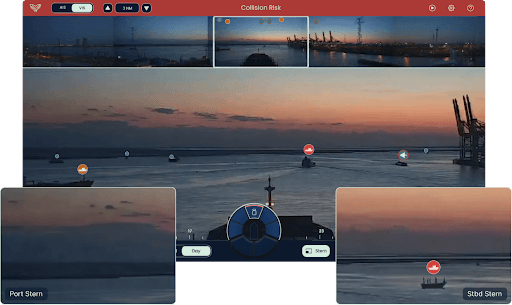
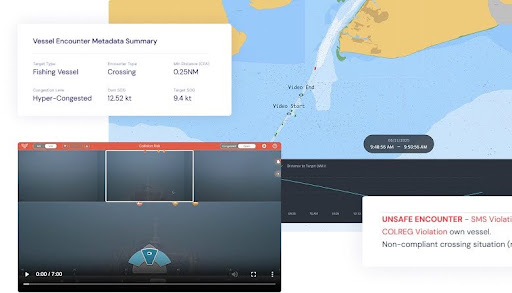

The role of the watchkeeper is not going anywhere. The MAIB’s argument is that expecting a person to monitor an uneventful screen for four hours and stay sharp asks something people are poor at, and that the fix is better support for the officer. That is the design brief. More on how we think about it in AI at sea: supporting crews and in the Lloyd’s Register evaluation of our platform.