September 24, 2025

Dor Raviv, Co-Founder & CTO, Orca AI
Share


Maritime navigation has always relied on layered systems of awareness – Radar, AIS, ECDIS and, above all, the human look-out. Under the International Regulations for Preventing Collisions at Sea (COLREGs), Rule 5 requires that “every vessel shall at all times maintain a proper lookout by sight and hearing as well as by all available means appropriate”. These obligations remain the bedrock of safe navigation but the operating environment in which they are carried out has changed dramatically. To understand navigational safety today, it helps to compare what traditional systems do best with what AI now contributes alongside them.
Today’s bridge teams have to contend with increasingly congested shipping lanes, a growing world fleet, leaner crewing models, tightening commercial margins, heightened cyber risks, stricter regulations, as well as increasing ESG scrutiny. While traditional tools remain indispensable, the proliferation of fragmented data streams can create complexity rather than clarity.
What crews now require is not yet more isolated screens but contextual intelligence that consolidates Radar, AIS, GPS and optical inputs into one coherent situational picture. This is where maritime situational awareness technology is evolving. AI augments legacy systems by fusing sensors, generating predictive insight and delivering decision support – without replacing human judgment. In doing so, it strengthens resilience against threats such as AIS spoofing, flags up developing collision risks earlier while extending visibility into low-visibility or Radar-cluttered environments.
Ultimately, the principle is the same as COLREGs Rule 5: to take “all available means appropriate” to maintain safety. As shipping edges toward the idea of cognitive seaworthiness – ensuring crews are not just equipped but fully supported in their situational awareness – AI-powered navigation systems are becoming less of an option and more of an expectation.
Radar and AI-powered situational awareness
For more than half-a-century, safe navigation has rested on a combination of proven technologies and disciplined human practice. Radar provides long-range detection and tracking of other vessels and hazards but its performance can be weaker when it comes to small craft or targets with a low radar cross-section (RCS) – a measure of how Radar-detectable an object is, influenced by its size, shape and material. Effectiveness is also reduced in conditions of clutter – the reflections created by sea state, precipitation or coastal terrain that obscure or mask genuine targets.
Even indirect inputs such as noon reports, while not strictly navigational, have historically played a role in shaping ship performance and voyage decisions. However, their static, once-daily format cannot keep pace with today’s real-time demands.
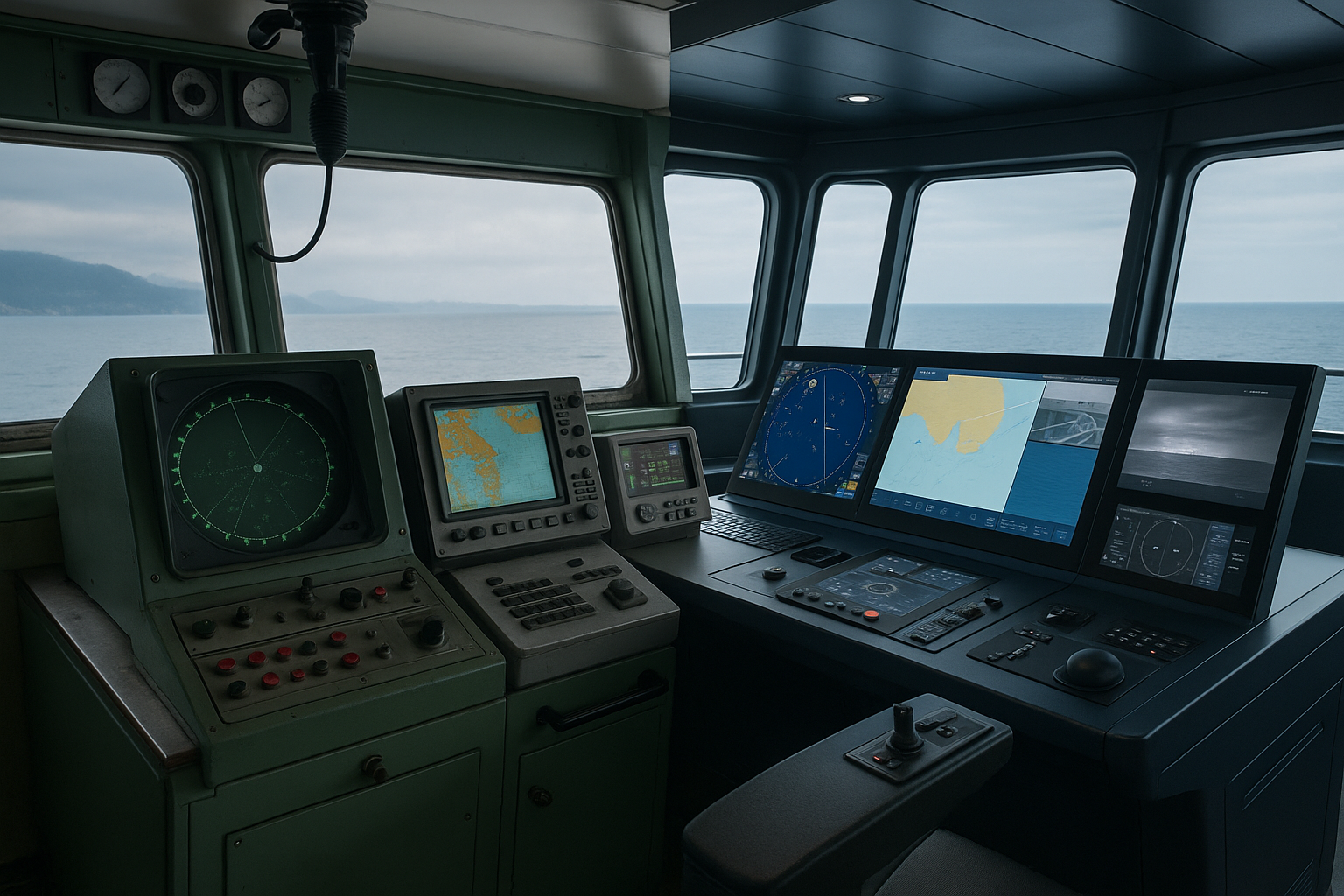
To show how navigation is evolving, this section compares Radar’s traditional strengths with the complementary AI capabilities that now extend its effectiveness under modern conditions.
By applying computer vision, sensor fusion and predictive analytics, AI systems create a richer and more actionable situational picture than any single instrument can deliver on its own. The comparison is not Radar vs AI navigation but how the new capabilities complete the older ones – ensuring that legacy systems remain relevant under modern conditions.
Collision avoidance is a primary application. Today’s AI-powered collision avoidance systems integrate Radar, AIS and camera inputs to flag developing risks earlier than traditional human plotting or ARPA (Automatic Radar Plotting Aid) – a function that calculates the course and speed of detected targets to predict risk of collision – can achieve. While valuable, ARPA depends heavily on manual oversight and can be slow when traffic is dense.
AI systems accelerate this process by analysing multiple data streams simultaneously and highlighting risk patterns before they are obvious to the human eye. Importantly, these systems do not execute COLREGs manoeuvres – in other words, they stop short of recommending or initiating course and speed changes. Instead, they provide timely alerts that reduce human error and give bridge teams critical seconds of foresight in congested or fast-moving scenarios.
Optical and thermal perception extend both human and Radar awareness. Using highly sensitive day/night (thermal) cameras, systems like Orca AI’s SeaPod object detection system can identify and classify small craft or low-RCS targets, even in darkness, fog or heavy clutter. This closes critical awareness gaps in conditions where visual lookouts or Radar alone are insufficient.
Together, these systems complement established tools. Radar shows where a vessel is; AI adds the predictive layer – where risks are developing, how trajectories are evolving and when intervention may be required. The combination of early detection with predictive foresight represents a fundamental step in the digital transformation in shipping safety.
AIS and AI-enabled verification
AIS (Automatic Identification System) adds a vital layer of identification and position data. Mandated by the IMO for most commercial vessels, AIS transmits a ship’s identity, position, course and speed to other vessels and to coastal authorities, allowing traffic monitoring across the global fleet. The system is overseen by the IMO, with data shared through coastal stations, satellites and ship-to-ship exchanges. Despite its value, AIS remains vulnerable to spoofing, jamming or simple gaps in coverage – an issue that is increasingly recognised as a critical weakness.
Spoofing is the deliberate falsification of GPS or AIS data to misrepresent a vessel’s position, course, speed or even its identity. Malicious actors have employed these techniques to disguise illicit activities, interfere with naval or coastguard surveillance or deliberately create navigational confusion in congested sea lanes. For commercial shipping, the danger is clear: a spoofed target can mislead a bridge team into plotting an unsafe course or failing to take early avoiding action.
AI-enabled situational awareness addresses this by cross-checking AIS and GPS against Radar and optical inputs. If the signals do not align, the system flags the anomaly in real time, allowing officers to recognise spoofing before safety is compromised. AI doesn’t replace AIS – it validates it, creating a verification layer that strengthens the integrity of global vessel-tracking systems.
ECDIS and predictive navigation
ECDIS (Electronic Chart Display and Information System) centralises navigational charts, voyage planning and position monitoring into a single electronic interface. It is intended to replace paper charts on compliant vessels, giving officers a dynamic view of the ship’s route and position. However, its accuracy depends entirely on the timeliness and quality of chart updates and other inputs.
AI extends ECDIS capability by adding predictive navigation and real-time vessel performance analytics. Modern AI platforms integrate inputs from Radar, AIS and onboard sensors to generate predictive trajectory analysis – identifying developing collision risks earlier than traditional plotting or ARPA (Automatic Radar Plotting Aid) can achieve.
While ECDIS shows where a ship should be, AI projects where surrounding vessels are going and how their paths may converge. The result is a move from static data to dynamic situational awareness. Noon reports, once the mainstay of voyage monitoring, still have value for record-keeping – documenting fuel use and compliance – but AI systems now deliver a continuous operational picture that supports faster, better-informed decision-making.
The human lookout, BRM and cognitive decision support
Alongside these electronic tools, the human element remains central. As already alluded to, COLREGs Rule 5 specifies that “every vessel shall at all times maintain a proper lookout by sight and hearing as well as by all available means appropriate in the prevailing circumstances and conditions so as to make a full appraisal of the situation and of the risk of collision.”
This establishes the obligation of lookout but does not prescribe how the bridge team should be organised. Bridge Resource Management (BRM) developed later as an operational and training concept, particularly in response to accident investigations in the 1970s and 1980s. BRM emphasises teamwork, communication and shared situational awareness between the lookout, the helmsman and the Officer of the Watch (OOW). It ensures that Rule 5 obligations are met in practice by making sure information flows freely, decisions are cross-checked and the bridge team operates as a coordinated unit. Unlike COLREGs, BRM is codified through the STCW (Standards of Training, Certification and Watchkeeping) framework.
AI’s role in navigation is not to replace established practices but to work alongside them – enhancing resilience, closing gaps and providing verification where human perception and legacy systems can fall short. In this sense, AI functions as a co-pilot rather than a captain. It takes on the continuous monitoring and cross-checking tasks that cause fatigue and distraction while leaving decision-making firmly in human hands.
Although COLREGs Rule 5 requires vessels to maintain a proper lookout at all times, human sight is limited in darkness, fog or heavy weather. AI-powered optical and thermal perception extends this capability, offering bridge officers the equivalent of a second pair of digital eyes that never tire.
Traditional tools tell you where you are and who is around you; AI projects where others are going and how their trajectories may converge. The result is a situational picture that is sharper, more consistent and less vulnerable to error. AI reinforces compliance and confidence while preserving the navigator’s ultimate authority.
The business case: ROI and safety impact
The impact of AI is felt not only on the bridge but also across the balance sheet. Its contribution can be measured in both risk reduction and operational returns.
On the risk side, AI enables earlier detection of hazards, continuous cross-checking against spoofed signals, and clearer visibility in low-light or congested conditions. These capabilities translate directly into fewer near-misses, fewer collisions and fewer claims. For crews, automated alerts and a consolidated situational picture can reduce cognitive load, lowering fatigue and error rates without diminishing their authority as decision-makers. Insurers and P&I clubs are taking note: AI-enhanced safety systems are increasingly viewed as tangible risk mitigators, with the potential to influence premiums and the handling of claims. Real-world trials support this view. In partnership with the NorthStandard P&I Club, Orca AI technology has been shown to reduce near-miss incidents by up to 40%, providing insurers with measurable evidence of risk reduction.
On the operational side, AI-enabled route optimisation helps avoid weather delays, cut fuel consumption and support compliance with emissions regimes. Predictive analytics and real-time dashboards extend beyond navigation, enabling condition-based maintenance and just-in-time hull cleaning. These measures not only lower costs and downtime but also deliver a measurable ESG contribution by reducing fuel use and greenhouse gas emissions.
For executives, the regulatory dimension is equally important. Automated data capture and analytics provide a robust basis for compliance with FuelEU Maritime, as well as with IMO frameworks including the DCS (Data Collection System) and CII (Carbon Intensity Indicator). These latter regulations are directly linked: the DCS requires ships to collect and submit fuel-consumption data while the CII uses this data to calculate a vessel’s annual efficiency rating.
The combined impact is significant:
- Fewer collisions and incidents → lower claims and liability. Earlier alerts and anti-spoofing verification reduce the likelihood of accidents, which in turn lowers exposure to costly claims, litigation and reputational damage.
- Optimised fuel and emissions → compliance support and cost reduction. AI-enhanced routing and performance monitoring improve efficiency, helping operators meet FuelEU Maritime requirements and achieve better CII ratings while also lowering bunker costs.
- Automated monitoring → reduced crew workload and fatigue. Continuous anomaly detection and situational awareness reduce cognitive strain on crews, allowing them to focus on decision-making rather than constant manual watchkeeping.
- Predictive maintenance and fouling management → extended asset life and ESG gains. By shifting from reactive to condition-based maintenance, operators minimise unplanned downtime, extend the service life of machinery and hull coatings, and contribute directly to lower emissions through cleaner, more efficient operations.
In short, AI strengthens both the safety case and the business case for investment. By delivering resilience where it matters most – protecting crews, vessels and cargo – while enabling leaner, smarter and more sustainable operations, AI is shaping what might be called the next stage of cognitive seaworthiness. In time, such systems may not be optional but expected as part of responsible, future-ready fleet management.
Beyond navigational safety – AI for operational efficiency
AI’s entry into shipping did not begin with navigational safety. Its earliest adoption was in weather prediction, voyage optimisation and fuel efficiency – areas where even small improvements could deliver significant commercial returns. What is now becoming clear is that the same techniques underpinning these applications – sensor fusion, anomaly detection and real-time analytics – can be extended well beyond route planning or fuel consumption. Increasingly, AI is enhancing vessel operations more broadly, reinforcing both safety and efficiency.
Engine room monitoring: Traditionally, engineers have relied on manual rounds and logbooks to track fuel burn, vibration and lubrication pressures. AI-enabled monitoring now delivers continuous oversight, identifying anomalies in real time and supporting predictive maintenance. The result is reduced downtime, lower repair costs and extended equipment life.
Cargo and container monitoring: Manual reefer rounds and visual checks are being supplemented with IoT sensors that feed into AI platforms, tracking temperature, humidity and location. This reduces the risk of cargo loss, strengthens claims defence and improves service reliability.
Voyage and fleet performance analytics: Noon reports once served as the backbone of fleet reporting but granularity is limited. AI platforms generate continuous performance dashboards that track propulsion, weather conditions and emissions. This not only enables trim and speed optimisation but also supports automated compliance with EU MRV and IMO DCS/CII requirements – reducing administrative burden while improving accuracy.
Digital twins and predictive analytics: Beyond voyage optimisation, AI models can create digital replicas of vessels or subsystems. These digital twins allow operators to simulate stresses, loads and weather scenarios in real time, supporting better planning and crew training. Combined with predictive analytics, they enable condition-based maintenance strategies that replace fixed service intervals with evidence-based interventions. This increases asset reliability and extends service life.
Hull and propeller fouling detection: Fouling increases drag and fuel consumption but has traditionally been managed reactively, with diver inspections or drydock cleaning once performance dropped. AI-enabled monitoring using sensors and drones can detect fouling early, enabling just-in-time cleaning. This delivers measurable fuel savings, lowers emissions and supports compliance with tightening efficiency benchmarks.
AI-enhanced CCTV: Engine rooms, cargo decks and restricted areas are still monitored largely through human vigilance. AI-enhanced CCTV systems transform this into proactive anomaly detection, identifying smoke, fire, leaks or unsafe behaviour automatically. Thermal feeds add an extra layer of protection, ensuring hazards are caught at the earliest possible stage. By reducing reliance on human observation alone, these systems cut response times and strengthen onboard safety.
Taken together, these applications illustrate how AI is reshaping vessel operations well beyond navigation. The same qualities that make AI valuable on the bridge – real-time insight, anomaly detection and predictive foresight – are now driving safer, more efficient and more sustainable operations across the entire ship.
Conclusion
The trajectory from Radar to AI reflects more than technological change; it marks a redefinition of safety and performance in modern shipping. Traditional tools remain indispensable but AI extends their value by providing predictive context, verifying signal integrity and reducing the cognitive load on bridge teams. These capabilities directly reduce risk, lower claims and support compliance – strengthening the safety case and the business case together.
At the same time, the same qualities that make AI powerful on the bridge are now transforming vessel operations more broadly. The core message is clear: older tools remain indispensable but their full value emerges when combined with the predictive power of AI.
FAQs: AI and maritime safety
What is the difference between Radar and AI navigation?
Radar shows the position and movement of objects but can struggle with small craft or clutter. AI navigation systems combine Radar with AIS, GPS and optical inputs, adding predictive analysis and decision support to enhance maritime situational awareness technology.
How does AI improve collision avoidance compared to Radar and AIS alone?
AI fuses Radar, AIS and optical/thermal sensors to detect and classify targets earlier. It provides predictive trajectory analysis that highlights developing risks faster than human plotting or ARPA, reducing the chance of error.
Can AI help detect GPS or AIS spoofing in maritime navigation?
Yes. AI cross-verifies AIS and GPS signals against Radar and optical inputs. If the data does not align, the system flags an anomaly, enabling crews to identify spoofing attempts before safety is compromised.
Can AI reduce human error in navigation?
Yes. By flagging developing collision risks, verifying signals against spoofing and monitoring vessel performance continuously, AI provides bridge teams with clearer, earlier alerts. This reduces fatigue-driven mistakes while keeping decision-making firmly in human hands.
What’s the difference between noon reports and real-time vessel analytics?
Noon reports provide a once-daily snapshot, valuable for documenting voyage progress, fuel use and compliance records. Real-time vessel performance analytics deliver continuous insights, allowing immediate action on navigation, performance and emissions.
How does AI support digital transformation in shipping safety?
AI consolidates fragmented data from Radar, AIS and ECDIS into a single situational picture. This reduces cognitive load, improves decision-making and supports the broader digital transformation in shipping safety by integrating navigation, performance and compliance data in real time.
Does AI navigation technology comply with COLREGs and international regulations?
Yes. AI systems are designed to support COLREGs – providing alerts and guidance while leaving manoeuvring decisions firmly with the bridge team.
What role does AI play in reducing fuel consumption and emissions?
AI continuously analyses vessel performance, weather and traffic conditions to optimise routes and speeds. This improves efficiency, cuts fuel use and supports compliance with FuelEU Maritime and IMO DCS/CII requirements.
How does AI help with compliance reporting?
AI platforms automatically collect and analyse data required under EU MRV, FuelEU Maritime and IMO DCS/CII. This ensures accurate reporting, better efficiency ratings and reduced administrative burden for shipowners and managers.
Are AI-based navigation tools meant to replace traditional systems or complement them?
They complement them. Radar, AIS and ECDIS remain vital but AI adds predictive intelligence and resilience, closing gaps in visibility, verification and decision support.
How do AI systems integrate with existing shipboard equipment?
Most are designed as overlay platforms, drawing inputs from Radar, AIS, ECDIS and engine-monitoring systems and consolidating them into a single situational picture.
What is the ROI of investing in AI navigation and safety technologies?
Operators see lower collision risk, reduced insurance exposure, improved fuel efficiency and compliance benefits. Together, these typically offset investment quickly while extending vessel life and reliability.
Is AI navigation technology recognised by insurers or P&I clubs?
Yes. Insurers and P&I clubs increasingly view AI-enhanced safety systems as effective risk mitigators. This recognition can influence premiums, accelerate claims handling and strengthen a shipowner’s risk profile.
How are regulators viewing AI-enhanced maritime technology?
Regulators see AI as a tool that can strengthen compliance, improve safety oversight and support emissions-reduction targets under frameworks such as FuelEU Maritime and the IMO’s DCS/CII.