



October 22, 2025

Noemie Ifrah, Marketing & Communications Manager, Orca AI
Share


Together with P&I club NorthStandard, Orca AI recently hosted an event in Singapore entitled “The Human + AI Bridge: Strengthening Maritime Operations Safety and Efficiency”. Gathering industry executives at the Andaz Hotel, the session explored how AI can strengthen the safety and efficiency of maritime operations, not by replacing human judgement but by enhancing it.
When AI becomes a crewmate
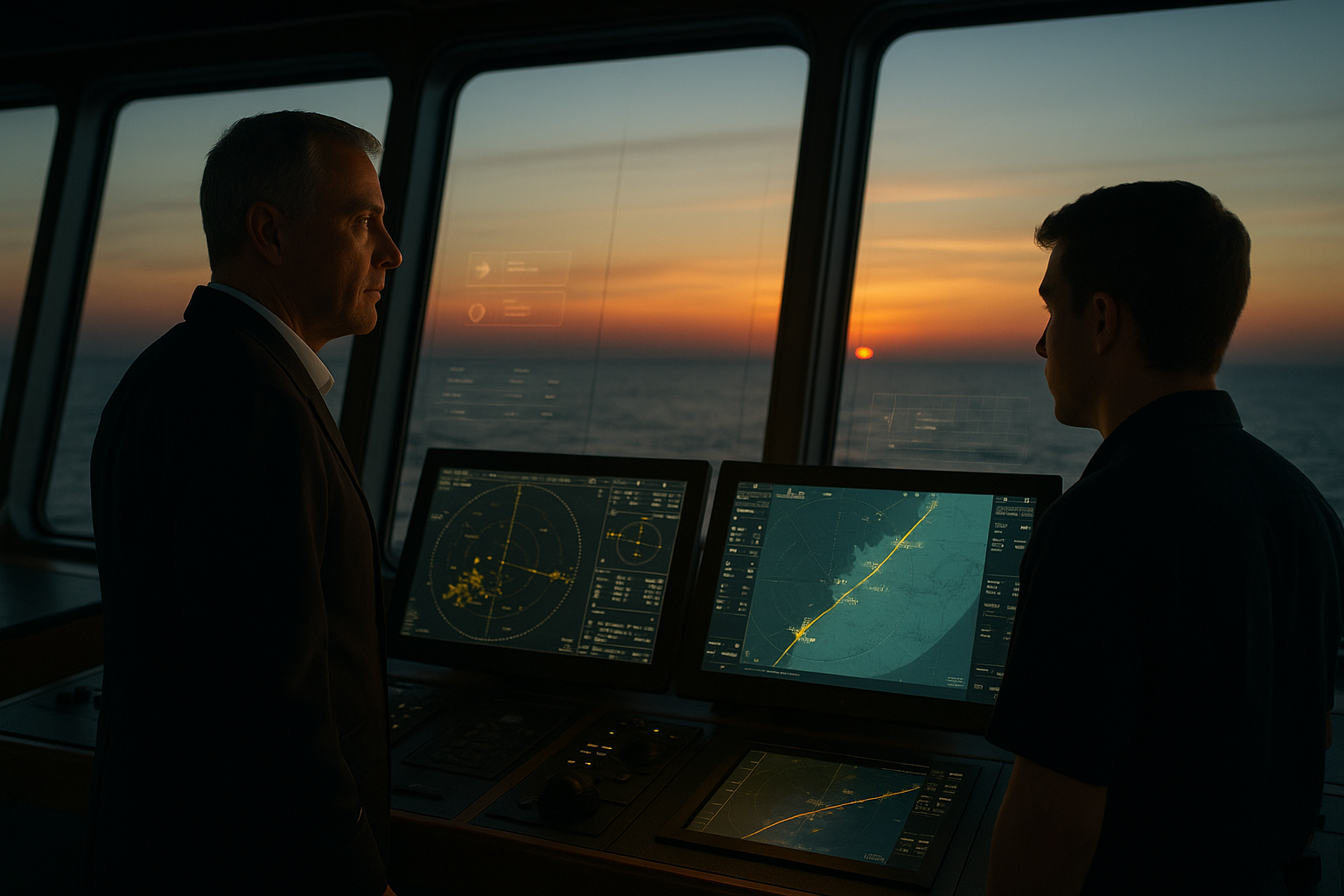
For Capt Giorgos Asteros, Operations Director at Maran Tankers Management, the case for AI begins with the realities of navigation. His crews regularly sail through the Malacca Strait and to/from congested Chinese ports “demanding” environments where fatigue is a constant risk. Installing Orca AI’s operational platform was simple, taking less than two days, but the difference on the bridge was immediate: high-risk targets are highlighted automatically, allowing officers to focus where it matters most.
After three years of deployment, Maran’s near-miss and course-change metrics have improved markedly, and data from Orca AI has even shaped new approach policies for ports such as Ningbo. Asteros credited these results not to futuristic autonomy but to technology that relieves cognitive load and supports tired eyes. “Help the bridge,” he said, “don’t add to the pressure.”
Watch highlights from The Human + AI Bridge event in Singapore
From curiosity to governance
If Maran’s story showed what works at sea, Capt Yves Vandenborn of NorthStandard examined what must happen on shore. Drawing on a Thetius survey of 130 maritime companies, he noted that while most are curious and cautiously positive about AI, only 11% have an AI policy or training programme in place. The main obstacles are predictable: lack of oversight, uneven governance and cultural resistance.
Vandenborn argued that adoption should begin with policy, culture and skills rather than tools. NorthStandard is following its own advice: the club has developed Chat-NS, an in-house AI assistant trained on internal claims and loss-prevention data, and is piloting automated claims-intake and contract-review systems. These efforts, he said, are less about speed than about learning how to govern technology safely, ensuring accountability and explainability before scaling.
Measuring what matters
From the technology side, Yarden Gross, Co-founder and CEO of Orca AI, presented more quantifiable evidence that AI can reduce navigational risk. In a study conducted with NorthStandard across over 100 container vessels covering eight million nautical miles, ships equipped with Orca AI recorded a 58% reduction in high-severity close-encounter events over nine months.
For Gross, the finding confirms that AI’s value lies in targeted automation rather than autonomy. The system lightens cognitive workload and maintains vigilance during long watch hours but human oversight remains central. His roadmap envisions graduated levels of automation, full manual control in port, decision support in congested waters and partial voyage optimisation offshore – always with the crew able to step in and override the AI system in place. “We have to build the technology around people,” he said, “because without them, it won’t work.”
Culture, trust and the human-in-the-loop
The panel discussion broadened the lens from tools to transformation. Harriet Wood, Change Lead at NorthStandard, described AI as a paradigm shift that demands not just training but a cultural re-orientation. Seafarers must evolve from procedural operators to critical thinkers who can interpret AI outputs, understand limitations and make contextual judgements. Her framework, AI literacy, human-in-the-loop training and critical thinking, set the tone for the panel’s wider reflections on trust.
Sachin Saharawat of Eastern Pacific Shipping (EPS) echoed that perspective from an operator’s standpoint. With 140 newbuilds on order and a dedicated Life at Sea programme, EPS treats innovation as an iterative process: pilot, test, adjust and learn. “Somebody has to take the leap of faith and accept a few failures,” he said. The goal, however, is unwavering: technology should ease the workload, not justify crew reductions.
Redefining value at sea
When the conversation turned to ROI, the panelists agreed that fuel efficiency delivers the quickest measurable gain but safety is not a metric, it is a baseline. True ROI, several argued, lies in empowered crews, stronger safety cultures and better decision-making under pressure.
Key takeaways
The event surfaced some clear red threads: People remain the centre of the system, and technology succeeds only when it enhances their capability. Governance and training are the real foundations of safe innovation, while data-driven evidence, like the 58 percent reduction in high-severity incidents, gives the conversation substance. But it is culture that ultimately decides whether progress endures: trust, transparency and a willingness to learn from mistakes will determine how successfully the Human + AI Bridge is built.


