



Maritime AI
Maritime AI: Uses, Technology and Value
Key takeaways
- Maritime AI applies artificial intelligence to maritime operations. It combines machine learning, deep learning, computer vision, sensor fusion, and big data analytics.
- It turns maritime data into usable information. Systems can detect patterns, forecast conditions, prioritize risk, and support defined tasks.
- It helps crews and shore teams act earlier. This can improve safety, efficiency, sustainability, and operational consistency.
- Orca AI uses maritime AI to improve navigational safety and operational efficiency. It connects earlier bridge awareness with fleet-wide learning, shared intelligence, and perception for autonomous vessels.
What is maritime AI?
Maritime AI is the application of artificial intelligence to vessel, port, and shore-side operations. It combines AI methods such as machine learning, deep learning, computer vision, and natural language processing with sensor fusion and big-data infrastructure to interpret maritime information, recognize patterns, forecast outcomes, and support or automate defined tasks.
Artificial intelligence in the maritime industry covers both onboard and shoreside work:
- Machine learning finds relationships in historical and live operating data.
- Computer vision detects and classifies vessels, objects, markings, smoke, or cargo conditions in camera images.
- Sensor fusion combines inputs such as Radar, AIS, cameras, GNSS, gyro, wind, and chart data.
- Decision support converts model outputs into information a person can assess.
- Equipment health analysis looks for changes that may point to wear, fouling, or a developing fault.
Applications include navigational awareness, collision-risk assessment, machinery condition monitoring, failure forecasting, voyage and energy management, emissions monitoring, port operations, cargo handling, and autonomous vessel functions. Common goals include improving safety and efficiency, reducing fuel use and emissions, supporting sustainability targets, and controlling operating costs. Decision support, forecasting, and emissions monitoring are already established areas of application.
AI navigation is one branch of maritime AI. It focuses on vessel movement, surrounding traffic, relative motion, and navigational risk.
Autonomous shipping assigns selected functions to remote or autonomous systems under a defined operating concept. AI decision support can be used aboard a conventionally operated vessel without making that vessel autonomous.
How does marine artificial intelligence work?
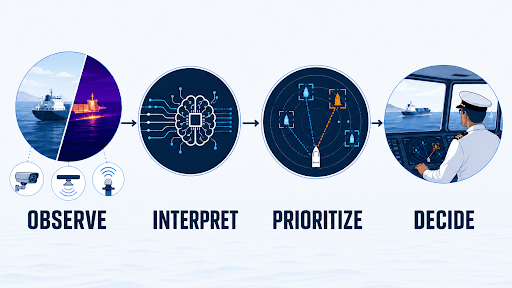
Marine artificial intelligence learns relationships from examples or applies trained models to current data. The basic flow is consistent: collect relevant inputs, prepare and assess the data, run a model, present an output and keep a person responsible for the operational decision. Performance must be checked against real observations and defined acceptance criteria.
Machine learning and pattern recognition
Machine-learning models find relationships in historical or live data. In machinery monitoring, inputs might include vibration, temperature, pressure and engine load. In fleet safety, they may include vessel tracks, CPA and TCPA development, encounter geometry and event outcomes.
Good results depend on representative data. A model trained mostly in daylight and clear weather may struggle at night or in rain. A fuel model built from one vessel class may transfer poorly to another. Operators therefore need to understand the training population, test conditions, error rates and process for monitoring performance after deployment.
Computer vision
Computer vision allows software to interpret camera images and video. At sea, it can support the detection, tracking and classification of vessels, small craft, buoys and floating objects. Thermal cameras add a different visual reference during darkness and some reduced-visibility conditions.
The operational value comes from consistent observation and prioritization. A bridge team may be managing Radar plots, AIS information, ECDIS, communications and a changing visual scene. Computer vision can maintain a parallel watch over the camera field of view and surface a target whose movement or proximity requires attention.
Sensor and data fusion
One source rarely tells the whole story. Radar provides range and bearing information. AIS provides transmitted identity and movement data. GNSS supports own-ship position. Cameras provide visual evidence. Weather and chart data add environmental and geographic context.
Sensor fusion brings relevant inputs together so a system can compare, correlate and interpret them. Disagreement also matters. A visual target without AIS, or an AIS position that conflicts with the observed scene, becomes especially important when navigation signals are unreliable.
| AI method | Typical maritime inputs | Useful output | Human responsibility |
|---|---|---|---|
| Computer vision | Day and thermal video | Detected and tracked targets | Confirm the situation and decide on action |
| Pattern recognition | Tracks, events and sensor histories | Trends or unusual behaviour | Interpret the finding in operational context |
| Forecasting | Weather, routes and machinery readings | Estimated future conditions | Judge uncertainty and operational consequences |
| Sensor fusion | Radar, AIS, GNSS, cameras and ship sensors | Correlated operating picture | Resolve discrepancies and retain command |
Why is AI important in the maritime industry?
AI matters because vessels and shore teams already receive more information than any one person can examine continuously. Properly scoped systems can sort, compare and prioritize parts of that information. The benefit is clearest when the output reaches the right person early enough to support a safer or more consistent decision.
The Lloyd’s Register April 2026 review of marine AI describes applications in decision support, forecasting and emissions monitoring. It also points to connectivity, cybersecurity, culture and standardization as part of an organization’s readiness. This is a useful distinction: a capable model still needs reliable data, suitable procedures and users who understand its role.
For an officer on a night watch in the Singapore Strait, the value may be earlier notice of a small, unlit craft. For a technical superintendent, it may be a change in vibration that warrants inspection. For a fleet safety team, it may be a repeat pattern across close-encounter events. Marine AI is useful when it turns a specific operational signal into a timely, reviewable piece of information.
Where is AI used in shipping?
AI in shipping is used where teams must interpret repeated, high-volume or time-sensitive information. Current applications include navigational awareness, machinery-condition monitoring, voyage and energy assessment, port-call planning and fleet learning. These tools support different users, so operators should avoid treating every maritime AI system as one interchangeable category.
Navigational decision support
AI-assisted watchkeeping can detect targets in day and thermal imagery, follow their movement and combine visual observations with bridge-sensor data. It can then rank developing risks using factors such as relative motion, CPA and TCPA.
This is particularly relevant in congested approaches, traffic separation schemes and waters with fishing activity. The situational awareness task remains broader than any single display. The officer must maintain the full navigational picture, comply with COLREGs and judge the safest action.
Condition monitoring and maintenance
Machinery models can compare current readings with normal operating patterns and flag a change for investigation. Typical inputs include temperatures, pressures, vibration, engine load and maintenance histories. These systems can help technical teams focus inspection work, but an alert is evidence for diagnosis rather than a diagnosis by itself.
Voyage and energy management
AI models can estimate how speed, weather, currents, draught and routing choices may affect voyage time and energy use. The output can support planning and comparison of options. Accuracy depends on the vessel model, data quality and changing conditions at sea.
Port and cargo operations
Ports and terminals use AI for arrival forecasts, equipment scheduling, yard planning and image-based inspection. Shipping companies may also apply models to cargo documentation or commercial communications. These are shore-side use cases, with different safety, data and assurance requirements from bridge systems.
Fleet safety and training
Recorded navigational events give safety teams evidence from real voyages. Groups can review how encounters developed, identify recurring patterns and select relevant examples for debriefing. This creates a ship-to-shore feedback loop based on observed events, giving safety teams material for debriefing, follow-up, and fleet-wide learning.
How is maritime AI different from autonomous shipping?
Maritime AI is a technology category; autonomous shipping describes how vessel functions are performed and where human control sits. A crewed vessel can use AI decision support without becoming autonomous. Autonomy requires a defined operating concept, system assurance, fallback arrangements and compliance with the applicable regulatory framework.
In May 2026, the International Maritime Organization adopted the MASS Code for Maritime Autonomous Surface Ships. The Code applies to cargo ships and took effect on 1 July 2026. Automation alone leaves a vessel outside the MASS definition. The ship must complete the approval process and hold a valid MASS Safety Certificate.
This distinction helps buyers ask a better question: what function does the AI perform, under which conditions, with what human oversight? A target-detection model, a machinery forecast and a remote-control system sit at very different points in the operational and regulatory picture.
What are the limits of AI in maritime operations?
Maritime AI can fail when inputs are missing, conditions differ from training data, interfaces create confusion or users place too much confidence in an output. Safe use therefore requires operating limits, performance monitoring, cybersecurity controls, fallback procedures and training that explains what the system can see, what it may miss and how uncertainty is shown.
Common concerns include:
- Data quality: Incomplete, inconsistent or poorly labelled data can produce unreliable results.
- Changing conditions: Weather, lighting, sea state, traffic mix and sensor condition may shift model performance.
- Integration: A useful output must fit bridge or shore workflows without adding avoidable alarm load.
- Cybersecurity: Connected systems require access controls, update processes and incident procedures.
- Explainability: Users need enough context to judge why an alert appeared and how much confidence to place in it.
- Assurance: Performance claims should state the dataset, operating conditions, metrics and independent role in evaluation.
Lloyd’s Register’s March 2026 maritime data research warns that AI and analytical tools depend on the quality and structure of the underlying data. Data governance is therefore an operational requirement with direct consequences for model performance.
How is maritime AI regulated?
Maritime AI sits within existing duties for safe navigation, watchkeeping, equipment use, cybersecurity, and safety management. SOLAS and COLREGs continue to apply to conventionally operated ships using AI decision support. For qualifying autonomous cargo ships, the IMO’s non-mandatory MASS Code took effect on July 1, 2026.
The International Convention for the Safety of Life at Sea sets core safety requirements, including navigation and equipment duties.
COLREGs govern conduct between vessels. Company procedures under the ISM Code turn those requirements into operating instructions, reporting lines, and risk controls.
In May 2026, the International Maritime Organization adopted the International Code of Safety for Maritime Autonomous Surface Ships.
The non-mandatory MASS Code:
- Applies to cargo ships within its scope
- Took effect on July 1, 2026
- Covers navigation, connectivity, remote operations, fire safety, cybersecurity, and search and rescue
- Requires operators to describe the vessel’s operating modes
- Keeps overall responsibility with the master
- Establishes an approval and certification process
For most current AI in shipping projects, the immediate questions remain familiar:
- Does the system support a task covered by the Safety Management System?
- What are its stated operating limits?
- How will crews verify its output?
- What happens when a sensor, connection, or software component fails?
- How are software changes tested and recorded?
- Who reviews performance across the fleet?
How should shipowners evaluate maritime AI?
Shipowners should begin with a defined operational problem, the person responsible for the decision, and a measurable result. They should then examine source data, vessel fit, test conditions, crew workflow, cybersecurity, support, and evidence from live operations. A limited trial can reveal workload and installation issues before wider deployment.
Use this evaluation checklist:
- Define the job. State the decision or task the system will support.
- Name the user. Identify who receives the output and when.
- Inspect the data. Check source, ownership, quality, frequency, storage, and missing values.
- Set the baseline. Record current event rates, workload, downtime, or operating performance.
- Review vessel fit. Check sensor position, bridge layout, connectivity, interfaces, and class requirements.
- Demand operational tests. Include the routes, weather, visibility, traffic, and target types the fleet encounters.
- Measure the right outcomes. Track accuracy, missed events, false alerts, uptime, crew use, and the operational result.
- Plan governance. Assign responsibility for access, software changes, model review, cyber risk, and incident follow-up.
The March 2026 maritime data report gives data preparation the right weight. Reliable analysis starts with consistent reporting, sufficient context, and clear data ownership.
How does Orca AI turn maritime AI into operational value?
Maritime AI is central to Orca AI’s work. Its value comes from connecting bridge awareness, fleet learning, shared intelligence, and autonomous operations:
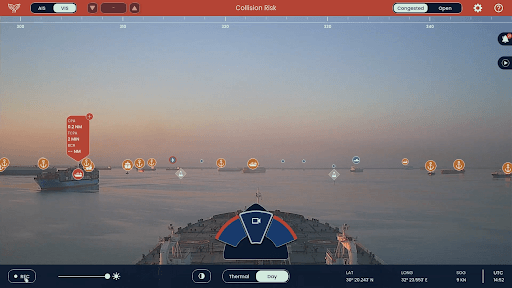
- Earlier understanding on the bridge: SeaPod combines visual and navigational inputs to detect, classify, and track surrounding targets, including non-AIS contacts. It prioritizes developing CPA/TCPA risks, giving the officer of the watch more time to assess the situation.
-
- Voyages become evidence: FleetView brings recorded footage and navigational data ashore. Safety teams can review encounters, passing distances, rate-of-turn events, and route deviations, then use the findings in debriefs, procedures, and crew training.

- Collective awareness beyond one vessel: Co-Captain combines verified observations from connected vessels with selected external data. Information gathered across Orca AI-equipped vessels becomes shared navigational context beyond the range of one vessel’s sensors.
- A foundation for autonomous operations: Orca AI’s perception capabilities can provide real-time target and risk information to autonomous navigation systems. Crewed vessels retain navigational authority on the bridge, while autonomous deployments follow their approved operating and oversight arrangements.
Recent operational evidence:
- Performance in live conditions: During an 828-nautical-mile live-vessel evaluation, Lloyd’s Register assessed 739 relevant targets across 98 observations. The system achieved 94% precision, 98.6% recall, and zero downtime.
- Fleet-level safety outcomes: A fleet-level analysis covering 139 vessels and more than 10.8 million nautical miles found that high-severity close encounters fell 52% over 12 months. In open water, high rate-of-turn events fell 31% and average minimum passing distance increased 4%.
These findings apply to the stated trial, cohort, methodology, and operating conditions.