



Situational awareness
Situational awareness: understanding what’s around you and what comes next
Key takeaways
- Situational awareness is perceiving what is around you, understanding it, and predicting what happens next. Mica Endsley’s three-level model is the standard frame, used in aviation, healthcare, and on the ship’s bridge.
- At sea, situational awareness is the margin between a routine watch and a close encounter. Investigators repeatedly trace collisions and groundings back to a loss of situational awareness on the bridge.
- It erodes in predictable ways: fatigue, high workload, rushed handovers, and over-reliance on a single instrument.
- The picture can be protected. Bridge Resource Management, rest, cross-checking, and a continuous, independent set of eyes at the vessel level all help hold situational awareness through a demanding watch.
- Orca AI supports situational awareness at the vessel level, adding continuous visual watchkeeping that runs alongside radar, AIS, and the officer of the watch.
What is situational awareness?
Situational awareness is knowing what is going on around you well enough to decide what to do next. The researcher Mica Endsley defined it in 1995 as perceiving the elements in your environment, understanding what they mean, and projecting what they will do in the near future. On a ship’s bridge, that means tracking every vessel, hazard, and shift in conditions around your own vessel, and staying ahead of them.
Good situational awareness is what lets an officer of the watch act early and calmly instead of reacting late. It is a skill, and it is also a state that can be built up or worn down over the course of a watch.
The three levels of situational awareness
Endsley’s model breaks awareness into three levels that build on each other: perception (Level 1), comprehension (Level 2), and projection (Level 3). Most breakdowns start at Level 1, when something is never noticed in the first place. The table below shows how each level looks on watch.
| Level | What it means | On the bridge |
|---|---|---|
| 1. Perception | Noticing the elements around you | Spotting every vessel, buoy, and change in weather or traffic on radar, on AIS, and by eye |
| 2. Comprehension | Understanding what those elements mean together | Reading a crossing vessel’s aspect and a closing CPA as one developing risk, not two separate contacts |
| 3. Projection | Predicting what happens next | Judging where both vessels will be in ten minutes and deciding to alter course early |
Why is situational awareness important for safety?
Because most casualties at sea come back to people, not equipment. Across 2015 to 2024, the EMSA Annual Overview of Marine Casualties and Incidents 2025 found the human element involved in 78.8% of investigated marine casualties. Situational awareness safety is the part of the human element a crew can train, support, and protect every watch.
A strong picture of the situation means threats are seen earlier, decisions are made with more time in hand, and the bridge team shares the same understanding. When that picture is thin, small errors turn into close encounters. This is why situational awareness in safety management sits alongside collision avoidance and maritime safety as a core competency, not a nice-to-have.
What causes a loss of situational awareness?
A loss of situational awareness rarely has one cause. It builds from several pressures at once, and a lack of situational awareness can set in without the officer noticing. The usual contributors are:
- Crew fatigue: Long hours and broken rest slow perception and judgement.
- High workload and tunnel vision. Focus narrows onto one task, and the wider picture drops away.
- Weak or rushed handovers. The incoming officer inherits an incomplete picture at the change of watch.
- Over-reliance on one instrument. Trusting a single input, such as AIS, leaves blind spots when it is wrong or absent.
- Alarm overload. Too many alerts stop being useful and start being noise, and alarm overload has crossed from nuisance to safety risk.
| Erodes awareness | Rebuilds awareness |
|---|---|
| Fatigue | Protected rest and watch rotations |
| High workload and tunnel vision | Shared priorities and Bridge Resource Management |
| Rushed handovers | Structured watch handovers |
| One source trusted alone | Radar, AIS, ECDIS, and visual cross-checks |
| Alarm overload | Alerts prioritized and reviewed |
What erodes situational awareness on watch, and what rebuilds it.
Situational awareness examples on the bridge
Maritime situational awareness is easiest to understand through real watches. A few common situations:
- A foggy port approach. Radar is busy with small craft and clutter; the officer cross-checks radar, AIS, and lookout to keep track of fishing boats crossing the channel.
- A congested traffic separation scheme. Several vessels alter course at once, and the picture changes minute to minute.
- A night collision. On 19 July 2024, the tanker Hafnia Nile struck the anchored Ceres I in the South China Sea. The Singapore TSIB investigation pointed to fatigue, Bridge Resource Management, and situational awareness: the duty lookout saw the vessels closing but did not report it. One person later died of injuries. A night-time collision in the Danish Straits showed the same pattern.
How can you improve situational awareness?
Improving situational awareness is mostly about protecting attention and cross-checking what you see. Practical situational awareness safety tips for the bridge:
- Manage fatigue. Honour rest hours and watch rotations, because a rested officer perceives more.
- Use Bridge Resource Management. Share the picture out loud, invite challenge, and brief the plan.
- Cross-check every input. Compare radar, AIS, ECDIS, and the view from the window; treat any disagreement as a question, not a nuisance.
- Run structured handovers. Hand over the full picture at the change of watch, not just the heading.
- Train for it. Debrief real events and near misses so the lessons stick.
Situational awareness tools and technology
The bridge already carries several situational awareness tools: radar and ARPA for tracking, ECDIS for position and route, and AIS for identifying vessels that broadcast. Each is strong, and each has gaps. Radar clutters in heavy weather; AIS only shows vessels that transmit, and its value grows when it is fused with other data; ECDIS is only as good as its inputs.
AI situational awareness adds an independent layer on top of these. Instead of replacing radar or the officer, computer vision watches continuously and helps interpret the picture, flagging risk that fits together across sensors, an approach described in closing the perception gap in maritime safety and the core capabilities of situational awareness systems. It sits below the institutional, fleet-wide view of maritime domain awareness and alongside AI navigation.
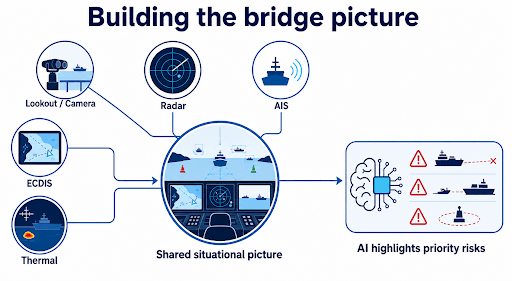
Building the bridge picture: Lookout/camera, radar, AIS, ECDIS, and thermal inputs converge into a shared situational picture; AI highlights priority risks.
How Orca AI improves situational awareness on the bridge
Orca AI adds an independent layer of situational awareness at the vessel level. It works alongside radar, AIS, and the officer of the watch rather than replacing them, watching continuously and pointing the bridge team at what matters first. The master stays in command.
What that means in practice, on watch:
- Prioritize the real risks, faster. The onboard digital watchkeeper, SeaPod, detects and ranks targets of all sizes automatically, so attention goes where it counts instead of being spread across a cluttered screen.
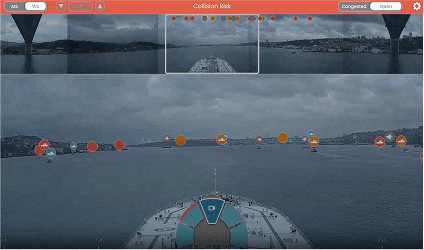
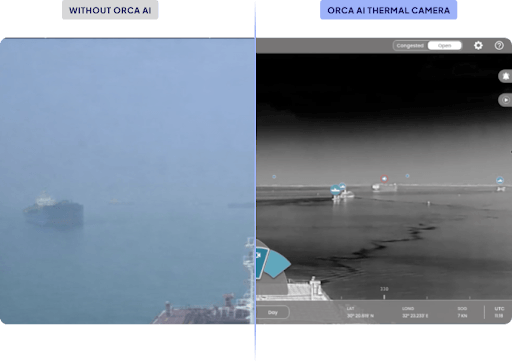
- See what radar and the eye miss. Day and thermal imaging with multi-sensor fusion surface non-AIS fishing boats and small craft, vessels lost in radar clutter in congested water, and hazards hidden by fog or darkness.
-
-
- Hold the picture when signals fail. Independent visual detection can help maintain a clear picture when GPS or AIS is spoofed or jammed.
- Lower cognitive load and fatigue. One consolidated view instead of scattered inputs eases workload, and helps close the experience gap for younger crews.
- Extend the picture to the office and the master. FleetView gives shore teams a live view to support a bridge and review events; MasterView shows the master patterns over time; Co-Captain shares verified alerts between nearby vessels so awareness reaches beyond the horizon. Advisory throughout: they inform decisions, they do not take them. Recorded events also feed crew training.
-
The aim is a bridge team that keeps a fuller picture for longer, and a shore team that can see it and help. It is one connected system, built on Orca AI’s technology platform.