October 30, 2025

Keren Raiten, VP Marketing, Orca AI
Share


Key takeaways
- Maritime green corridors are dedicated trade routes where ports, shipowners, fuel suppliers, cargo owners, and regulators work together to test zero-emission shipping in real operating conditions.
- The concept has moved beyond early feasibility studies, with more corridor initiatives now focused on fuel supply, port infrastructure, commercial demand, and vessel readiness.
- Green fuels are only one part of the challenge. Corridors also need safer navigation, reliable voyage execution, transparent reporting, and stronger coordination between bridge and shore teams.
- Orca AI supports this operational layer by helping crews and fleet teams improve situational awareness, reduce collision risk, and generate clearer data on vessel behavior across complex routes.
More than 84 active corridor initiatives now exist globally (up from fewer than 30 in 2022), and for the first time, four have reached what the Getting to Zero Coalition calls the “realization stage”: vessels operating, infrastructure being built, and commercial agreements signed. That puts them in a different category from the MoU-heavy early years, when most corridor announcements amounted to a press release and a letter of intent.
But progress has not been even. Many initiatives remain stalled – held back by the cost differential between conventional and zero-emission fuels, and by the absence of the policy certainty that would close it. The IMO’s Net-Zero Framework, which was expected to provide that signal, was due for formal adoption in October 2025. The vote was postponed after political pressure from the US and Saudi Arabia, and a new vote is expected in autumn 2026.
In the meantime, the corridors that are moving forward share something in common: they’ve gone beyond the fuel question. They’ve had to solve for port infrastructure, commercial alignment, vessel readiness, and, increasingly, the operational complexity of running vessels on constrained, high-traffic routes where efficiency and safety are closely linked.

What are maritime green corridors?
A maritime green corridor is a designated shipping route where governments, ports, fuel suppliers, cargo owners, and shipping companies align around a shared goal: proving that zero-emission operations can work at a commercial scale. The concept was formally backed at COP26 through the Clydebank Declaration, where 22 countries committed to establishing at least six zero-emission routes by mid-decade. That deadline has now arrived.
Why green corridors are not only about alternative fuels
Green corridors are often described by their fuel pathway: methanol, ammonia, hydrogen, shore power, or battery-electric operation. But a cleaner fuel does not make a route viable by itself. The vessel still has to complete the voyage safely, on schedule, and with enough consistency for the emissions benefit to be measurable, repeatable, and commercially credible. That depends on:
- Berths that can turn vessels around without hours lost at anchor
- Emissions data that holds up to scrutiny from charterers and regulators
- Safe navigation through some of the world’s busiest and most contested waterways
- Enough visibility across the fleet that shore teams can coordinate what’s happening
What makes a green corridor work?
A green corridor is not simply a shipping route with cleaner fuel. It is a system – and like any system, it only works when all its parts are functioning at the same time.
Defined trade lanes
The starting point is the route itself. Green corridors are most viable on lanes with predictable traffic, repeat vessel movements, and cargo owners with a commercial reason to support cleaner operations and not just an environmental one. Short-sea routes like Heysham–Dublin or Moss–Horten work partly because the operational environment is contained and the stakeholders are few. Deep-sea corridors like Singapore–Rotterdam are harder to coordinate precisely because the number of parties involved is so much larger.
Clear operational boundaries – what the corridor covers, who is responsible for what – matter as much as the route itself.
Fuel and bunkering infrastructure
The fuel question gets the most attention, and for good reason. Green methanol has moved furthest, with a growing number of dual-fuel vessel orders and committed bunkering supply on key routes. Ammonia is the front-runner for deep-sea bulk trades, but carries handling and safety requirements that ports and crews are still working through at scale. Battery-electric systems and shore power are well-established on short crossings where schedules are predictable and grid connections are reliable. Many operators are running hybrid approaches in the meantime, which reflects where the infrastructure is rather than where it needs to be.
Vessel readiness
Choosing a fuel pathway and having a fleet configured to use it are different problems. Depending on the corridor, that means newbuilds specified from the outset, retrofits on existing tonnage – with the cost, drydock time, and operational disruption that brings – and dual-fuel engines that preserve flexibility while the supply side catches up. Ammonia, in particular, requires dedicated storage and handling systems and crew procedures that most seafarers have not been trained for before. Fleet-wide retraining is consistently one of the longer-lead-time items in corridor development and one of the most underestimated.
Commercial alignment
This is where a significant number of corridor initiatives have run into difficulty. Technical readiness and commercial agreement are not the same thing, and the gap between them has held back more projects than any infrastructure challenge. Who absorbs the cost premium of zero-emission fuel? How are emissions reductions measured and verified in a way that satisfies charterers, cargo owners, and regulators simultaneously? How do contracts get structured to reward operators who invest early rather than penalizing them for it? The corridors that have reached operational status are the ones that worked through these questions before the press release, not after.
Port and terminal coordination
Even when a vessel arrives fuel-ready and on schedule, the corridor can still underperform if the port call goes wrong. Berth availability, pilotage, tug coordination, bunkering windows – each one needs to be sequenced around the vessel rather than the other way around. Port congestion is a particular problem on high-volume routes, where a vessel idling at anchor for 24 hours burns fuel that no green choice can offset. The emissions case for a corridor depends on the voyage performing efficiently end-to-end, not just on what comes out of the funnel at sea.
Digital visibility and operational coordination
Timing affects fuel consumption. Congestion affects emissions. Safety incidents disrupt schedules and generate the kind of unplanned manoeuvres that waste fuel and create reporting gaps. Shore teams managing a corridor fleet need a clear, consistent picture across all their vessels, not a patchwork of individual reports arriving at different intervals in different formats.
Real-time fleet platforms make it possible to coordinate arrivals, monitor navigational risk across the fleet, and produce the verified emissions data that regulators and cargo owners require under frameworks like FuelEU Maritime. Without that layer, even a well-fuelled, well-crewed corridor is operating with one hand tied behind its back.
How many maritime green corridors exist in 2026?
The Annual Progress Report on Green Shipping Corridors 2025 puts the current total at 84 active initiatives across every major trade region, with 25 new corridors launched in 2025 alone, including first-time entrants from China, India, Brazil, Chile, Ghana, and Kenya. Over 300 stakeholders are now involved globally.
| Corridor | Route | Primary fuel | Status |
| Singapore–Rotterdam | Asia–Europe (deep-sea) | Ammonia, methanol | Active — 28 partners |
| Singapore–LA/Long Beach | Trans-Pacific | Multiple fuels + digital | MoU renewed April 2026 |
| UK–Ireland (Heysham) | Short-sea, UK | Shore power / green methanol | Infrastructure underway |
| Green Baltic X-Press (GBX) | Northern Europe feeder | Green methanol | Launched Q3 2024 |
| Green Finland X-Press (GFX) | Northern Europe feeder | Green methanol | Launched Q3 2024 |
| Australia–East Asia | Bulk carrier, deep-sea | Ammonia | Planned from 2028 |
| Moss–Horten | Oslo Fjord (short-sea) | Electric | Operational |
Why are shipowners investing in green corridors?
For shipowners and operators, green corridors create a structured setting to trial new fuels, digital systems, and crew workflows on a defined route before rolling anything out fleet-wide – which, given the cost and complexity of the transition, is a significant practical advantage.
There are commercial reasons too:
- Lower-risk fuel transition: a corridor provides boundaries. If something doesn’t work, the exposure is limited to a single route rather than to an entire fleet.
- ESG credibility: early participation signals a genuine commitment to decarbonization, which cargo owners, charterers, and investors are increasingly factoring into commercial decisions.
- Access to incentives: preferential financing, subsidies, and reduced port fees are specifically designed to ensure that operators who move early aren’t left at a disadvantage against those who wait.
- Regulatory readiness; operating within a corridor gives companies a controlled environment to prepare for FuelEU Maritime, EU ETS, and the incoming IMO Net-Zero Framework before those obligations apply across the whole fleet.
- Competitive positioning: operators building corridor experience now will be better placed when zero-emission requirements are no longer optional.
Green shipping corridors in action: real-world examples
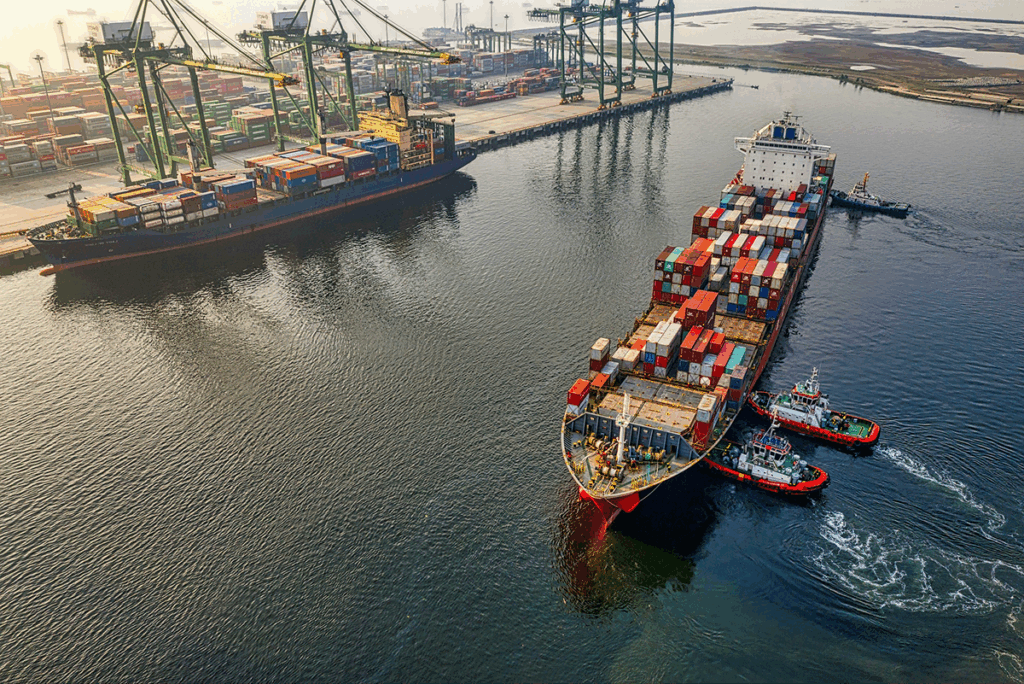
UK–Ireland: Heysham and the Irish Sea
The UK’s first green shipping corridor is taking shape at Heysham Port, where NatPower Marine and Peel Ports are installing shore power infrastructure across all four berths, serving the port’s Irish Sea ferry routes including Dublin. Once all four berths are electrified, the infrastructure is expected to cut more than 10,000 tonnes of CO₂ annually by enabling vessels on these routes to operate on zero emissions at berth and, ultimately, under electric propulsion at sea. Further along the Irish Sea, a study has identified the Holyhead–Dublin route as a strong candidate for green methanol, with modeled emissions reductions of up to 80%.
Norway: Moss–Horten electric ferries
The Oslo Fjord crossing between Moss and Horten is one of the most advanced operational examples of corridor electrification worldwide. Norwegian distributor ASKO runs two fully autonomous electric vessels on the route daily, cutting an estimated 5,000 tonnes of CO₂ per year compared to the road freight they replace. The vessels currently operate with a minimal crew, with the transition to fully uncrewed voyages monitored from a shore-based operations centre already underway. Other Ropax ferries on the same crossing have reduced emissions by 75%.
Singapore–Rotterdam green and digital corridor
The world’s longest green and digital shipping corridor connects two of the busiest port hubs on the planet, with 28 partners including Maersk, MSC and CMA CGM. What sets this corridor apart is its explicit commitment to both fuel and digital transition in parallel. Successful trials have already been run for port-to-port data exchange to optimize vessel arrival planning, and for paperless ship-to-shore clearance. It is as much a blueprint for how real-time fleet coordination supports green operations as it is a fuel switching exercise.
Singapore–Los Angeles/Long Beach
The trans-Pacific corridor linking Singapore with the two largest container ports on the US West Coast has been running since 2023, with its MoU renewed in April 2026 for a further three years. The workstreams cover alternative fuels pilot trials, port-to-port data connectivity, and energy efficiency, with C40 Cities acting as facilitator. At the volumes these ports handle, even incremental progress on any of those fronts has significant emissions implications.
Europe’s green Baltic and Nordic corridors
Singapore-based carrier X-Press Feeders launched two dedicated green methanol feeder routes – the Green Baltic X-Press and Green Finland X-Press – in Q3 2024, in partnership with six European ports across Belgium, Estonia, Finland, Latvia and Lithuania. The methanol used is ISCC-certified, and the initiative is built around ports like Tallinn that have invested heavily in digitalisation, treating data infrastructure as a core part of the corridor rather than a supporting feature. The European Alternative Fuels Observatory tracks progress across the network.
Australia–East Asia iron ore corridor
This corridor targets one of the highest-volume bulk trade routes in the world: Western Australian iron ore moving to steel mills in East Asia. A study found that ammonia-powered bulk carriers could be commercially viable on this route from 2028, with the potential to scale to around 360 vessels by 2050. The timeline depends heavily on government support for clean ammonia production, which remains the central variable. If that support materialises, this corridor has the scale to be one of the most consequential in the world.
Why fuel alone isn’t enough: the operational challenge
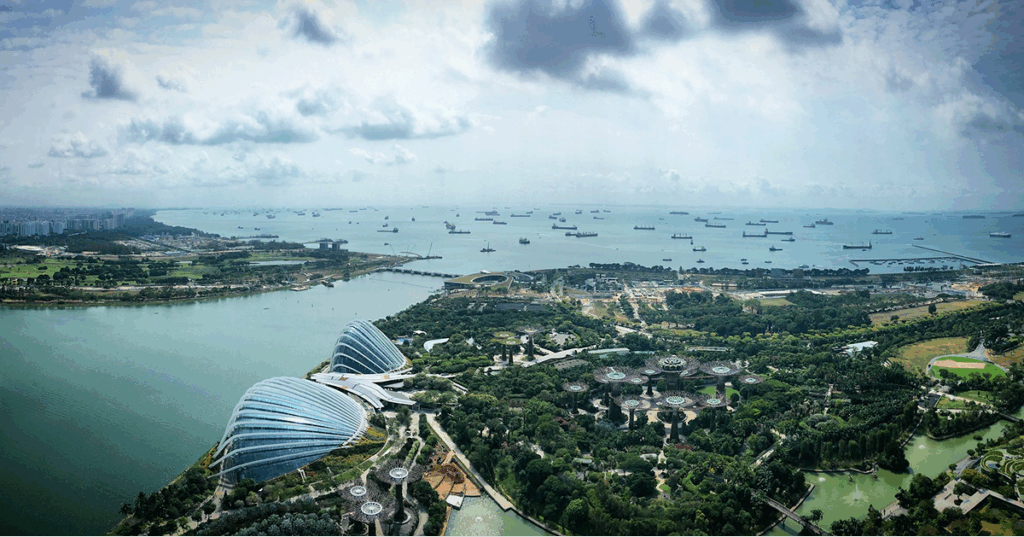
It’s not just about avoiding collisions at sea. Shipping today faces a complex web of challenges that can derail even the best-laid decarbonization plans.
- Port congestion – A vessel waiting at anchor burns fuel. On high-volume routes, where port infrastructure hasn’t kept pace with the size of modern vessels, those waits can stretch to days. The emissions from that idle time directly undermine whatever gains the green fuel was supposed to deliver.
- Geopolitical disruption – In high-traffic, sensitive areas like the Red Sea and the Strait of Hormuz, reports detail a range of threats from piracy and projectile attacks to severe GPS spoofing and electronic interference. These factors can deceive or disable traditional navigation systems, compounding the risk of an incident in waters already prone to congestion and collision.
- Operational inconsistency – Without visibility across the fleet, vessels navigate reactively. Speed adjustments happen too late. Arrival planning is based on estimates. Safety incidents go undetected by shore teams until after the fact. The result is excess fuel burn and emissions that accumulate voyage by voyage, across every vessel on the route.
The table below shows how these challenges map onto the operational layer Orca AI addresses:
| Green Corridor Pillar | Key Challenge Addressed | Orca AI’s Contribution |
| Safety & Risk Mitigation | Collision risk in congested or low-visibility conditions. | AI-powered object detection and collision-avoidance alerts in real-time. |
| Operational Efficiency | Inconsistent navigation and fuel waste from reactive manoeuvres. | Enhances bridge awareness and consistency across fleets; enables proactive navigation. |
| Data Transparency & Compliance | Need for verifiable emissions and performance reporting. | Records time-stamped data on vessel behaviour for reliable audit trails and reporting. |
How Orca AI supports green corridor operations
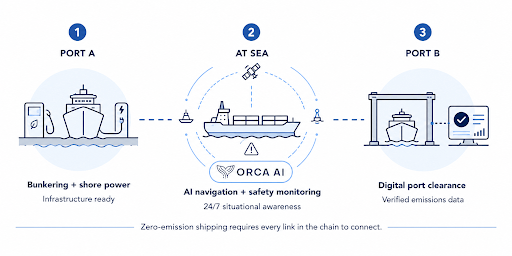
Situational awareness and collision avoidance
Orca AI acts as an automated lookout on the bridge, using AI and computer vision to enhance situational awareness 24/7. The system continuously detects, tracks and classifies targets, from vessels to floating objects, in real time, particularly in the congested or low-visibility conditions and GPS spoofing environments that are common across the world’s busiest corridor routes. This reduces human error and cognitive load, and cuts down on the reactive collision avoidance manoeuvres that burn excess fuel and directly undermine a corridor’s emissions performance.
Fleet-wide visibility for shore teams
The platform gives shore teams visibility into fleet safety and operations via cloud-based dashboards, allowing fleet managers to monitor navigational trends and maintain consistent performance across all vessels on a corridor. For the collaborative ecosystem a green corridor depends on, that kind of real-time operational picture is what keeps traffic flowing smoothly and predictably between ports.
Fleet-sourced awareness along the route
Corridors concentrate repeat traffic on a single lane, which is exactly where shared awareness compounds. Co-Captain, Orca AI’s connected advisory network, lets vessels and shore teams share verified, anonymized awareness along the route: spoofing alerts in contested waters, congestion ahead of a bunkering window, hazards reported by the vessel that passed an hour earlier. It is advisory only, with the master in command, and it gives every vessel on the corridor the benefit of what the rest of the fleet has already seen.
Verified data for compliance and reporting
Green corridors require verifiable data for compliance and reporting. Orca AI records time-stamped data on vessel behaviour – speed, location and safety events – creating a reliable audit trail that feeds directly into corridor governance and regulatory reporting requirements, including those introduced under FuelEU Maritime and the incoming IMO Net-Zero Framework.
The road ahead
Green corridors are a blueprint for what zero-emission shipping needs to look like at scale. But their success depends on a complete stack: fuel, infrastructure, policy, and operational technology working together. Decarbonizing the fuel without fixing the operational layer surrounding it produces corridors that underperform their own targets.
Orca AI’s role is to complement the fuel and infrastructure pillars, making these routes safer, more reliable and more transparent. As corridors move from planning to operation, the data and navigational capabilities provided by SeaPod and FleetView become part of what makes them work.
FAQs
How do green corridors affect insurance and liability for shipowners?
Operating on a green corridor introduces variables that standard P&I and hull cover wasn’t written around – new fuels with different handling risks, autonomous or partially autonomous vessel operations, and routes that may pass through geopolitically sensitive waters. Most operators are navigating this case by case rather than through standardised corridor-specific cover. It’s an area where industry frameworks are still catching up with what’s happening operationally.
Can a vessel participate in a green corridor without switching fuel immediately?
Yes. Several corridors are structured around phased participation, where operators commit to the route and the data-sharing requirements before their vessels are fully converted to zero-emission fuel. Dual-fuel engines are common precisely because they allow operators to join a corridor while the bunkering infrastructure and commercial frameworks mature. What tends to be non-negotiable from the start is the reporting and verification layer.
What happens to a corridor when a key partner withdraws?
It depends on how the corridor is structured, but withdrawal of a major port, cargo owner or fuel supplier has derailed several initiatives that looked viable on paper. The corridors with the most resilience tend to have multiple partners at each node rather than single points of failure, and commercial agreements that create real switching costs for early exit. This is one reason multi-stakeholder corridors like Singapore–Rotterdam have proven more durable than bilateral arrangements.
How do green corridors interact with EU ETS and carbon pricing?
Vessels calling at EU ports are already subject to the EU Emissions Trading System, which puts a direct cost on CO₂ emissions. Operating on a green corridor doesn’t automatically exempt a vessel from ETS obligations, but it does give operators a structured environment to reduce their emissions exposure and build the verified data trail that accurate ETS reporting requires. As the carbon price rises, the fuel cost premium of zero-emission alternatives becomes easier to justify commercially.
Are there green corridors specifically for tankers or bulk carriers, or are they mainly container routes?
Container shipping has dominated corridor development so far, partly because the major container lines have the scale and commercial leverage to pull port and fuel partners together. But bulk carrier and tanker corridors are developing – the Australia–East Asia iron ore route is the most advanced example on the bulk side. The challenge for tankers and bulk carriers is that their trade patterns are less predictable than container liner services, which makes it harder to build the repeat-movement structure a corridor depends on.