



Green Shipping
What is green shipping and how does it improve emissions performance?
Key takeaways
- Green shipping refers to the maritime industry’s effort to reduce the environmental impact of global shipping. The concept encompasses initiatives across vessel technology, alternative fuels, operational practices, emissions-monitoring systems, and regulatory frameworks to reduce greenhouse gas (GHG) emissions and improve environmental performance.
- Regulation, transparency, and supply chain expectations are accelerating change across the industry. Policies such as the IMO’s revised decarbonization strategy, EU emissions regulations, and growing sustainability requirements from cargo owners are making emissions performance increasingly visible in maritime operations.
- Orca AI enables operational green shipping at scale. Through AI-driven situational awareness and route optimization, we reduce reactive maneuvering, improve fuel stability, and strengthen emissions transparency, contributing to measurable fleet-wide impact.
What is green shipping?
Green shipping refers to efforts across the maritime industry to reduce the environmental impact of global shipping. The concept encompasses a wide range of approaches aimed at improving how ships are designed, powered, operated, and regulated to lower emissions and enhance environmental performance across maritime transport.
Green shipping spans several areas of activity within the industry, including advances in vessel technology, the adoption of lower-carbon and alternative marine fuels, improvements in ship operations and voyage management, systems for monitoring and reporting emissions, as well as adherence to international and regional environmental regulations (e.g. FuelEU Maritime, IMO 2023 GHG Strategy). Together, these elements shape how shipping companies and regulators address the environmental footprint of commercial maritime activity.
Why has green shipping become a major industry priority?
The push toward greener shipping has accelerated as the environmental impact of maritime transport has come under greater scrutiny from regulators, cargo owners, and financial institutions. While shipping remains the most carbon-efficient mode of large-scale freight transport, the sector still represents a significant source of global greenhouse gas emissions.
At the same time, overall emissions from maritime transport have continued to rise alongside global trade volumes. Between 2019 and 2024, global maritime transport emissions increased from approximately 889 million tonnes of CO₂ to around 973 million tonnes, a rise of approximately9%.Alongside these trends, the International Maritime Organization (IMO) has revised its 2018 decarbonization strategy through the 2023 IMO Revised Strategy (MEPC 80), setting a target for international shipping to reach net-zero greenhouse gas emissions by or around 2050, supported by interim reduction targets of 20–30% by 2030 and 70–80% by 2040, both measured against a 2008 baseline.
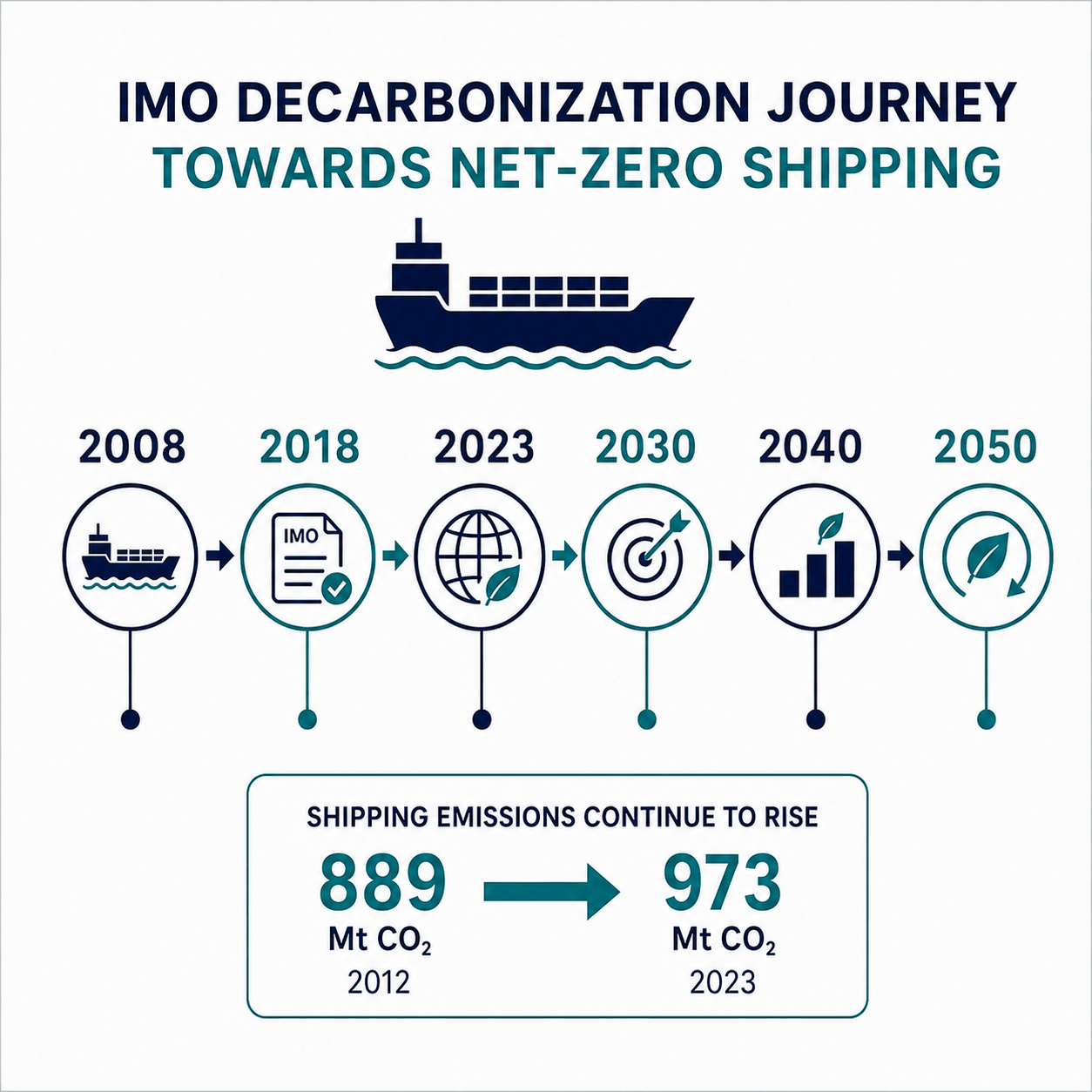
Commercial pressures are also playing a growing role. Cargo owners and logistics providers are increasingly assessing the environmental footprint of their supply chains, while regulators are introducing more detailed reporting frameworks for fuel consumption and emissions performance. As a result, emissions transparency is becoming a normal part of maritime operations and fleet management.
Taken together, these regulatory, commercial, and environmental pressures have moved green shipping from a peripheral sustainability discussion to a central issue in the future development of the global maritime industry.
What are the main approaches driving green shipping?
Alternative fuels
One of the most widely discussed pathways is the transition toward lower-carbon marine fuels. While liquefied natural gas (LNG), methanol, and advanced biofuels are already in commercial use across various fleet segments, fuels such as ammonia and hydrogen remain at the pilot and early development stage. And although these fuels have the potential to reduce greenhouse gas emissions compared with conventional heavy fuel oil, their adoption depends on the development of global bunkering infrastructure, vessel compatibility, and evolving safety standards.
Vessel efficiency technologies
Another important pathway focuses on improving the energy efficiency of ships through advances in design and engineering. Shipbuilders and operators are implementing technologies such as optimized hull forms, advanced hull coatings, air lubrication systems, and energy-saving propulsion devices to reduce hydrodynamic resistance and improve fuel efficiency. In addition, some vessels are incorporating wind-assisted propulsion systems (WAPS), such as rotor sails and rigid sails, that allow wind energy to supplement engine power during voyages.
Operational efficiency
Operational practices also play a role in reducing fuel consumption and emissions across the global fleet. Measures such as speed management, optimized voyage planning, and weather routing help vessels maintain efficient sailing profiles over long distances. By reducing unnecessary deviations and maintaining stable propulsion loads, these practices can improve overall energy efficiency without requiring structural changes to the vessel.
Emissions monitoring and reporting
Environmental performance in shipping is increasingly evaluated through standardized reporting frameworks. Systems such as the Energy Efficiency Existing Ship Index (EEXI), the Carbon Intensity Indicator (CII), and the EU Monitoring, Reporting and Verification (MRV) regulation require vessels to measure and report fuel consumption and emissions data. In addition, policy mechanisms such as the EU Emissions Trading System (EU ETS) are introducing financial accountability for emissions, reinforcing the importance of accurate monitoring and transparency.
Infrastructure and supply chain changes
Green shipping also depends on developments beyond the vessel itself. Ports, energy providers, and maritime authorities are investing in shore power systems, alternative fuel bunkering infrastructure, and port electrification to support lower-emission operations. At the same time, initiatives such as green shipping corridors are being developed to accelerate the adoption of cleaner fuels and technologies along specific trade routes through coordinated efforts between shipping companies, ports, and regulators.
How do regulators measure shipping emissions and efficiency?
The overarching framework for ship air pollution and emissions regulation is MARPOL Annex VI, the IMO convention establishing international limits on sulphur oxide (SOx) and nitrogen oxide (NOx) emissions from ships. It also provides the parent framework under which the key greenhouse gas measures covered in this section have been developed and enforced.
Energy Efficiency Existing Ship Index (EEXI)
- Design efficiency benchmark for existing ships. The Energy Efficiency Existing Ship Index (EEXI) measures the technical efficiency of ships already in service by calculating the theoretical carbon dioxide emissions generated per unit of transport work based on vessel design characteristics such as engine power, ship type, and capacity. Each vessel must meet an efficiency threshold set by the IMO.
- Technical compliance requirement for the global fleet. If a ship does not meet its required EEXI value, operators must implement technical measures to improve efficiency. These may include engine power limitation, propulsion system modifications, or other design adjustments aimed at reducing the vessel’s estimated emissions intensity.
Carbon Intensity Indicator (CII)
- Operational emissions performance metric. The Carbon Intensity Indicator (CII) applies to ships over 5,000 gross tonnes engaged in international voyages, evaluating how efficiently a vessel transports cargo by measuring greenhouse gas emissions relative to transport work over a year of operation. Ships are required to improve their CII rating by 2% annually through 2026, with the reduction trajectory under review for 2027 onwards. This provides an ongoing assessment of a vessel’s emissions intensity rather than its theoretical design efficiency.
- Annual performance rating system. Each vessel receives a rating from A to E, with A representing the best carbon intensity performance and E the lowest. Ships that receive a D rating for three consecutive years or an E rating in a single year must submit a corrective action plan within their Ship Energy Efficiency Management Plan (SEEMP) to demonstrate how performance will be improved.
Ship Energy Efficiency Management Plan (SEEMP)
- The Ship Energy Efficiency Management Plan (SEEMP) is a mandatory operational framework that supports continuous improvement in vessel efficiency. It requires ship operators to monitor fuel consumption, track emissions performance, and implement efficiency measures across voyages. When vessels fail to meet required CII performance levels, corrective actions must be documented within the SEEMP.
Emissions monitoring and reporting frameworks
- Regional regulatory systems also require ships to report emissions data. For example, the EU Monitoring, Reporting, and Verification (MRV) regulation applies to ships above 5,000 gross tonnes on voyages to, from, or between ports in the European Economic Area (EEA), requiring them to report fuel consumption and CO₂ emissions creating a standardized dataset for monitoring maritime emissions.
How is green shipping different from maritime decarbonization?
Green shipping and maritime decarbonization are related but distinct.
| Area | Decarbonization Strategy | Green Shipping |
|---|---|---|
| Focus | Structural transition to alternative fuels and propulsion technologies. | Operational optimization within the existing vessel configuration. |
| Investment horizon | Long-cycle vessel, fuel, and infrastructure investment. | Daily operational and routing decisions. |
| Timeline | Multi-decade transition planning. | Immediate and continuous efficiency gains. |
| Primary lever | Capital allocation and fleet renewal. | Execution discipline and performance management. |
An efficiency-first approach lets operators stabilize emissions performance within their existing vessel configurations – using onboard data and operational intelligence.
The role of technology in supporting green shipping
- Emissions monitoring systems. Ships and fleet operators increasingly rely on digital monitoring systems to track fuel consumption, emissions, and energy performance in near-real time. These systems collect data from onboard sensors and engine management systems, allowing operators to measure emissions intensity and support compliance with frameworks such as the IMO Data Collection System and EU monitoring and reporting requirements.
- Efficiency analytics. Data analytics platforms are used to evaluate vessel efficiency across fleets by analyzing operational data, including fuel consumption patterns, engine performance, and voyage profiles. These tools help shipping companies identify performance trends, benchmark vessels against efficiency targets, and better understand the factors influencing emissions and fuel use.
- Navigation and voyage data platforms. Modern navigation systems increasingly integrate digital data streams, providing crews and fleet managers with detailed information on routes, traffic conditions, weather patterns, and voyage performance. By combining these inputs, such platforms support more informed decision-making and help improve overall voyage efficiency.
- Environmental reporting tools. As environmental transparency becomes more important across the maritime sector, specialized reporting platforms are used to consolidate emissions data and generate compliance reports. These systems support regulatory reporting requirements and allow operators to document environmental performance for regulators, charterers, and other stakeholders.
How Orca AI contributes to green shipping technology?
Voyage optimization through navigational safety
Orca AI improves voyage execution by giving crews automated situational awareness and the data to make real-time route decisions. The shift from static planning to real-time maritime route optimization enables crews to maintain steadier speed profiles and avoid fuel-intensive corrective maneuvers.

Delivering measurable fuel efficiency at fleet scale
Execution stability produces measurable results. In the Ionic fleet deployment, our platform contributed to a 3% reduction in fuel consumption while improving safety performance in challenging waters. Similar gains were recorded in Seaspan’s global fleet operations, where reduced maneuver volatility translated into lower fuel costs.
Across client fleets in 2023, this approach contributed to approximately 172,716 tonnes of CO₂ reduction, driven by fewer sharp maneuvers, reduced speed drops, and a lower number of potential incidents.
Supporting CII and FuelEU alignment through operational stability
Stabilizing propulsion patterns and reducing operational volatility positively influence CII performance over time. Consistent voyage execution strengthens emissions reporting integrity and supports alignment with FuelEU Maritime regulatory requirements.