



July 9, 2024

Dor Raviv, Co-Founder & CTO, Orca AI
Share


Key takeaways
- Digital ships use AI, IoT sensors, satellite connectivity, and real-time data analytics to reduce the risk of collisions, equipment failures, and human error at sea.
- The greatest cause of maritime accidents – human error – can be significantly reduced through AI-assisted situational awareness on the bridge.
- Orca AI’s platform, deployed across hundreds of vessels worldwide, has demonstrated a 33% reduction in close encounters in open waters.
- Core technologies powering the digital ship include AI-based computer vision, predictive maintenance, real-time route optimisation, and shore-based remote monitoring.
Maritime shipping carries over 80% of global trade, and the safety of the system depends on real-time decisions, often made under difficult conditions. Digital ships represent the industry’s clearest answer to that challenge: vessels in which AI, connectivity, and sensor technology work together to reduce human error, improve situational awareness, and prevent incidents before they occur.
This article explores how that technology works, why it matters for safety, and what shipping companies need to know about adopting it. Orca AI’s platform is already deployed across global fleets, delivering measurable results at sea today.
What is a digital ship?
Maritime safety has always been a defining concern of the shipping industry — enshrined in international frameworks like the IMO’s International Convention for the Safety of Life at Sea (SOLAS) and reinforced through decades of regulation, training, and operational practice. What has changed is the technology available to support it.
A digital ship is a modern vessel equipped with an integrated ecosystem of sensors, high-speed connectivity, automation, and advanced data layers that together create a unified, intelligent operating environment. Unlike traditionally equipped vessels, digital ships process and act on real-time data to support safer navigation, more efficient operations, and proactive risk management. The Global Maritime Trends 2050 Report identifies this convergence of AI, machine learning, and satellite connectivity as the most significant transformation in commercial shipping in a generation — and the fleets investing in it now are already seeing the safety results.
Key components of a digital ship
A digital ship integrates several core technologies working together:
- Satellite connectivity (LEO/5G): Enables real-time, high-bandwidth ship-to-shore data exchange at speeds previously unavailable at sea
- IoT sensors: Continuously monitor hull stress, temperature, equipment health, and environmental conditions
- AI-based computer vision: Detects and classifies navigational hazards, including vessels not transmitting AIS signals
- Big data analytics: Processes data from sensors, cameras, weather feeds, and port systems to support decision-making
- Digital twin: A virtual replica of the vessel used for performance monitoring, simulation, and predictive maintenance
- Remote monitoring systems: Give shore-based teams full visibility into vessel operations and crew safety
Why do digital ships improve maritime safety?
The most persistent safety problem in shipping remains collisions, most of which are caused by human error and poor visibility. Digitalization directly addresses this by transforming data into actionable intelligence, enabling crews to prevent incidents rather than react to them. By moving toward the principles of Maritime 4.0 and data-driven operation, the industry is already seeing measurable results: Orca AI’s fleet data shows a 33% reduction in close encounters in open waters and a 40% decline in crossing events worldwide.
What causes most maritime accidents?
Human error is consistently identified as the primary cause of maritime incidents, with contributing factors including:
- Crew fatigue and under-manning on the bridge
- Poor visibility during nighttime or adverse weather conditions
- Over-reliance on AIS data, which excludes non-transmitting vessels
- Alert overload, since crews managing too many simultaneous alarms is now a recognised safety risk, not just an operational nuisance
- Inadequate situational awareness in high-traffic or congested waterways
Each of these failure modes is directly addressed by digital ship technology. AI systems don’t fatigue, miss objects that don’t broadcast, or lose focus during long watches.
Core technologies behind safer digital ships
The digital ship is powered by several converging technologies that together support maritime safety and operational efficiency. Each layer builds on the last: connectivity enables data flow, IoT generates the data, AI interprets it, and automation acts on it.
Satellite connectivity and 5G
The foundation for digital ship capability is connectivity. The shift from 4G to 5G enables data transfers up to 100 times faster than previous generations, enabling ships to share critical safety data in near real time. A landmark development came in 2025, when MPA Singapore, working with IMDA and M1, completed the rollout of maritime 5G coverage across all major fairways, anchorages, terminals, and boarding grounds. The network delivers high-bandwidth, low-latency connectivity that supports real-time applications, including digital bunkering, autonomous vessel trials, and remote inspections — a signal of where the broader industry is heading.
For more on how satellite connectivity options compare, see our guide to Starlink and Inmarsat maritime solutions.
IoT sensors and real-time vessel monitoring
IoT sensors go beyond passive data collection. On a digital ship, they actively support safety by:
- Detecting structural weaknesses in hull integrity before they become critical
- Monitoring engine and machinery health to flag failures before they occur
- Measuring sea state changes and environmental conditions in real time
- Triggering automated alerts for crew intervention when thresholds are exceeded
- Supporting condition-based, AI-predicted maintenance schedules
Critically, today’s AI models can process approximately 90% of vessel data (compared to only 10% for traditional empirical models), generating accurate performance insights that genuinely change how vessels are operated.
AI-based computer vision for hazard detection
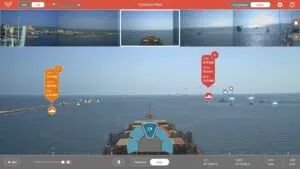
AI-based navigation systems like Orca AI’s SeaPod use both daylight and thermal cameras powered by advanced algorithms to detect, classify, and track hazards in real time. Thermal imaging is particularly critical for maintaining detection capability at night and in low-visibility conditions, where human watchkeeping is most vulnerable.
These systems identify obstacles, including other vessels, floating debris, and small or distant objects that may not transmit AIS signals, enabling crews to adjust course in advance rather than react in an emergency — a significant evolution from radar-based collision avoidance to genuinely intelligent, autonomous-capable navigation support. Continuous data processing makes these systems smarter over time, ensuring reliability even in the most congested traffic situations.
Big data and analytics
Modern ships generate vast amounts of data from sensors, cameras, weather forecasts, crew communications, and ship-to-port interactions. Big data analytics solutions process this influx in real time, giving the captain and crew a comprehensive operational picture, highlighting critical insights while managing the complexity underneath. This capability is essential for charting optimised voyages that prioritise safety, fuel efficiency, and decarbonisation, and for identifying maintenance-related issues before they become operational problems.
How do digital ships improve decision-making on the bridge?
Smart ship systems surface the right information at the right moment. This section covers how remote monitoring and AI-assisted situational awareness work together to support faster, better-informed decisions both on the bridge and ashore.
Remote monitoring and shore-based visibility
Remote monitoring technology gives operators on board and in shore-based offices complete visibility into vessel performance, irrespective of location. A well-implemented system covers the full operational picture:
- Tracking vessel performance and route adherence in real time
- Detecting anomalies in machinery or navigation patterns before they escalate
- Scheduling proactive maintenance without disrupting operations
- Maintaining compliance documentation automatically
- Supporting incident investigation with a continuous operational data record
FleetView, Orca AI’s shore-side platform, is built around this capability, giving fleet managers the real-time intelligence they need to intervene early and manage performance across their entire fleet.
AI-assisted situational awareness on the bridge
Orca AI’s platform enhances the digital ship by fusing real-time visual data with traditional navigation systems — radar, AIS, ECDIS (Electronic Chart Display and Information System) — to give bridge crews a continuous, AI-enhanced picture of their surroundings. This fusion is critical: it supports the bridge team with data-driven decision-making at the exact moments when human perception alone is most likely to fall short. Co-Captain, Orca AI’s latest bridge intelligence product, extends this capability further — and with the growing risk of GPS spoofing and GNSS signal degradation in key shipping lanes, the need for AI systems that can validate positioning data against visual reality has never been more pressing.
What role does automation play in digital ship safety?
Predictive maintenance and equipment reliability
One of the most significant shifts enabled by digital ship technology is the move from calendar-based maintenance to AI-driven predictive maintenance.
| Approach | Traditional (calendar-based) | Predictive (AI-driven) |
| When action is taken | Fixed schedule, regardless of condition | When AI detects a failure signature |
| Risk of failure | High — issues develop between checks | Low — flagged in advance |
| Cost profile | Reactive repairs often more expensive | Planned interventions reduce downtime |
| Data used | Manual inspection logs | Continuous sensor feeds, pattern analysis |
| Crew impact | Disrupts operations | Minimal — planned around voyages |
This moves operations from reacting to breakdowns to pre-empting them entirely — reducing downtime, improving safety, and lowering the total cost of fleet management.
Route optimisation and real-time risk assessment
Predictive analytics use sensor and camera data to forecast adverse weather conditions, enabling preemptive rerouting. AI navigation systems continuously evaluate potential hazards and suggest optimal response strategies. With ongoing geopolitical disruption affecting major shipping routes, the ability to reroute dynamically based on real-time intelligence has shifted from a nice-to-have to a core operational requirement. This is especially true as GPS signal degradation and GNSS spoofing in contested waters become an increasingly routine operational reality rather than an edge case.
Legacy ships vs connected vessels
| Area | Traditional vessel | Digital ship |
| Data flow | Siloed systems and manual reporting | Integrated real-time data from sensors, cameras, AIS, radar, and shore systems |
| Safety posture | Reactive and compliance-led | Proactive and risk-led |
| Situational awareness | Dependent on human lookout, radar, and AIS | Supported by AI-based perception and sensor fusion |
| Maintenance | Calendar-based inspections | Condition-based and predictive |
| Fleet visibility | Limited shore-side view | Remote monitoring across vessels |
| Navigation risk | Risk identified mainly by bridge team | Risk flagged earlier through decision-support systems |
| Crew workload | High manual interpretation load | Clearer alerts and prioritised information |
How are digital ships used in practice? Collision avoidance and bridge assistance
Perhaps the greatest safety leap for digital ships is the ability to prevent the most persistent problem in maritime operations: collisions. Recent high-profile incidents, including the Hafnia Nile/Ceres I collision in the Singapore Strait, a night-time collision in the Danish Straits, and the Stena Immaculate incident, all underscore a consistent truth: even in well-monitored shipping lanes, human error and fatigue remain the critical variable.
Orca AI’s SeaPod acts as an additional watchkeeper — a bridge navigational watch alarm system (BNWAS) powered by AI — significantly enhancing situational awareness even in challenging conditions. It promptly identifies obstacles, including other vessels, floating debris, and small or distant objects that may not transmit AIS signals, enabling crews to adjust course in advance. This proactive approach prevents emergency manoeuvres while also reducing fuel consumption and emissions. Continuous data processing makes the system smarter with every voyage.
What are the main challenges of adopting digital ship technology?
- Cybersecurity risks: A highly connected vessel creates a larger attack surface. Robust cybersecurity frameworks for operational technology (OT) are now a baseline requirement, not an optional add-on.
- Crew training and skill gaps: New AI systems require new competencies. Shipping companies must invest in structured training programmes that help crews interpret AI outputs, manage automated alerts, and maintain appropriate human oversight.
- Legacy compatibility: Integrating AI navigation systems with older bridge equipment can be technically complex and requires phased planning — though plug-and-play systems like SeaPod significantly reduce this friction.
- Regulation lag: International regulatory frameworks are still catching up with the pace of technological change, creating uncertainty for operators planning long-term investment in autonomous or semi-autonomous systems.
- GPS spoofing and GNSS degradation: As digital navigation depends heavily on positioning data, incidents of spoofing and signal jamming have become a growing operational risk that digital ship systems must be equipped to detect and compensate for.
Conclusion: the future of safe, digital shipping
The sea has always demanded good judgement from the people navigating it. What has changed is the quality of information available to support that judgement. Digital ships don’t replace the decisions crews make — they make those decisions better informed, better timed, and less dependent on what a tired officer can see from a bridge at three in the morning. That is the shift already underway across the world’s most safety-conscious fleets, and the results are hard to argue with.
FAQs
How does the “digital ship” transition safety management from a reactive, compliance-based process to a proactive, predictive strategy?
The transition is powered by real-time data and predictive analytics. Traditional safety management systems (SMS) often rely on manual reporting and retrospective analysis, making them reactive to incidents. The digital ship, however, utilises an integrated network of IoT sensors and smart ship systems to continuously feed operational data into an AI-powered digital twin. This allows leaders to move beyond simple compliance to proactive risk management. Instead of waiting for scheduled maintenance, the system predicts the exact moment equipment is likely to fail, ensuring necessary interventions occur before any safety incident arises — fundamentally transforming the safety culture from damage control to foresight.
Beyond collision avoidance, how do smart ship systems improve fleet-wide operational efficiency?
The value of smart ship systems extends across the entire fleet’s operational profile. Predictive analytics optimise fuel consumption by identifying the most efficient routes based on real-time weather and hull performance data. Remote monitoring systems provide shore-based teams with complete visibility into vessel operations, allowing for centralised performance management and early intervention. This ability to continuously monitor and optimise every aspect of the voyage reduces unnecessary downtime and operational expenditure — increasing overall fleet availability and lowering total cost of ownership.
What role does Orca AI’s technology play in the immediate future versus the long-term vision of autonomous shipping?
Orca AI’s technology serves as the essential operational foundation for the future of autonomous shipping, while delivering immediate safety benefits today. By deploying advanced AI-based computer vision and sensor fusion, the system already performs the critical function of eliminating human error in situational awareness and collision avoidance. This continuous process generates the high-quality visual and operational dataset necessary to train fully autonomous systems. Investing in solutions like Orca AI is therefore not only a crucial safety measure for current voyages — it is a strategic investment that future-proofs the fleet and accelerates the transition into the autonomous era.
What are the main barriers to adopting digital safety systems, and how can a shipping company prepare its fleet and crew?
The three primary barriers are cybersecurity risks, legacy compatibility, and a widening crew training gap. To prepare, leaders should first invest in robust cybersecurity frameworks to protect operational technology from external threats. Second, plan for phased integration to manage compatibility between new AI navigation systems and older equipment. Third — and most critically — prioritise upskilling the existing workforce. Comprehensive training programmes that teach crews how to interpret and manage AI-generated data ensure the technology serves as a genuine assistant, not a distraction.
How does GPS spoofing threaten digital ships, and how can it be countered?
GPS spoofing — where false positioning signals are broadcast to deceive a vessel’s navigation systems — has become one of the fastest-growing risks to digital ships operating in high-threat maritime regions, including the Eastern Mediterranean, Baltic Sea, and Persian Gulf. Because digital navigation depends heavily on GNSS data, spoofed signals can lead crews to unknowingly deviate from course or enter restricted waters. Countering spoofing requires multi-source positioning validation, AI-based anomaly detection that cross-references GNSS data against visual and radar inputs, and real-time alerting that flags sudden or implausible position changes. Orca AI’s platform supports these capabilities by fusing positional data with computer vision to identify discrepancies before they translate into navigational errors.
How do digital ships support maritime decarbonisation goals?
The link between digitalisation and decarbonisation is direct. Digital ships use real-time data from IoT sensors, weather feeds, and AI analytics to continuously optimise voyage routes for both safety and fuel efficiency — reducing unnecessary fuel burn and lowering emissions in the process. Predictive maintenance also plays a role: well-maintained engines and systems consume less fuel. As regulatory frameworks like the IMO’s greenhouse gas strategy and the EU Emissions Trading System — which entered into force for vessels over 5,000 GT on 1 January 2024 — tighten requirements, digital monitoring tools provide the data layer shipping companies need for accurate emissions tracking and compliance reporting.
Can older vessels be retrofitted with digital ship technology?
Yes — and retrofitting is increasingly common. The emergence of low-cost edge gateways and plug-and-play sensor systems has made it significantly more practical to bring legacy vessels into the digital ship era without requiring full system overhauls. Orca AI’s SeaPod is a self-contained system that can be installed on existing vessels to deliver AI-based situational awareness, hazard detection, and bridge support without replacing existing radar or ECDIS systems. The key to a successful retrofit is phased integration planning — assessing existing equipment, identifying compatibility requirements, and prioritising the systems with the greatest safety impact first. Companies that have undergone this process report both immediate safety improvements and long-term operational efficiency gains. See what 1,000 vessel installations have taught us for practical guidance on this process.


